
US Aviation Faces Historic Gridlock as America 250 Triggers FAA’s Busiest July 4th in 15 Years
The Federal Aviation Administration is battling unprecedented operational stress as 5.85 million passengers and severe airspace restrictions collide during the America 250 holiday weekend.

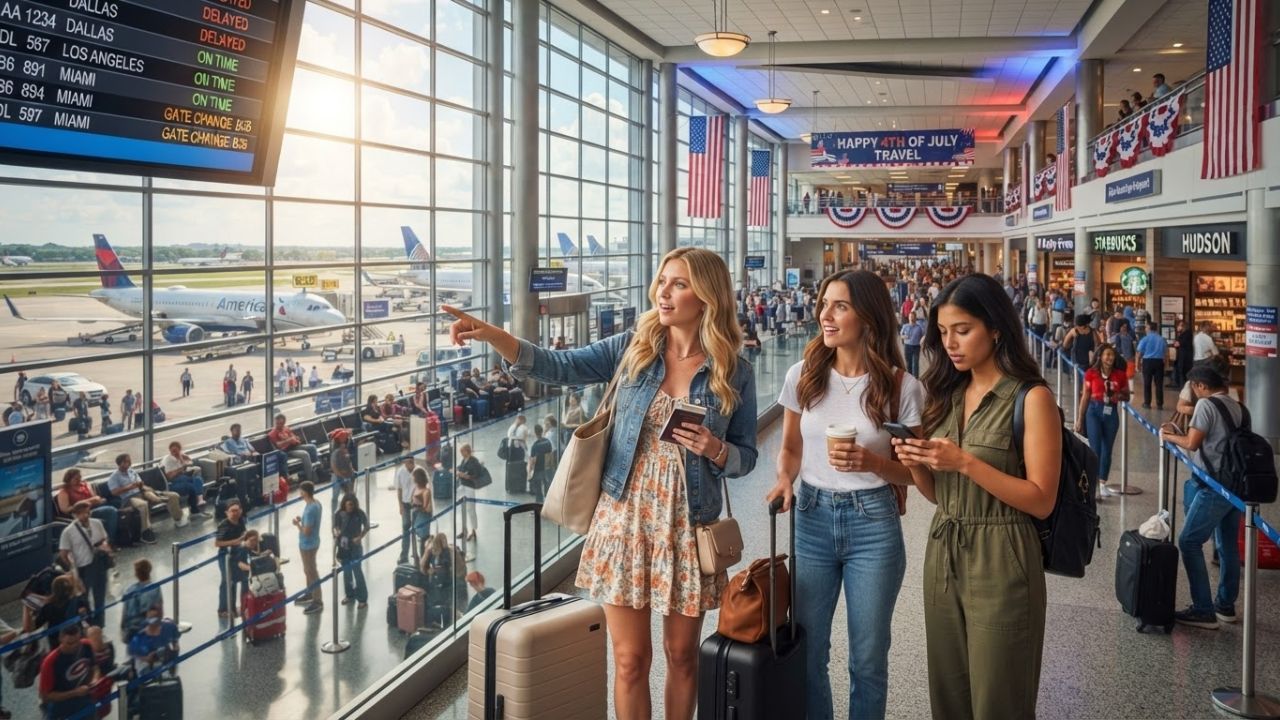
Image generated by AI
[Washington, July 3] — The Federal Aviation Administration (FAA) is currently managing the most operationally intense Independence Day travel period in 15 years. A rare and highly volatile collision of record-breaking passenger demand, severe regional thunderstorms, and historic national security restrictions tied to America 250 celebrations has pushed the US aviation network to its physical limit.
According to data compiled by AAA, 72.2 million Americans will travel during this extended holiday window, including an estimated 5.85 million passengers moving through the commercial airspace. To absorb this historic demand, the FAA is actively coordinating between 51,000 and 52,000 distinct flight movements daily. Air traffic controllers report that system volume peaked severely on July 2 and July 3, requiring maximum operational coordination to maintain safe aircraft separation while minimizing terminal gridlock.
America 250 Security Restrictions Cripple D.C. Airspace
The core of the operational disruption stems from the "Salute to America 250" celebration, formally designated as a National Special Security Event. To facilitate ceremonial military flyovers, stealth bomber operations, and massive fireworks displays, the FAA has executed unprecedented temporary flight restrictions across the Washington metropolitan area.
These security protocols have directly impacted commercial operations at Ronald Reagan Washington National Airport (DCA). In an exceptionally rare move, all commercial flights at DCA were paused on July 3 between 10:00 AM and 1:00 PM. An even more severe operational suspension is scheduled for July 4, freezing the airport entirely from 12:00 PM until midnight.
East Coast Gateways Suffer Cascading Delays
The severe airspace limitations over the nation's capital have triggered massive ripple effects up and down the Eastern Seaboard. Because domestic airline scheduling is highly interconnected, the artificial bottlenecks in D.C. have heavily degraded operational flow at major gateway hubs.
Flight tracking data indicates severe aircraft repositioning challenges and modified scheduling congestion across Boston Logan, John F. Kennedy International Airport, LaGuardia Airport, Newark Liberty International Airport, Philadelphia International Airport, and Baltimore/Washington International Airport. Aircraft held back due to D.C. airspace closures are subsequently arriving late for secondary sectors, ensuring that localized delays instantly infect the broader national network.
Severe Weather Compounds Operational Friction
While passenger volume remains the primary catalyst for network stress, hostile atmospheric conditions are severely degrading recovery efforts. The official FAA Weather Outlook has identified significant thunderstorm activity threatening Atlanta, sections of Florida, and the broader Northeast. These convective storm cells require immediate aircraft rerouting, which temporarily reduces airport arrival rates.
Simultaneously, operations along the West Coast are battling visibility constraints. Low cloud ceilings have restricted throughput at Los Angeles International Airport, San Francisco International Airport, and Seattle-Tacoma International Airport. Because air traffic control facilities are functioning near maximum capacity, even minor, localized weather events are generating cascading delays across thousands of kilometers.
Key Facts Breakdown
- Historic Volume: The busiest FAA Independence Day travel period in 15 years.
- Flight Operations: The FAA is managing 51,000 to 52,000 daily flights.
- Passenger Load: 5.85 million Americans flying over the holiday weekend (AAA data).
- DCA Airport Closures: Flights paused July 3 (10:00 AM - 1:00 PM) and July 4 (12:00 PM - Midnight).
- Weather Threats: Thunderstorms hitting Atlanta and Florida; low ceilings restricting West Coast hubs.
Airline Travel Waiver Data
| Airline | Proactive Action Taken | Target Region |
|---|---|---|
| American Airlines | Issued travel waivers for free booking modifications | East Coast Airports |
| Delta Air Lines | Issued travel waivers for free booking modifications | East Coast Airports |
| United Airlines | Issued travel waivers for free booking modifications | East Coast Airports |
| Southwest Airlines | Issued travel waivers for free booking modifications | East Coast Airports |
Why This Matters
Our analysis of the flight data indicates that the FAA's margin for error this weekend is effectively zero. The unprecedented decision to completely freeze Ronald Reagan Washington National Airport (DCA) for 15 cumulative hours across two peak travel days removes a massive pressure valve from the East Coast corridor. When 52,000 daily flights are forced to navigate around temporary military airspace while simultaneously dodging summer thunderstorms, airlines lose their ability to recover delayed aircraft. The rapid issuance of proactive travel waivers by the "Big Four" carriers (American, Delta, United, and Southwest) proves that airline operations centers recognized this systemic fragility days in advance. They are financially incentivizing passengers to abandon their original itineraries because they physically cannot process 5.85 million travelers through an artificially constrained airspace without triggering a massive network collapse.
Industry Outlook
Market trends suggest that the operational backlog generated by the July 4th airspace closures will require at least 72 hours to fully resolve. Passengers navigating the East Coast corridor must treat this weekend as an active crisis event; arriving two to three hours early is mandatory due to overwhelming security checkpoints. Industry observers strongly advise utilizing the FAA Summer Travel Portal and airline mobile applications to intercept delay notifications before leaving for the terminal. Moving forward, the aggressive airspace management required for America 250 highlights a glaring vulnerability in US airspace design: the system simply lacks the elasticity required to balance national security events alongside peak commercial demand.
Related Travel Guides
Disclaimer
This article is for informational and educational purposes only. It does not constitute legal, financial, or professional advice. While we strive to provide accurate and up-to-date information, travel policies, regulations, and conditions change rapidly. Always verify information with official sources before making travel decisions. Nomad Lawyer makes no representations about the accuracy, reliability, completeness, or suitability of the information provided. Readers should consult qualified professionals for advice specific to their circumstances. The views expressed in this article are those of the author and do not necessarily reflect the views of Nomad Lawyer.
Kunal K Choudhary
Co-Founder & Contributor
A passionate traveller and tech enthusiast. Kunal contributes to the vision and growth of Nomad Lawyer, bringing fresh perspectives and driving the community forward.
Learn more about our team →