
US Airports May Allow Full Bottles as Heathrow-Style Security Changes Expand With TSA Security Rule Modernisation
US Airports May Allow Full Bottles as Heathrow-Style Security Changes Expand With TSA Security Rule Modernisation

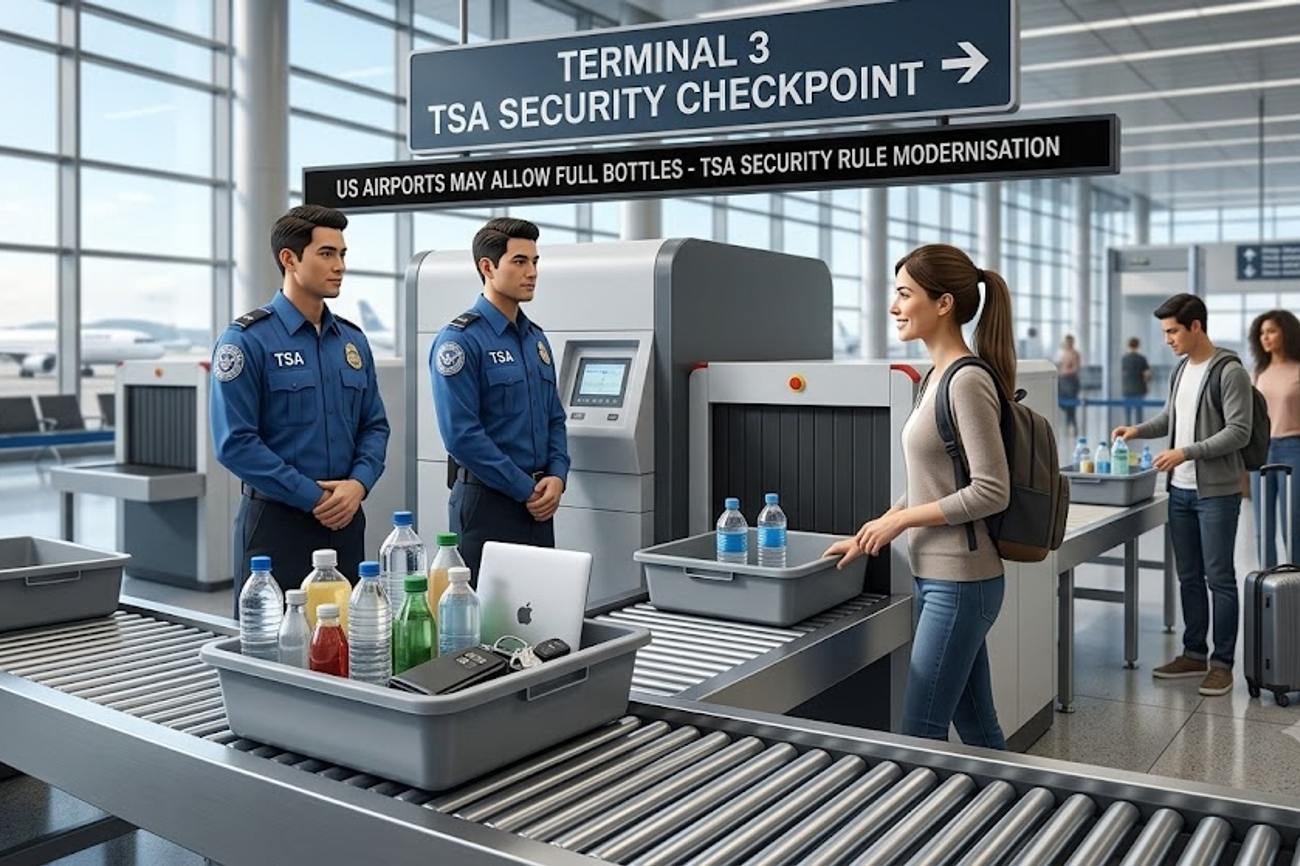
Image generated by AI
The 3.4-ounce liquid restriction has remained a global aviation standard for exactly 20 years, yet the recent deployment of Computed Tomography (CT) scanners at London Heathrow (LHR) has already pushed liquid allowances to 2 litres. This shift represents a fundamental break from the 2006 security protocols that defined the modern airport experience, signaling a transition from blanket restrictions to technology-driven, risk-based screening.
The CT Scanner Shift in Numbers
The potential modernization of TSA security rules is not a policy whim but a direct result of hardware evolution. The transition from traditional 2D X-ray systems to 3D Computed Tomography (CT) scanners allows security officers to analyze baggage contents with a level of granularity previously impossible. While the TSA has not yet implemented a nationwide policy, the benchmark is being set by the United Kingdom's aviation sector.
At London Heathrow (LHR), London City Airport (LCY), and Teesside International Airport (MME), the traditional 100ml limit has been dismantled in favor of CT-enabled screening. Specifically, Heathrow now permits liquids up to 2 litres, a 2,000% increase over the current 100ml limit enforced across the United States. This technological leap allows for the identification of liquid threats without requiring passengers to remove bottles from their bags, directly addressing the primary cause of checkpoint congestion.
The TSA is currently evaluating a tiered rollout, with TSA PreCheck members likely serving as the primary test group. This strategy aligns with the current PreCheck framework, which already permits passengers to keep shoes on and reduces the need to remove electronics. Adding full water bottles to this benefit package would mark the most significant update to passenger convenience since the 2006 liquid explosives plot prompted the original restrictions.
Comparative Security Benchmarks: US vs. UK
The disparity between the current US framework and the emerging UK model highlights a significant gap in infrastructure deployment. While the US possesses a vast network of thousands of checkpoints, the UK has utilized its more concentrated hub structure to accelerate the adoption of CT technology.
The following table illustrates the operational gap between the current TSA standard and the "Heathrow-Style" model the TSA is reviewing:
| Feature | Current TSA Standard | Heathrow (LHR) Model | Variance/Impact |
|---|---|---|---|
| Liquid Limit | 100ml (3.4 oz) | Up to 2 Litres | 1,900ml increase |
| Screening Tech | Mixed X-Ray/CT | Advanced CT Scanners | 3D vs 2D Imaging |
| Bottle Status | Must be emptied | May remain filled | Higher passenger convenience |
| Bagging Req. | Quart-sized clear bag | No specific bag required | Reduced prep time |
| Implementation | Nationwide (Standard) | Hub-specific (Implemented) | Scalability challenge for US |
This shift is part of a broader global movement toward "smart security." According to data trends often tracked by IATA, the industry is moving away from "one size fits all" security toward a model where the technology determines the restriction. The US challenge is one of scale; upgrading thousands of checkpoints requires a capital investment and operational timeline far more complex than that of the UK's primary airports.
What This Means for Travelers
For the individual traveler, this transition introduces a period of "regulatory fragmentation." Until the TSA achieves nationwide CT deployment, passengers will face inconsistent rules depending on their departure and connection points.
1. The Connection Trap: If you are flying from a CT-equipped international airport (like LHR) where you can carry a 2-litre bottle, but your connecting flight departs from a US airport still using traditional X-rays, you will be forced to discard your liquids at the second checkpoint. Always adhere to the strictest rule of your entire itinerary to avoid waste.
2. PreCheck Strategy: If you are a TSA PreCheck member, monitor airport-specific announcements. The rollout will likely be pilot-based. Travelers frequenting major hubs like SFO or JFK should check current terminal capabilities, as these are the most likely sites for initial testing.
3. Booking and Timing: While this change does not affect ticket prices, it will eventually impact "dwell time"—the time spent in the terminal before boarding. As CT scanners reduce the time spent at the conveyor belt, the traditional "arrive 3 hours early" window may shrink. However, during the transition phase, checkpoints may actually be slower as staff adjust to new protocols. For real-time data on airport congestion and throughput, OAG provides critical insights into flight schedules and airport efficiency.
Forward Projection: The End of the 3-1-1 Rule
The trajectory of aviation security is moving toward a "frictionless" experience. Based on the current adoption of CT scanners, the 3-1-1 rule (liquids, gels, aerosols under 100ml in a clear bag) is moving toward obsolescence.
We can project a three-phase rollout in the US market:
- Phase 1 (Pilot): Selected TSA PreCheck lanes at Tier 1 airports allow full water bottles.
- Phase 2 (Expansion): General population access at CT-equipped terminals, removing the need for clear quart-sized bags.
- Phase 3 (Standardization): Nationwide removal of the 100ml limit as legacy X-ray machines are decommissioned.
The ultimate goal is the integration of biometric identity and CT scanning, where the passenger's identity is verified via facial recognition and their luggage is scanned in a continuous flow without stopping to remove liquids or laptops. This evolution is mirrored in the global tourism recovery data provided by the World Travel & Tourism Council (WTTC), which emphasizes the need for infrastructure modernization to handle increasing passenger volumes.
FAQ: TSA Liquid Rule Changes 2026
Will I be able to bring a full water bottle on all US flights soon? Not immediately. The TSA is reviewing the change and may start with pilot tests at specific airports for TSA PreCheck members. You must continue to empty bottles unless explicitly told otherwise at a specific checkpoint.
Does this mean I can bring any amount of liquid? No. Even in the UK model at Heathrow, there is a limit (up to 2 litres). It is not an "unlimited" policy, but a significant increase from the current 100ml restriction.
Which airports are most likely to implement this first? Major international hubs with the highest passenger volumes and the most recent hardware upgrades are the primary candidates for pilot programs.
Do I still need a clear plastic bag for my liquids? Under current TSA rules, yes. The clear bag requirement is tied to the 100ml limit. If the TSA adopts the CT-scanner model, the requirement for quart-sized bags will likely be removed.
The era of the empty water bottle is ending, replaced by a 3D-imaged future where security is invisible and efficiency is measured in seconds.
#TSA-Security-Modernization #CT-Scanner-Deployment #LHR-Liquid-Policy #Airport-Throughput-Data #TSA-PreCheck-Benefits #Aviation-Infrastructure-2026
Related Travel Guides
- Hundreds of Travelers Affected at US Airports including Orlando, Miami and 23 More with 2,919 Delays and 118 Cancellations
- EgyptAir Starts Direct Cairo Birmingham Flights in 2026 With a Major Boost for UK Travel Links
- Vietnam Airlines Signs Paris Agreement for Five Airbus A350-900 Jets: Long-Haul Fleet Strategy and Traveler Guide
Disclaimer
This article is for informational and educational purposes only. It does not constitute legal, financial, or professional advice. While we strive to provide accurate and up-to-date information, travel policies, regulations, and conditions change rapidly. Always verify information with official sources before making travel decisions. Nomad Lawyer makes no representations about the accuracy, reliability, completeness, or suitability of the information provided. Readers should consult qualified professionals for advice specific to their circumstances. The views expressed in this article are those of the author and do not necessarily reflect the views of Nomad Lawyer.
Kunal K Choudhary
Co-Founder & Contributor
A passionate traveller and tech enthusiast. Kunal contributes to the vision and growth of Nomad Lawyer, bringing fresh perspectives and driving the community forward.
Learn more about our team →