
US Airlines Slash Flight Capacity as Fuel Costs Surge: Airfare Impact and Traveler Guide 2026

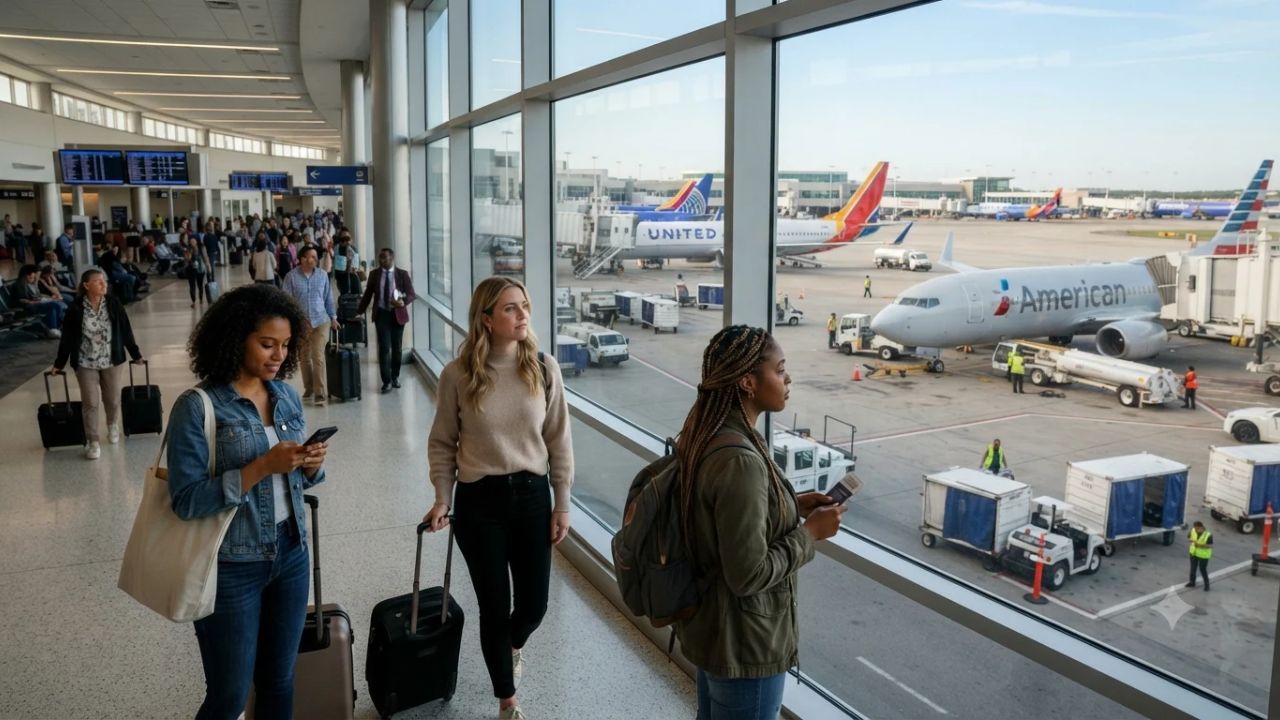
Even as domestic airport security checkpoints screen near-record passenger volumes, commercial carriers across the United States are actively grounding aircraft and slashing scheduled frequencies instead of adding new flights. With jet fuel consuming approximately 21% and labor eating roughly 34% of total operating expenses in the first quarter of 2026 according to Airlines for America, legacy and low-cost operators are confronting a punishing cost-per-seat reality. Faced with surging operational expenditures, American Airlines, United Airlines, and Southwest Airlines have initiated calculated capacity reductions, choosing to cancel underperforming routes and trim regional flight choices to defend profit margins against volatile energy bills.
The Economics of Scarcity: Inside the 2026 Capacity Retrenchment
The US aviation sector is experiencing an unprecedented structural divergence. Consumer desire to travel remains resilient, with business travel rebounding and leisure bookings holding firm across primary holiday corridors. Yet instead of competing aggressively for market share through rapid fleet expansion, major airlines are adopting strict capacity discipline.
The primary catalyst is the harsh arithmetic of commercial aviation expenses. When jet fuel prices climb, the economic viability of thin regional routes collapses. Because airlines operate thousands of daily departures across complex hub-and-spoke networks, even incremental increases in fuel costs translate into hundreds of millions of dollars in unexpected quarterly expenses.
Industry data published by Airlines for America confirms that fuel represented roughly 21% of total US airline operating expenditures during the first quarter of 2026, while labor accounted for approximately 34%. Together, these two non-negotiable cost categories consume more than half of all airline revenue. When operating expenses rise this sharply, carriers cannot simply absorb the difference without compromising balance sheets.
The leading domestic carriers have responded with distinct operational adjustments:
| Airline Operator | Capacity Strategy | Primary Operational Focus |
|---|---|---|
| American Airlines | Targeted Route Review | Trimming marginal frequencies; protecting primary fortress hubs |
| United Airlines | Margin Over Market Share | Cancelling routes failing profitability benchmarks; focusing on premium travel |
| Southwest Airlines | Slowing Capacity Growth | Re-evaluating point-to-point routes; maximizing fleet utilization and revenue per seat |
American Airlines has initiated detailed reviews across its schedule, focusing cuts on routes where ticket yields fail to outpace elevated fuel burn. Rather than eliminating services wholesale, the carrier is trimming off-peak mid-week frequencies while consolidating flights around core hubs. United Airlines has adopted a similar stance, explicitly prioritizing profitability targets over passenger volume, pulling capacity from secondary markets while preserving international and premium domestic services. Meanwhile, Southwest Airlines has dialed back its planned network expansion, emphasizing revenue productivity and seat efficiency across its extensive domestic network.
What Makes the 2026 American Aviation Environment Different
Historically, spikes in jet fuel prices coincided with economic downturns that dampened consumer appetite for air travel. In 2026, however, the aviation sector faces the opposite scenario: a supply squeeze colliding with robust travel demand.
This dynamic creates severe distortions for consumers. When carriers reduce total seat inventory while travelers continue actively booking holidays and corporate trips, pricing power shifts decisively to the airlines. Cheap last-minute domestic fares have largely disappeared. Peak summer departures, holiday weekends, and high-demand leisure routes to outdoor recreation hubs are selling out earlier, with remaining seat buckets commanding steep premiums.
Additionally, capacity reductions do not affect all airports equally. Major international gateways and primary fortress hubs—such as Chicago O'Hare, Dallas/Fort Worth, Denver, and Atlanta—maintain dense flight schedules because they feed profitable connecting banks. Conversely, secondary and regional airports across the Mountain West, the Rust Belt, and the South bear the brunt of schedule trims. Travelers in mid-sized cities increasingly face fewer nonstop options, inconvenient departure times, and mandatory layovers. For international visitors coordinating broad cross-country trips via Visit The USA, navigating this concentrated domestic network demands careful itinerary coordination.
Visitor Insider Tips: Navigating Capacity Cuts, Fare Spikes, and Secondary Hubs
The 60-to-90-Day Advance Booking Rule
With fewer daily frequencies operating across key domestic city pairs, relying on last-minute discounts is an obsolete strategy. For travel during peak periods—including summer holidays, Thanksgiving, and autumn foliage weekends—secure your flights 60 to 90 days in advance. As departure dates approach, airlines systematically close out lower-fare inventory classes, leaving only high-tier economy and premium seats.
Exploit Metropolitan Co-Terminals
When planning travel into major metropolitan regions, always evaluate alternative secondary airports. Because major hub facilities suffer from constrained gate capacity and high landing fees, carriers frequently price flights into secondary co-terminals more competitively:
- San Francisco Bay Area: Compare San Francisco International (SFO) with Oakland (OAK) or San Jose (SJC).
- South Florida: Check Fort Lauderdale (FLL) or West Palm Beach (PBI) if Miami (MIA) displays exorbitant rates.
- Chicago Area: Evaluate Chicago Midway (MDW) against Chicago O'Hare (ORD).
- New York Region: Compare Newark (EWR), LaGuardia (LGA), and John F. Kennedy (JFK), or consider Long Island MacArthur (ISP) for low-cost domestic hops.
Master Airline App Automation
With fewer daily flights on any given route, a single mechanical cancellation or severe weather delay can leave you stranded for days if you wait in customer service lines. Download your carrier's smartphone application prior to departure. When disruptions strike, major airline apps automatically present rebooking alternatives, allowing you to secure the last available seat on an alternate flight or reroute through a different connecting hub before terminal agents can even process the line.
Travel Carry-On Only
With load factors running exceptionally high, gate agents are aggressively checking bags and overhead bins are filling early. Flying with a single compliant carry-on backpack or roll-aboard luggage saves valuable time during tight 45-minute hub transfers and eliminates the risk of lost luggage during complex multi-carrier itineraries.
Understand Federal Passenger Protections
Review current consumer protections established by the Federal Aviation Administration and the Department of Transportation. If an airline significantly alters your flight schedule, changes departure times by more than three hours, or cancels your service due to capacity consolidation, you are legally entitled to a full cash refund rather than an expiring airline travel voucher.
Cultural and Environmental Context: Regional Isolation and Aviation Sustainability
The strategic retrenchment of airline networks carries significant socio-economic ramifications across the United States. When national carriers withdraw air service from smaller regional cities, local economies suffer. Regional communities lose vital connectivity for business recruitment, medical transport, and tourism, creating a widening economic divide between prosperous mega-hub metropolitan areas and rural regions.
From an environmental standpoint, however, capacity discipline introduces unexpected ecological benefits. Operating fewer flights with higher average passenger loads drastically reduces per-passenger carbon emissions. Rather than flying partially empty narrowbody jets on speculative routes, airlines are maximizing seat efficiency.
At the same time, persistent high fuel costs serve as an urgent commercial incentive for airlines to accelerate fleet modernizations. Carriers are hastening the retirement of older, thirstier aircraft in favor of new-generation airliners like the Airbus A220, Airbus A321neo, and Boeing 737 MAX, which burn 15% to 20% less fuel per seat-mile. The economic pressure also narrows the pricing gap between conventional petroleum-based jet fuel and Sustainable Aviation Fuel (SAF), encouraging long-term investments in clean bio-derived energy sources.
FAQ: US Flight Reductions and Ticket Prices 2026
Why are US airlines cutting flights despite strong travel demand?
Airlines are reducing capacity because elevated jet fuel (21% of operating costs) and labor (34% of costs) have eroded the profitability of marginal routes, forcing carriers to prioritize earnings over seat growth.
Which major carriers are reducing their flight schedules?
American Airlines, United Airlines, and Southwest Airlines have all implemented targeted capacity reductions, flight schedule trims, or moderated fleet growth plans for late 2026.
How do airline capacity reductions affect domestic ticket prices?
Because seat availability decreases while passenger demand remains strong, airfares are generally rising, particularly for peak weekend flights and holiday periods.
What is the most effective way to secure lower domestic airfares?
Travelers should book flights 60 to 90 days ahead, remain flexible with departure dates, and compare fares across alternative airports within multi-airport metropolitan areas.
In an era of disciplined airline capacity, travelers who plan their journeys months ahead and master regional transit alternatives will consistently outmaneuver shrinking schedules and rising airfares.
Related Travel Guides
Disclaimer
This article is for informational and educational purposes only. It does not constitute legal, financial, or professional advice. While we strive to provide accurate and up-to-date information, travel policies, regulations, and conditions change rapidly. Always verify information with official sources before making travel decisions. Nomad Lawyer makes no representations about the accuracy, reliability, completeness, or suitability of the information provided. Readers should consult qualified professionals for advice specific to their circumstances. The views expressed in this article are those of the author and do not necessarily reflect the views of Nomad Lawyer.
Raushan Kumar
Founder & Lead Developer
Full-stack developer with 11+ years of experience and a passionate traveller. Raushan built Nomad Lawyer from the ground up with a vision to create the best travel and law experience on the web.
Learn more about our team →