
United Airlines Flight UAL1843 Diverts to Durango Following Severe Front Range Convective Weather and Hold Fuel Depletion
United Airlines Flight UAL1843, a Boeing 737-824 flying from Palm Springs to Denver, diverted to Durango due to severe storms and low fuel.

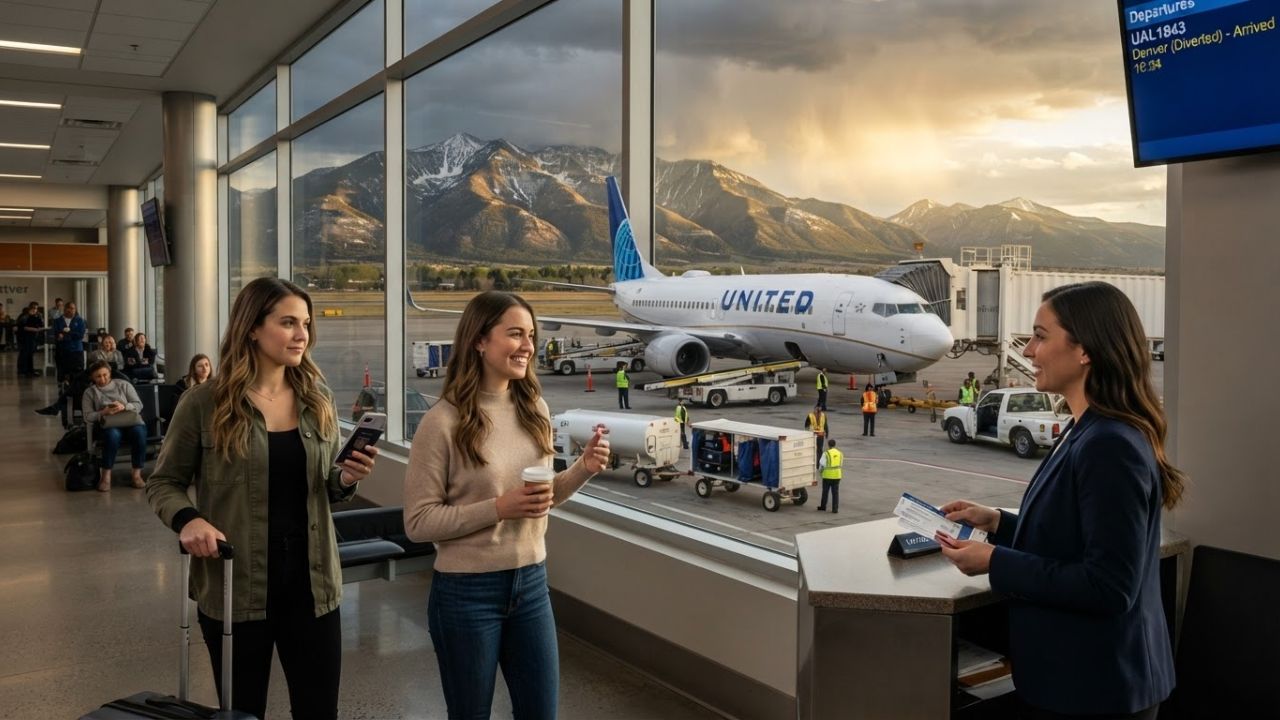
Image generated by AI
[Durango, July 9, 2026] — United Airlines flight UAL1843 from Palm Springs International Airport to Denver International Airport executed an unscheduled diversion to Durango-La Plata County Airport. The rerouting was prompted by severe weather over the Colorado Front Range.
Un-forecasted convective turbulence forced air traffic controllers to place incoming flights into holding patterns. As the Boeing 737-824 held over Colorado, flight crew members monitored their remaining fuel levels.
Recognizing that continued holding would drop fuel below safety reserves, the captain abandoned the arrival path. The aircraft was directed to the clear airspace of southwest Colorado for a precautionary landing.
Logistical Accommodation at Regional Airfields
Durango-La Plata County Airport typically handles regional turboprops and commuter jets rather than mainline aircraft. The arrival of a Boeing 737-824 required rapid runway coordination between local ground operations and air traffic control.
The flight deck managed the aircraft's stopping distance to ensure a safe landing on Durango's runway. The Boeing jet was directed to a secure parking stand on the apron for routine checks.
Ground crews verified the mechanical status of the aircraft while passenger service teams organized terminal support. Checked baggage remained secured within the cargo hold to streamline the eventual departure process.
Passenger Rights and Carrier Obligations
Because the delay was caused by convective weather rather than airline mechanical faults, passengers are not entitled to direct cash compensation. Federal transportation guidelines distinguish weather-related disruptions from carrier-caused delays.
However, United Airlines passenger service agents distributed electronic meal vouchers to affected commuters. The carrier also assisted with local hotel accommodations for passengers facing overnight delays.
Stranded travelers received updated boarding passes via the airline's mobile application. Passengers are encouraged to monitor flight status notifications for changes to their connection schedules.
Crew Duty Limits Require Relief Flight
The final leg of the flight to Denver was delayed due to pilot duty hour limitations. Strict safety regulations limit the number of consecutive hours a flight crew can legally operate an aircraft.
The original pilots exceeded their maximum duty window during the extended holding patterns and diversion. As a result, they were legally barred from flying the aircraft for the final segment.
To resolve the crew shortage, the airline organized a secondary transport flight to ferry a replacement crew to Durango. The relief team will complete the flight to Denver once required pre-flight checks are finalized.
Rarity of Mainline Operations at Commuter Fields
Mainline aircraft diversions to regional airfields are uncommon in scheduled airline operations. Carriers prefer to divert larger planes to secondary hubs that feature dedicated maintenance hangars and passenger facilities.
The decision to land the Boeing 737-824 at a smaller field highlights the severity of the convective storm blocking Denver. When fuel conservation is the primary concern, safety guidelines dictate landing at the nearest suitable runway.
Local airport operators proved capable of handling the sudden influx of mainline passengers. This successful coordination demonstrates the value of regional airports during emergency weather diversions.
Flight Parameters (UAL1843)
| Parameter | Details |
|---|---|
| Flight Number | UAL1843 (UA1843) |
| Aircraft Model | Boeing 737-824 |
| Departure Airport | Palm Springs International Airport (PSP) |
| Original Destination | Denver International Airport (DEN) |
| Diversion Airport | Durango–La Plata County Airport (DRO) |
| Primary Cause | Severe convective weather & holding fuel depletion |
Passenger Care Details
| Service Item | Action Taken |
|---|---|
| Baggage | Stowed securely in cargo hold until final departure |
| Meal Vouchers | Distributed electronically via passenger mobile apps |
| Lodging | Local hotel accommodations arranged by carrier |
| Rebooking | Digital boarding passes updated automatically |
| Crew Status | Replaced due to regulatory duty hour limits |
Why This Matters
This incident reveals the operational challenges regional airports face when accommodating mainline aircraft diversions. Durango-La Plata County Airport is designed for commuter operations, and landing a Boeing 737-824 requires precise ground handling coordination.
Our analysis of the flight data indicates that crew duty limits are a major cause of secondary delays during weather diversions. Even when weather clears quickly, flights remain grounded because airlines must transport relief crews to regional locations.
Additionally, this event demonstrates that fuel planning must account for growing congestion in high-altitude holding patterns. The decision to divert early highlights a conservative safety approach that avoids low-fuel emergencies at busy hubs.
Industry Outlook
Market trends suggest that airlines will face more frequent convective weather disruptions as summer temperatures rise. Improving automated crew scheduling systems is necessary to speed up relief crew deployment.
Furthermore, regional airports are likely to upgrade their ground service equipment to support larger mainline airframes. Enhancing regional infrastructure remains essential to maintaining safety during system-wide weather delays.
Related Aviation News Guides
- United Airlines Flight 498 Diverts to Wichita Following Mechanical Issue on Boeing 737-900ER
- United Airlines Flight 1255 Diverts to Salt Lake City Due to Cabin Pressurization System Fault on Boeing 737-900
- United Airlines Flight UAL2027 Diverts to Salt Lake City Due to Severe Storms and Wind Shear in Denver Airspace
Disclaimer
This article is for informational and educational purposes only. It does not constitute legal, financial, or professional advice. While we strive to provide accurate and up-to-date information, travel policies, regulations, and conditions change rapidly. Always verify information with official sources before making travel decisions. Nomad Lawyer makes no representations about the accuracy, reliability, completeness, or suitability of the information provided. Readers should consult qualified professionals for advice specific to their circumstances. The views expressed in this article are those of the author and do not necessarily reflect the views of Nomad Lawyer.
Preeti Gunjan
Contributor & Community Manager
A passionate traveller and community builder. Preeti helps grow the Nomad Lawyer community, fostering engagement and bringing the reader experience to life.
Learn more about our team →