
Bypassing Travel Chaos: United Airlines Proposes Historic 8-Bunk Crew Rest Overhaul to Combat Fatigue and Prevent Global Flight Cancellations: Airline News
As record-breaking passenger demand and travel chaos pack ultra-long-haul cabins, United Airlines negotiates a massive 8-bunk crew rest shift to secure operational safety.

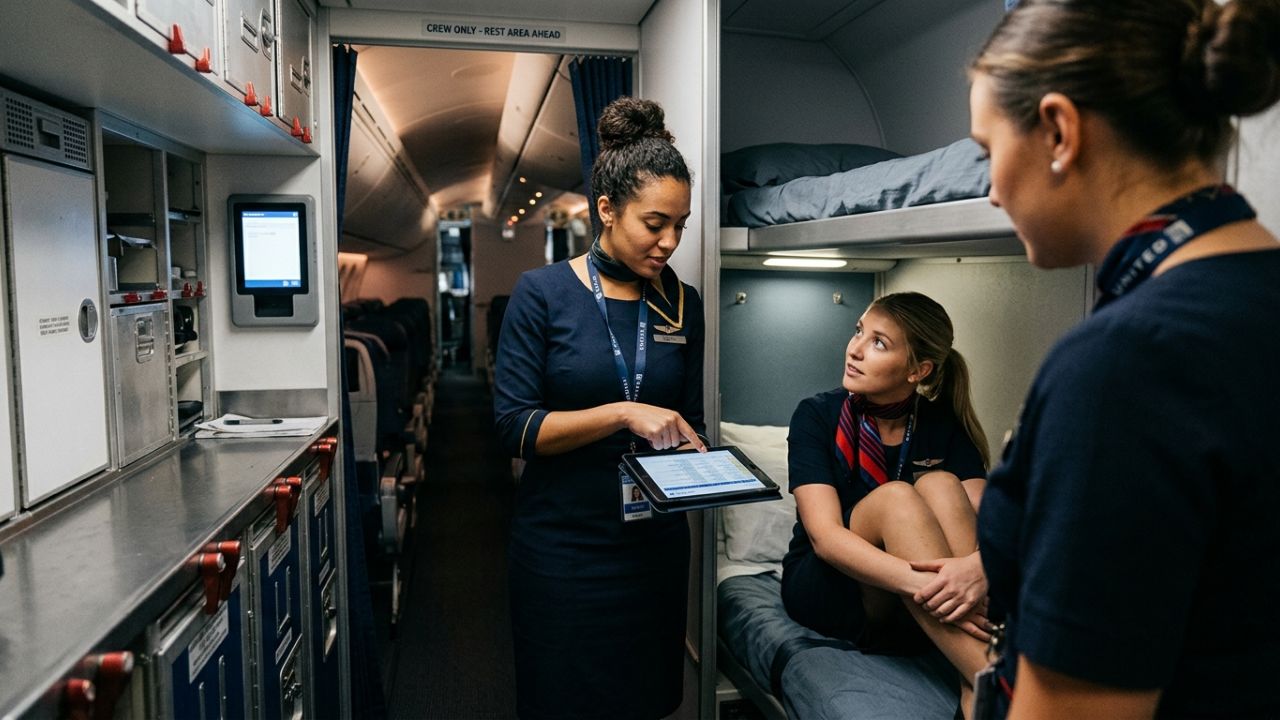
Image generated by AI
In a massive internal policy shift driven directly by the extreme pressures of global travel chaos, United Airlines is currently negotiating a radical overhaul of its ultra-long-haul crew rest protocols. Reported on June 20, 2026, as exhausted passengers frantically monitor the latest airline news to avoid rolling flight cancellations across the United States, a critical debate is unfolding at United's Chicago (ORD) headquarters. With global networks running at absolute maximum capacity, non-revenue (off-duty) flight attendants attempting to position for future flights are increasingly being forced into jumpseats because passenger cabins are completely sold out. To combat escalating crew fatigue and secure operational safety, United and the AFA-CWA union are reviewing an unprecedented proposal to grant off-duty staff temporary access to the 8 dedicated lay-flat crew bunks hidden onboard widebody aircraft. This highly sensitive negotiation provides crucial "survival intelligence" into how major carriers are desperately managing scarce cabin space to prevent compounding airport disruptions, cementing this policy shift as today's most crucial headline in breaking aviation updates.
By introducing direct passenger coordination and dynamic scheduling backups, the regional aviation hubs target growing passenger demand across vital commerce sectors. The choice to coordinate flight departures in phases helps to manage gate capacity, supporting the country's broader regional transportation network.
Context: The Hidden 8-Bunk Safety Network
For the highly interconnected global aviation grid, securing mandatory, regulated crew rest is the ultimate tactical defense against catastrophic operational failure on ultra-long-haul routes.
Most passengers traversing the globe are entirely unaware of the secret infrastructure hidden directly above or behind them. Widebody aircraft utilized by United Airlines contain two completely separate, highly regulated rest environments: a dedicated pilot rest zone near the front, and a secure flight attendant rest compartment positioned in the rear cabin. This rear section typically houses up to eight lay-flat bunks. Currently, these bunks are strictly designated as operational spaces exclusively reserved for active-duty staff rotating through mandatory rest cycles dictated by FAA fatigue rules (specifically 14 CFR Part 117). However, as intense network expansion and unprecedented passenger demand pack every available commercial seat, non-revenue staff positioning for their next operational assignment are suffering. Trapped in rigid jumpseats during 14-hour flights, these off-duty crews arrive exhausted, directly threatening future operational reliability.
To view live flight schedules, verify the active departure status of your specific United Airlines long-haul itinerary, or to track potential route restorations prior to heading to the airport, travelers must consult official aviation directories. For direct updates regarding how crew positioning issues might trigger sudden flight cancellations out of Chicago (ORD), travelers should aggressively utilize the official digital portals of their respective airlines. To explore live flight tracking and monitor the exact severity of the cascading bottlenecks paralyzing the broader international airspace, passengers can consult the official FlightAware tracking service.
Section-Wise Breakdown: Negotiating the Bunks
The Union Agreement: AFA-CWA Proceeds Cautiously
United Airlines has reportedly reached an in-principle understanding with the Association of Flight Attendants-CWA (AFA-CWA) to explore shared bunk access. However, the union is deliberately slowing implementation. Crew rest is not a luxury perk; it is a heavily regulated fatigue mitigation tool. Union negotiators are aggressively demanding that active working crews retain absolute priority access, that peak rest cycles never overlap, and that clear, unbreakable time limits are established for non-rev usage.
The Proposed Mechanism: Dynamic Allocation
Under the proposed structural shift, off-duty flight attendants may temporarily rest in the 8-bunk compartment exclusively during designated periods—such as during active passenger meal services when the working crew is fully deployed on the cabin floor. Once an active-duty flight attendant requires their scheduled, legally mandated rest block, the non-rev user would immediately be evicted and moved back to a jumpseat.
The A321XLR Threat: Redefining Narrowbody Rest
A massive underlying factor driving this Chicago-based debate is United’s impending deployment of the Airbus A321XLR. This next-generation, long-range single-aisle aircraft is slated to operate grueling transatlantic routes, but it completely lacks built-in bunk systems. Instead, United must manually convert standard passenger seats into isolated rest zones using heavy curtains and blocked rows. This impending reality is forcing the airline to rapidly rewrite its crew rest logistics before the A321XLR fleet goes live.
Technical Roster: Official Airline Fatigue Management Matrix
To ensure absolute factual accuracy regarding the exact regulatory standards, the specific aircraft configurations, and the proposed union logistics defining this 8-bunk shift, the following matrix details the strictly verified operational data:
Official United Airlines Crew Rest Logistics Matrix
| Operational Metric / Regulation | Verified Aviation Data |
|---|---|
| Operating Carrier | United Airlines |
| Headquarters / Hub Focus | Chicago (ORD), United States |
| Union Representation | Association of Flight Attendants-CWA (AFA-CWA) |
| Widebody Rest Infrastructure | Rear cabin compartment containing up to 8 lay-flat bunks |
| FAA Governing Standard | 14 CFR Part 117 (Duty time and rest standards) |
| Mandatory Rest Threshold 1 | Structured rest required for flights exceeding 8 hours |
| Mandatory Rest Threshold 2 | Extended rest blocks mandatory for flights over 12 hours |
| Proposed Access Shift | Off-duty (non-rev) crew permitted during meal services |
| Future Fleet Challenge | Airbus A321XLR (No built-in bunks; requires blocked rows) |
Data accurately reflects the verified structural rest regulations and the AFA-CWA negotiation parameters tracking the United Airlines operational shift as of June 2026.
Operational Impact: Preventing Crew-Driven Delays
For the thousands of passengers relying on United's ultra-long-haul network, the outcome of this internal union negotiation directly dictates the reliability of their future flights.
When an airline fails to adequately manage staff fatigue, the system collapses. If non-rev crews are exhausted by jumpseat positioning, they become legally unfit to operate their subsequent assigned flights, triggering an immediate cascade of rolling flight cancellations. By rebalancing scarce operational space and dynamically allocating unused bunk time, United is attempting to shield its network from crew-driven travel chaos. Ensuring that all staff—both active and positioning—are physically rested is the ultimate defense against the severe operational bottlenecks that paralyze major hubs like Chicago O'Hare.
Industry Analysis: The Collision of Comfort and Economics
Aviation analysts monitoring the United Airlines proposal note that fatigue policy is rapidly evolving faster than modern aircraft interior design.
Anup Kumar Keshan, Founder and Editor-in-Chief of Travel And Tour World, observed that this development reflects a massive structural shift in aviation labor dynamics. Airlines are entering a ruthless phase where "crew wellbeing, operational flexibility, and aircraft efficiency are colliding in real time." Keshan emphasized that internal decisions regarding these 8 bunks "signal how airlines will redefine rest ethics in the next decade of ultra-long-haul travel." Aviation operators warn that as airlines push narrowbody aircraft like the A321XLR on longer transatlantic routes with leaner crews, rest space will transition from a guaranteed regulatory entitlement into a fiercely contested operational resource.
Actionable Advice for Ultra-Long-Haul Passengers
If you are planning to travel on an ultra-long-haul flight exceeding 12 hours this summer, you must understand how crew logistics impact your journey. Execute this strategic checklist immediately:
- Respect the Curtains: If you are seated near the rear galley of a widebody aircraft or near the designated curtained rows of an A321XLR, do not attempt to breach these zones. These are legally mandated crew rest areas governed by FAA regulations; disrupting a resting flight attendant poses a direct threat to flight safety.
- Anticipate Service Blackouts: Understand that during flights over 12 hours, the working crew must rotate into the 8-bunk system. Service in the passenger cabin will be heavily reduced during these blocks. Request necessary items (water, blankets) prior to the cabin lights dimming.
- Monitor Crew-Related Delays: If your outbound flight out of Chicago is suddenly delayed due to "crew positioning" or "awaiting flight attendants," realize that the complex logistics of moving non-rev staff across a congested network is likely the cause. Exploit your airline app immediately to monitor potential rolling delays.
FAQ: United Airlines Crew Rest Bunks
What is the proposed crew rest change at United Airlines?
United is negotiating with the AFA-CWA union to allow off-duty (non-rev) flight attendants to access the 8 dedicated lay-flat crew bunks during long-haul flights.
Why are off-duty crew members currently denied access?
Currently, the bunks are strictly designated as operational safety spaces exclusively reserved for active-duty staff rotating through FAA-mandated rest cycles.
How does the Airbus A321XLR affect this debate?
The upcoming A321XLR narrowbody aircraft lacks built-in bunks, forcing United to block passenger rows for crew rest, intensifying the debate over how airlines manage limited cabin space.
The Reality of Fatigue Management
The internal negotiations at United Airlines in Chicago prove definitively that human endurance is the ultimate limiting factor in modern aviation. By attempting to maximize the utility of the 8-bunk crew compartments, United is fighting a desperate battle to maintain operational integrity amidst record-breaking passenger demand. Yet, as exhausted travelers aggressively compete for limited cabin seating, they must accept a critical new reality: the safety of their 14-hour flight depends entirely on the physical well-being of the crew hidden in the rear compartment. Surviving this era of ultra-long-haul expansion demands an acknowledgment of complex aviation logistics, a complete refusal to disrupt mandated rest zones, and the tactical discipline to utilize digital tracking apps the exact second a flight is delayed due to crew unavailability.
Key Takeaways
- Massive Policy Shift: United Airlines is negotiating with the AFA-CWA to allow non-rev flight attendants access to crew rest bunks.
- The 8-Bunk System: Widebody aircraft utilize a rear compartment with up to 8 lay-flat bunks to satisfy FAA 14 CFR Part 117 regulations.
- Dynamic Allocation: The proposal would allow off-duty crew to rest during active passenger meal services when bunks are empty.
- The A321XLR Challenge: The lack of built-in bunks on upcoming narrowbody jets is forcing a total rethink of crew rest logistics.
- Survival Strategy: Passengers are strongly urged to respect curtained rest zones on all flights exceeding 8 hours to ensure operational safety.
Related Travel Guides
Massive Travel Chaos Paralyzes Chicago O'Hare with 1,425 Disruptions
Disclaimer
This article is for informational and educational purposes only. It does not constitute legal, financial, or professional advice. While we strive to provide accurate and up-to-date information, travel policies, regulations, and conditions change rapidly. Always verify information with official sources before making travel decisions. Nomad Lawyer makes no representations about the accuracy, reliability, completeness, or suitability of the information provided. Readers should consult qualified professionals for advice specific to their circumstances. The views expressed in this article are those of the author and do not necessarily reflect the views of Nomad Lawyer.
Kunal K Choudhary
Co-Founder & Contributor
A passionate traveller and tech enthusiast. Kunal contributes to the vision and growth of Nomad Lawyer, bringing fresh perspectives and driving the community forward.
Learn more about our team →