
Bypassing Travel Chaos: How Airlines Utilize Hidden 4-Pilot Double Crews on Ultra-Long-Haul Flights to Evade Airport Disruptions and Flight Cancellations: Airline News
As massive travel chaos disrupts global air corridors, airlines rely on hidden 4-pilot double crews to safely navigate ultra-long-haul flights and bypass rolling airport disruptions.

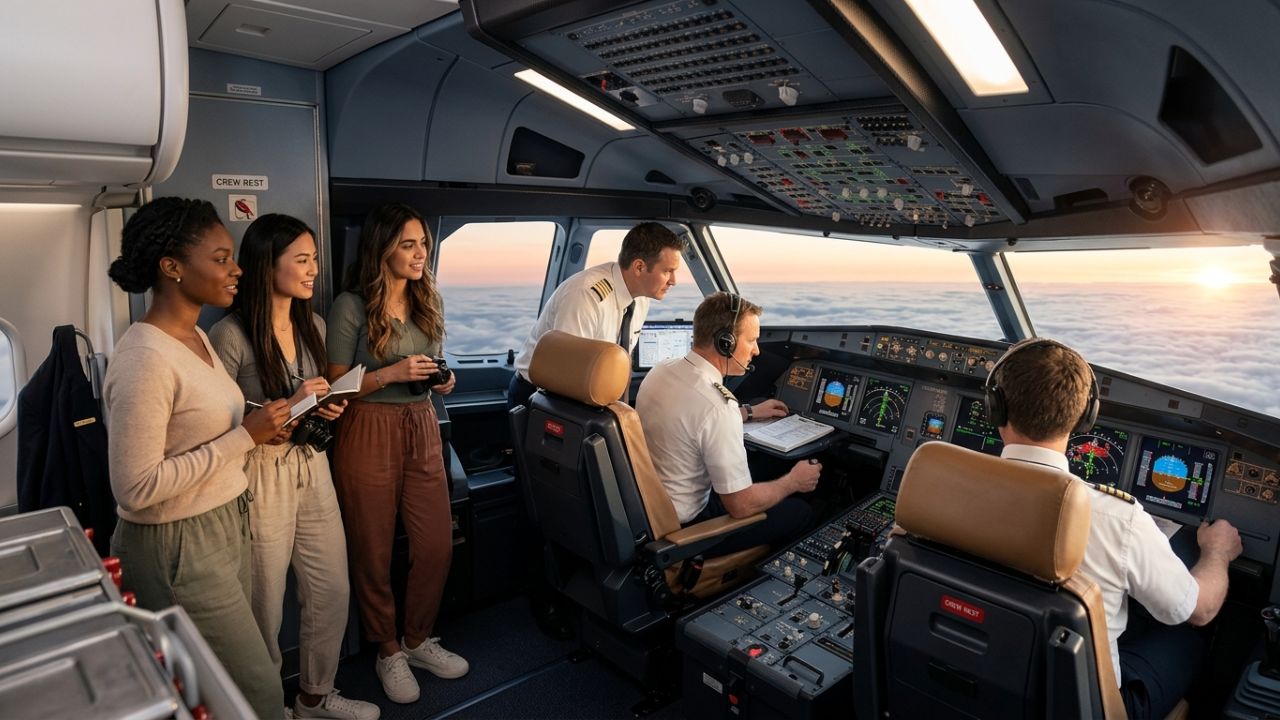
Image generated by AI
As rolling waves of unpredictable travel chaos force commercial airlines to radically reroute widebody jets to avoid congested global airspace, non-stop journeys stretching past 17 hours have become a critical survival strategy. Reported on June 20, 2026, amidst widespread airport disruptions that are triggering massive flight cancellations across major international hubs, passengers are uncovering a hidden aviation secret that guarantees their safety during these marathon flights. Whether a massive jetliner is departing from the United States, navigating congested European airspaces above Germany and the United Kingdom, or connecting ultra-long corridors from Singapore to Australia, operating these transoceanic missions requires complex logistical planning. To ensure structural flight safety while actively flying around storm cells or closed airspace, airlines utilize an elite four-pilot double crew. This heavily regulated, hidden cockpit secret proves that while automation has advanced tremendously, the human brain remains the ultimate asset for preventing catastrophic failure, making this strategy today's most vital headline in breaking airline news and aviation updates.
By introducing direct passenger coordination and dynamic scheduling backups, the regional aviation hubs target growing passenger demand across vital commerce sectors. The choice to coordinate flight departures in phases helps to manage gate capacity, supporting the country's broader regional transportation network.
Context: Engineering Human Endurance in the Sky
For the international aviation network, the mandate to carry a double crew exposes the incredible depth of safety engineering baked into commercial flights, particularly when external networks collapse.
Under standard conditions, regular domestic flights operate with just a single captain and a first officer. However, when an aircraft crosses into the ultra-long-haul category—defined by international regulatory bodies (like the FAA and EASA) as any routing featuring a scheduled block duty time exceeding 12 to 17 total hours—everything changes. To handle these missions safely, global aviation bodies enforce strict frameworks known as ultra-long-haul flight safety protocols. The primary goal of these international regulations is absolute operational redundancy. By staffing the cockpit with two captains and two first officers, airlines ensure that a perfectly fresh, highly alert flying team is available at every moment of the trip. When a flight is suddenly forced to divert around a massive band of travel chaos over the Pacific, this double crew prevents severe cognitive degradation and handles work-intensive navigational updates smoothly.
To view live flight schedules, verify the active departure status of your specific international itinerary, or to track potential route restorations prior to heading to the airport, travelers must consult official aviation directories. For direct updates regarding how massive operational failures might impact your current flight cancellations out of the United States or Singapore, travelers should aggressively utilize the official digital portals of their respective airlines. To explore live flight tracking and monitor the exact severity of the cascading bottlenecks paralyzing the broader oceanic airspace, passengers can consult the official FlightAware tracking service.
Section-Wise Breakdown: The Four-Pilot Operations
The Takeoff Redundancy Protocol
Many flyers wonder why all four flight crew members are seated in the flight deck before the aircraft even leaves the runway. Utilizing four-pilot cockpit operations during the departure phase provides invaluable backup safety layers. Takeoff is arguably the most work-intensive, high-risk window of any journey. While the primary flying crew handles the physical manipulation of the aircraft, the two resting crew members sit in the rear jump seats, serving as a vital second set of eyes. They actively assist by cross-checking navigation charts, reading checklists aloud, and monitoring air traffic control.
Fatigue Risk Management
Human exhaustion is one of the most dangerous invisible threats in modern transportation. Comprehensive aviation fatigue risk management systems are designed around a sobering reality: tired minds make catastrophic mistakes. To counter this hazard, long-haul flight operations require structured crew coordination. Because a double crew spends up to 20 hours together, they use specialized monitoring protocols to check in on each other, ensuring that no single person is pushed past their absolute mental limits.
The In-Flight Shift Division
Once the heavy widebody jet reaches cruising altitude, the team divides neatly into two fully independent units, typically referred to as Crew A and Crew B. This clean shift division allows the active crew to focus entirely on navigating weather systems. If a serious mechanical anomaly occurs over the middle of the ocean, the resting team is awakened instantly, bringing four highly trained minds together to solve the crisis.
Technical Roster: Crew Logistics and Rest Matrices
To ensure absolute factual accuracy regarding the exact structure of a four-pilot double crew and the specific rest facilities required on modern widebody aircraft, the following matrices detail the strictly verified operational data:
Official 4-Pilot Crew Organization Structure
- Team A (Active Shift): 1 Captain + 1 First Officer (At Controls)
- Team B (Resting Shift): 1 Captain + 1 First Officer (In Bunks)
Official Flight Phase Duty Rotation
- Takeoff: All 4 Pilots Present on Flight Deck
- First Half of Flight: Crew A flying / Crew B sleeping in bunks
- Second Half of Flight: Crew B flying / Crew A sleeping in bunks
- Landing: All 4 Pilots Present on Flight Deck
Commercial Airline Pilot Crew Rest Facilities
| Aircraft Type | Typical Bunk Count | Rest Quality | Operational Profile |
|---|---|---|---|
| Boeing 777-300ER | 2 Bunks | High Isolation | Transoceanic Routes |
| Airbus A350-1000 | 2-3 Bunks | Soundproofed | Ultra-Long-Range (ULH) |
| Boeing 787 Dreamliner | 2 Bunks | Controlled Humidity | Extended Twin-Engine (ETOPS) |
Data accurately reflects the strict operational standards mandated by the FAA and EASA for extended commercial flights exceeding 12 to 17 total hours. The dedicated bunks respect natural human sleep architecture, guaranteeing deep restorative REM cycles.
Passenger Impact: Hidden Protection During Flight
For the passengers physically seated in the cabin, the presence of a hidden double crew is the ultimate invisible safety net against mid-air emergencies.
When a massive 16-hour flight encounters severe turbulence or a sudden passenger medical emergency over the Pacific Ocean, the operational workload spikes violently. A standard two-pilot crew would quickly become overwhelmed managing the aircraft while simultaneously communicating with medical dispatchers on the ground. However, because a four-pilot crew is onboard, the resting pilots (Crew B) are instantly summoned from their hidden bunks. This allows the active pilots to maintain strict physical control of the aircraft while the secondary captains manage the crisis protocols. For travelers, this means their flight is constantly protected by an elite, fully rested command team, drastically reducing the risk of a catastrophic pilot error caused by severe sleep deprivation.
Industry Analysis: The Future of "Project Sunrise"
Aviation analysts monitoring the expansion of ultra-long-haul routes note that the reliance on double crews will only increase as airlines push the absolute physical limits of aircraft range.
Analysts emphasize that upcoming initiatives, like the highly anticipated "Project Sunrise" paths connecting distant continents (such as non-stop flights from Sydney to London), will legally require perfectly executed commercial airline pilot crew rest schedules. Modern widebody aircraft (like the Airbus A350-1000) are equipped with advanced, hidden compartments that are completely separated from the passenger cabin to guarantee quiet, soundproofed isolation. Unlike smaller aircraft where a three-pilot rotation requires a fragmented schedule, a four-pilot crew benefits from long, uninterrupted sleep windows. This format ensures that when the relief crew steps back up to the controls for the final, highly complex approach into a congested hub, they are razor-sharp.
Actionable Advice for Ultra-Long-Haul Travel
If you are booked on a transoceanic flight exceeding 14 hours, you must execute this strategic survival checklist to mirror the safety protocols of the flight crew:
- Manage Your Own Fatigue: Passengers suffer from severe deep vein thrombosis (DVT) and cognitive fatigue on ultra-long-haul flights. Emulate the flight crew's strict rest schedules. Set an alarm to walk the cabin every three hours, and utilize noise-canceling headphones to simulate the "High Isolation" of the pilot bunks.
- Audit Aircraft Equipment: When booking an ultra-long-haul route, actively seek out flights operated by the Airbus A350 or Boeing 787 Dreamliner. These aircraft feature advanced cabin pressurization and controlled humidity (the exact same environment provided to the resting pilots), significantly reducing jet lag upon arrival.
- Understand Diversion Logistics: If a medical emergency forces your 16-hour flight to divert, do not panic. The four-pilot crew is explicitly trained for this. However, a massive diversion may cause the crew to "time out" (exceed their legal duty hours). If this occurs, the airline will ground the flight until a replacement double crew can be flown in.
FAQ: The Ultra-Long-Haul Double Crew
Why do long flights have four pilots?
Civil aviation authorities mandate an elite four-pilot crew (two captains and two first officers) on flights with a scheduled block duty time exceeding 12 to 17 hours to mitigate severe cognitive degradation.
Where do the extra pilots sleep?
Modern aircraft like the Boeing 777-300ER and Airbus A350-1000 feature hidden, highly isolated crew rest compartments equipped with 2 to 3 dedicated bunks, completely separated from the passenger cabin.
Are all four pilots in the cockpit during takeoff?
Yes. During work-intensive phases like takeoff and landing, all four pilots are present on the flight deck to maximize safety, cross-check navigation, and monitor air traffic control.
The Reality of Transoceanic Aviation Safety
The structural requirement for airlines to deploy a four-pilot double crew proves definitively that commercial aviation refuses to gamble with human endurance. As passengers utilize these massive 17-hour flights to bypass congested transit hubs and evade regional airport disruptions, they must accept a critical new reality: the safety of a non-stop global flight relies entirely on highly regulated sleep. Surviving the modern era of ultra-long-haul travel demands immense trust in the flight deck, a complete adherence to personal in-flight health protocols, and the understanding that if an emergency arises over the open ocean, there are four highly trained captains ready to bring the aircraft down safely.
Key Takeaways
- The Double Crew Mandate: Flights exceeding 12 to 17 total hours are legally required to carry a four-pilot double crew (two captains, two first officers).
- Takeoff Redundancy: All four pilots must be present on the flight deck during takeoff and landing to provide maximum navigational backup.
- Shift Rotation: The flight is divided into halves, with Crew A flying while Crew B sleeps in hidden, soundproofed bunks, and vice versa.
- Fatigue Management: The protocol explicitly prevents catastrophic pilot error caused by severe sleep deprivation and cognitive decline.
- Hidden Bunk Facilities: Widebody aircraft like the Boeing 787 and A350-1000 feature specialized rest areas with controlled humidity and high isolation.
Related Travel Guides
Massive Travel Chaos Paralyzes Chicago O'Hare with 1,425 Disruptions
Disclaimer
This article is for informational and educational purposes only. It does not constitute legal, financial, or professional advice. While we strive to provide accurate and up-to-date information, travel policies, regulations, and conditions change rapidly. Always verify information with official sources before making travel decisions. Nomad Lawyer makes no representations about the accuracy, reliability, completeness, or suitability of the information provided. Readers should consult qualified professionals for advice specific to their circumstances. The views expressed in this article are those of the author and do not necessarily reflect the views of Nomad Lawyer.
Kunal K Choudhary
Co-Founder & Contributor
A passionate traveller and tech enthusiast. Kunal contributes to the vision and growth of Nomad Lawyer, bringing fresh perspectives and driving the community forward.
Learn more about our team →