
UAE and Saudi Arabia Deploy AI Microclimate Routing and Biometric Corridors for Smart Tourism 2026

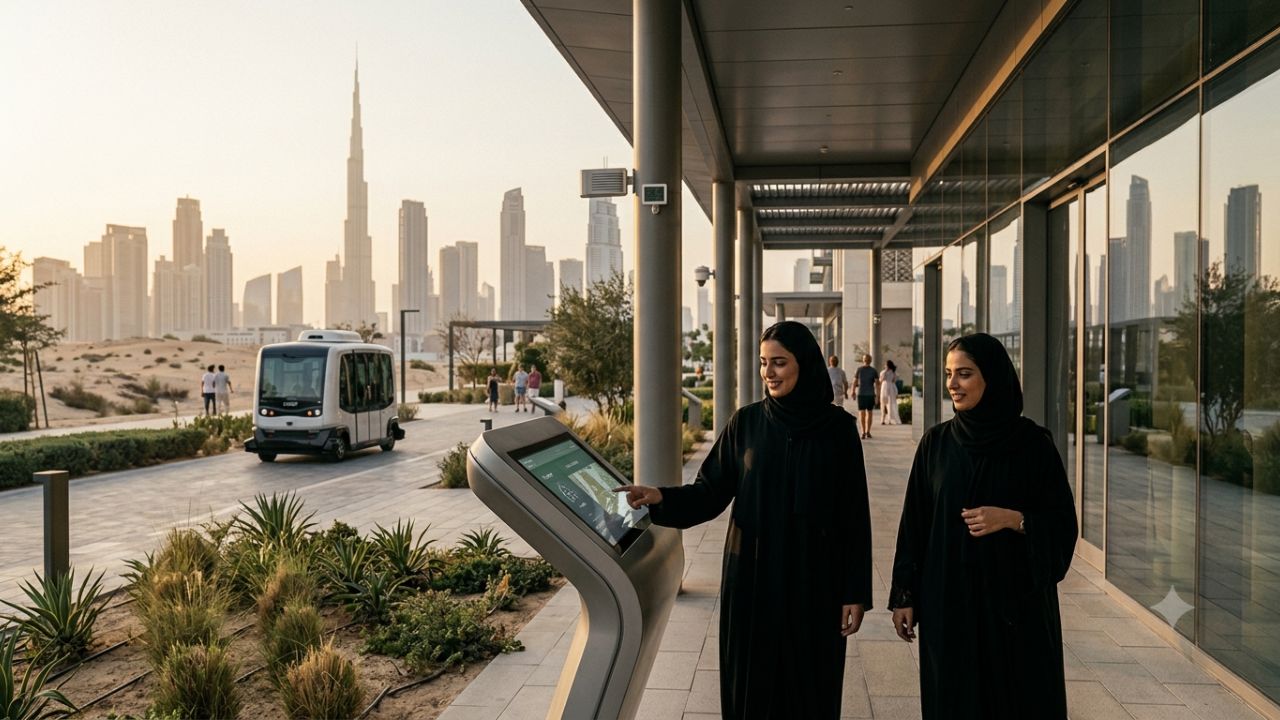
Major travel hubs across the Arabian Peninsula—led by Dubai, Abu Dhabi, and Saudi Arabia—are replacing traditional physical restrictions with AI-powered crowd automation, bioclimatic microclimate routing, and zero-wait biometric transit corridors.
[DUBAI, United Arab Emirates] — A quiet technological revolution is reshaping the travel landscape of the Gulf Cooperation Council (GCC) member states. Facing record-breaking international arrivals—including 19.59 million international overnight visitors to Dubai in 2025 and 27.4 million international arrivals in Saudi Arabia—destination planners are deploying cutting-edge artificial intelligence to balance tourist throughput with hyper-arid environmental limits.
Unlike European cities that rely on crude visitor entry taxes or coach bans, Middle Eastern destinations under Dubai's Economic Agenda D33 and Saudi Arabia's Vision 2030 are operationalizing real-time IoT sensors, bioclimatic stress indices, and computer-vision biometric corridors to manage tourist density dynamically.
                 GCC AI SMART TOURISM ARCHITECTURE & DATA FLOW
+-------------------------------------------------------------------------------+
|                        ENVIRONMENTAL & PASSENGER TELEMETRY                    |
|  • Terrestrial IoT Sensors  • Subsurface Water Monitors  • Satellite Heat Maps|
+---------------------------------------+---------------------------------------+
                                        |
                   +--------------------+--------------------+
                   |                                         |
                   v                                         v
+---------------------------------------+                 +---------------------+
|    BIOCLIMATIC REROUTING ENGINES      |                 | ALGORITHMIC CAPACITY|
| • Fiala Thermal Index & WBGT Models   |                 | • Red Sea: 1.5M Cap |
| • Re-sequences Mid-day Desert Safaris |                 | • AlUla: 1.2M 2030  |
| • Triggers District Chilled Water     |                 | • Diriyah Citadel   |
+---------------------------------------+                 +---------------------+
Comparative Framework of GCC Smart Tourism Initiatives
Destination authorities and mega-project developers across the UAE, Saudi Arabia, and Qatar maintain strict ecological carrying capacities using real-time algorithmic throttling:
| Project / Authority | Monitored Asset Base | Target Visitor Capacity Ceilings | IoT & Telemetry Infrastructure | Ecological Carrying Capacity Mechanics |
|---|---|---|---|---|
| Red Sea Global (RSG) | 28,000 sq km archipelago, 90+ islands, barrier reefs | 1.5 million annual visitors upon full completion | Subsurface acoustic monitors, water clarity IoT, satellite imagery | Automated quota throttling for dive craft based on live coral health metrics |
| Royal Commission for AlUla (RCU) | 22,000 sq km landscape, Hegra UNESCO tombs | 1.2 million by 2030; capped at 2.0 million by 2035 (max 8,500 keys) | Sandstone strain gauges, acoustic sensors, micro-weather tracking | Time-locked digital permits via AlUla App to prevent monument erosion |
| Diriyah Gate (DGDA) | At-Turaif UNESCO mud-brick citadel, Wadi Hanifah | Spatial throughput aligned with 27M wider precinct target | Foot-traffic density sensors, thermal degradation monitors | Geofenced ticketing windows restricting hourly entries to mud-brick ruins |
| Dubai International Airport (DXB) | Airport Operations Control Centre (AOCC) | 96 million annual capacity (46.0M in H1 2025) | Machine learning predictive flow engines, 122 smart gates | 98.7% screened under 5 min; 99.2% departures clear border in <10 min |
| Hamad Int'l Airport (DOH) | Qatar Terminal & Passenger Corridors | Unlimited transit capacity | 700+ biometric touchpoints ("Fast Pass" system) | Facial biometrics auto-deleted within 24 hours of flight departure |
                 DUBAI INTERNATIONAL AIRPORT (DXB) PERFORMANCE
+------------------------------------------------------------------+
| H1 2025 Guests: 46.0 Million (+2.3% YoY) | Total Smart Gates: 122|
| Luggage Delivery: 91% within 45 min      | Security Screening:   |
| Passport Departure: 99.2% under 10 min   | 98.7% under 5 min     |
+------------------------------------------------------------------+
Thermal Comfort AI and Climate-Adaptive Dynamic Routing
To overcome hyper-arid summer temperatures exceeding 42°C, Dubai’s Department of Economy and Tourism (DET) and Abu Dhabi’s Department of Culture and Tourism (DCT) utilize the Universal Thermal Climate Index (UTCI) and Wet-Bulb Globe Temperature (WBGT) based on the Fiala thermoregulation model.
- Microclimate Optimization: Compact urban street orientations and engineered shading reduce mean radiant temperatures by over 20°C during peak summer hours.
- Automated Re-sequencing: When sensors register high thermal stress, outdoor walking tours (such as at Al Fahidi or Qasr Al Hosn) are automatically rescheduled to early morning or evening hours, while footfall is guided into indoor landmarks like Louvre Abu Dhabi or the Museum of the Future.
- Grid Cooling Integration: Chilled water distribution from district cooling providers (like Empower in Dubai) is dynamically adjusted in advance to prevent mid-day power grid spikes.
       +------------------------------------------------------------------+
       |             REGIONAL DISPERSION & CULTURAL CORRIDORS             |
       +------------------------------------------------------------------+
       |  • Hatta Mountain Hub (Dubai 2040): Sensor-guided bus caps       |
       |  • Ras Al Khaimah: Carrying capacity tracking at Jebel Jais      |
       |  • Al Ain Region: Arab Capital of Tourism 2026 (Falaj oasis tracking) |
       +------------------------------------------------------------------+
Ecological Yield Management and Scarcity Economics
In conventional tourism models, revenue is driven by swelling visitor volumes. In contrast, Gulf mega-projects employ "ecological yield management"—inducing artificial scarcity through algorithmic caps.
Properties like The St. Regis Red Sea Resort, Nujuma (A Ritz-Carlton Reserve), and AlUla's luxury desert pavilions charge premium rates that directly fund zero-carbon infrastructure, mangrove seedling expansion (over 1 million planted), and wildlife restoration. This allows AlUla (RCU) to project a SAR 120 billion to SAR 150 billion cumulative contribution to national GDP by 2035 while maintaining strict conservation bounds.
Frequently Asked Questions
How does Dubai use AI to manage airport crowds?
Dubai International Airport (DXB) uses machine learning predictive flow engines at its Airport Operations Control Centre (AOCC) alongside 122 biometric smart gates, allowing 98.7% of passengers to clear security in under 5 minutes.
What visitor cap has Saudi Arabia placed on the Red Sea project?
Red Sea Global enforces a legally mandated environmental ceiling capped at 1.5 million annual visitors across its 28,000-square-kilometer archipelago to protect coral reefs and marine biomes.
What is the visitor cap for AlUla?
The Royal Commission for AlUla (RCU) restricted foundational visitation to 250,000 annually, expanding to a strictly managed 1.2 million by 2030 and capped at 2.0 million by 2035.
Related Travel Guides
Disclaimer
This article is for informational and educational purposes only. It does not constitute legal, financial, or professional advice. While we strive to provide accurate and up-to-date information, travel policies, regulations, and conditions change rapidly. Always verify information with official sources before making travel decisions. Nomad Lawyer makes no representations about the accuracy, reliability, completeness, or suitability of the information provided. Readers should consult qualified professionals for advice specific to their circumstances. The views expressed in this article are those of the author and do not necessarily reflect the views of Nomad Lawyer.
Raushan Kumar
Founder & Lead Developer
Full-stack developer with 11+ years of experience and a passionate traveller. Raushan built Nomad Lawyer from the ground up with a vision to create the best travel and law experience on the web.
Learn more about our team →