
Typhoon Bavi Triggers 1,038 Flight Delays and 176 Cancellations Across Japan, Singapore, Malaysia, and Philippines in 2026
Typhoon Bavi caused widespread aviation chaos across East Asia, resulting in 1,038 delays and 176 cancellations affecting major hubs like Tokyo Haneda and Kuala Lumpur.

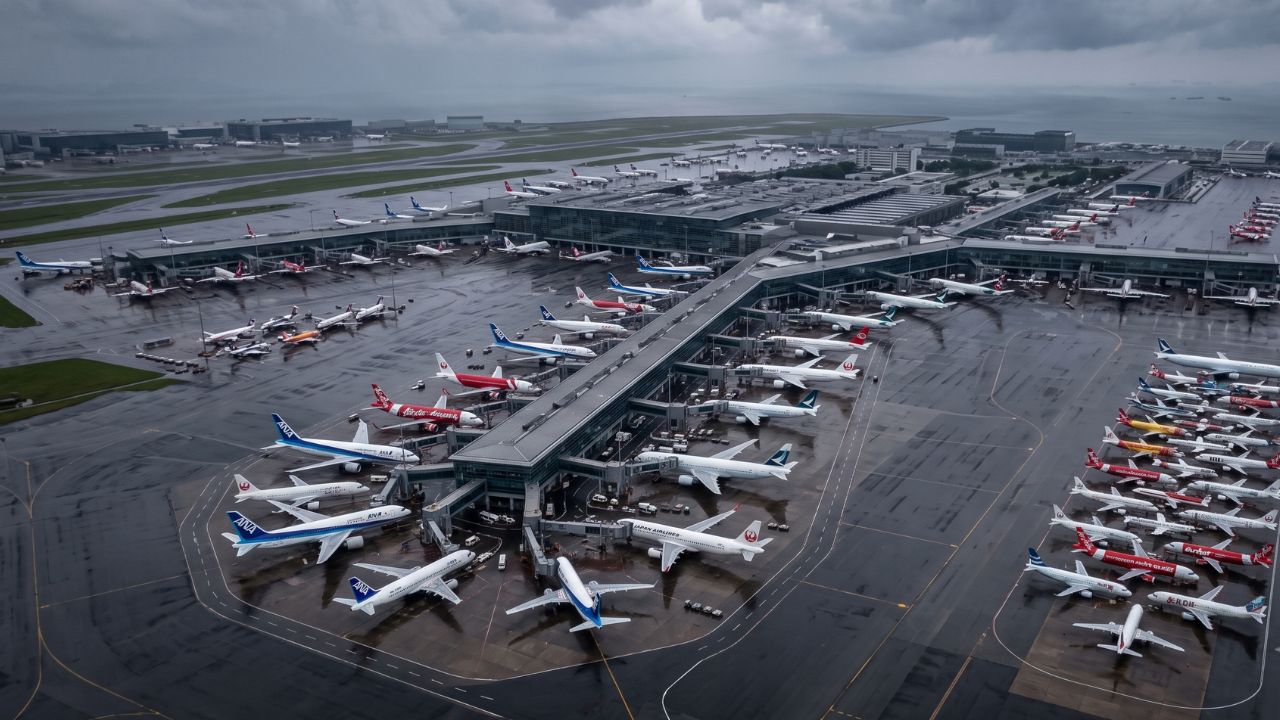
Image generated by AI
Typhoon Bavi has triggered a systemic collapse of flight schedules across East Asia, resulting in 1,038 delays and 176 cancellations on July 12, 2026. The storm's trajectory through the East China Sea created a ripple effect, disrupting operations not only in Japan but also across major aviation hubs in Singapore, Malaysia, and the Philippines.
The disruption is characterized by a "knock-on" effect. Because modern airline networks rely on precise aircraft rotations, a single grounded plane in Okinawa or Tokyo creates a scheduling vacuum for subsequent flights to Jakarta, Incheon, and Hong Kong.
Regional Hub Impact Analysis
Tokyo Haneda emerged as the primary epicenter of the crisis, recording 217 delays and 33 cancellations. Domestic services bore the brunt of the operational restrictions as high winds made aircraft movements hazardous.
In Southeast Asia, Kuala Lumpur reported the second-highest volume of disruption with 215 delays and 7 cancellations. This suggests that while the storm's physical presence was centered in Japan, the logistical dependency on Japanese hubs severely crippled Malaysian regional services.
Singapore Changi and Manila also faced significant pressure, recording 134 and 130 delays respectively. The instability at these hubs was driven by the displacement of crews and aircraft originally scheduled for Japanese routes.
Meteorological Drivers of the Aviation Crisis
The chaos began on July 11, when Typhoon Bavi struck Okinawa with sustained winds exceeding 200 km/h. The Japan Meteorological Agency issued urgent warnings for landslides and flooding, forcing airlines to prioritize safety over schedules.
After destabilizing southern Japan, Bavi moved toward China’s eastern Zhejiang province, making landfall late Saturday night. The scale of the storm was such that Chinese authorities evacuated over 1.7 million residents to mitigate the risk of the storm's landfall.
Airline Performance and Disruption Data
The impact varied significantly by carrier. All Nippon Airways (ANA) faced the most severe scheduling pressure, logging a region-high 145 delays. Conversely, Japan Transocean Air Co. suffered the most significant percentage of total flight losses with 29 cancellations.
Low-cost carriers and regional specialists were also heavily impacted. AirAsia recorded 59 delays, primarily centered around the Kuala Lumpur and Singapore Changi corridors, while ANA Wings saw 23 cancellations and 49 delays.
Detailed Disruption Breakdown by Airport
| Airport | Delays | Cancellations | Primary Impact Driver |
|---|---|---|---|
| Tokyo Haneda | 217 | 33 | Strong winds & operational limits |
| Kuala Lumpur | 215 | 7 | Regional rotation failures |
| Singapore Changi | 134 | 15 | Schedule maintenance collapse |
| Manila | 130 | 5 | Carrier-specific operational gaps |
| Naha | 94 | 31 | Direct exposure to Typhoon Bavi |
| Narita | 73 | 22 | Domestic/International adjustments |
Carrier-Specific Impact Statistics
| Airline | Cancellations | Delays | Key Affected Hubs |
|---|---|---|---|
| Japan Transocean Air Co. | 29 | 15 | Okinawa |
| China Eastern | 25 | - | Kansai, Fukuoka, Narita, Haneda, Manila, Singapore |
| ANA Wings | 23 | 49 | Various Japan Hubs |
| Jetstar Japan | 20 | 4 | Narita, Naha, Fukuoka, Kansai, New Chitose |
| Skymark | 11 | 38 | Naha, Haneda, New Chitose |
| All Nippon | 7 | 145 | Nationwide Japan |
| Japan Airlines | 4 | 111 | Nationwide Japan |
| AirAsia | - | 59 | Kuala Lumpur, Singapore Changi |
Recovery Outlook for Passengers
Travelers should expect operational volatility for at least the next 24 hours. Even as weather conditions stabilize, airlines must undergo a complex process of aircraft repositioning and crew rescheduling.
Passengers with connecting itineraries are at the highest risk. If an incoming aircraft from Naha or Narita is delayed, the onward service is likely to be missed, regardless of the weather at the destination airport.
Immediate Action Steps for Travelers:
- Verify Status: Check airline apps directly rather than relying on airport monitors.
- Buffer Time: Allot extra time for security and check-in due to increased terminal congestion.
- Documentation: Retain all receipts for meals or lodging if a cancellation triggers an overnight stay.
- Notifications: Ensure mobile push notifications are active for real-time gate and schedule changes.
Aviation recovery in East Asia will remain fragile until all displaced aircraft are returned to their original rotation cycles.
Related Travel Guides
Disclaimer
This article is for informational and educational purposes only. It does not constitute legal, financial, or professional advice. While we strive to provide accurate and up-to-date information, travel policies, regulations, and conditions change rapidly. Always verify information with official sources before making travel decisions. Nomad Lawyer makes no representations about the accuracy, reliability, completeness, or suitability of the information provided. Readers should consult qualified professionals for advice specific to their circumstances. The views expressed in this article are those of the author and do not necessarily reflect the views of Nomad Lawyer.
Raushan Kumar
Founder & Lead Developer
Full-stack developer with 11+ years of experience and a passionate traveller. Raushan built Nomad Lawyer from the ground up with a vision to create the best travel and law experience on the web.
Learn more about our team →