
Turkish Airlines Airbus A330 Emergency Landing at Kathmandu: 288 Evacuated via Slides as Landing Gear Bursts into Flames at Tribhuvan Airport; Major Aviation News and Travel Chaos in Nepal
A Turkish Airlines Airbus A330 (Flight TK726) arriving from Istanbul made a harrowing emergency landing at Kathmandu’s Tribhuvan International Airport (TIA) on May 11, 2026, after its landing gear caught fire upon touchdown. All 277 passengers and 11 crew members were successfully evacuated via emergency slides. The incident, believed to be caused by a hydraulic or brake malfunction, triggered a total shutdown of Nepal’s primary international gateway, causing massive flight cancellations and airport disruptions.

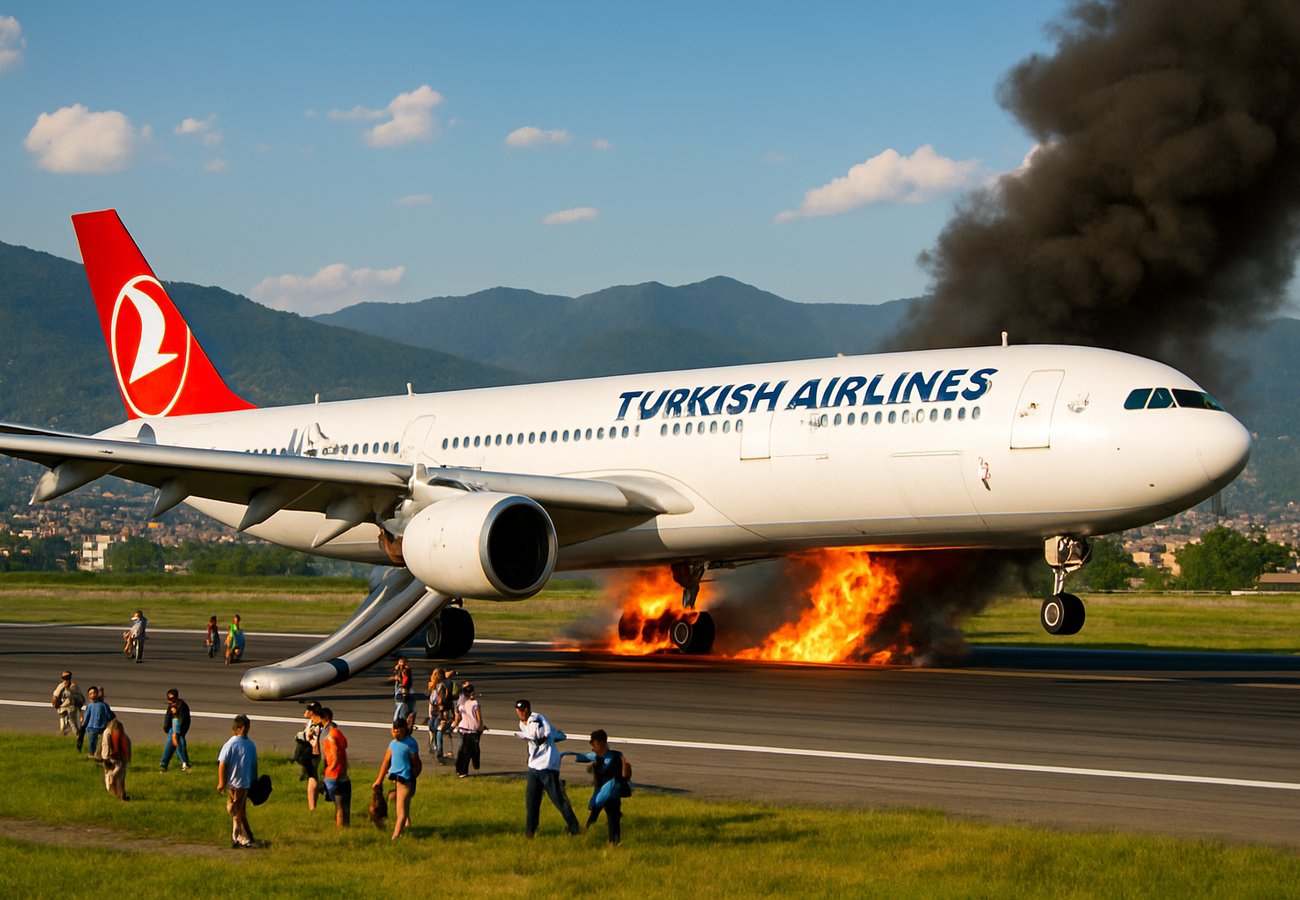
Runway Crisis: Turkish Airlines Flight TK726 evacuations on the TIA tarmac following a landing gear fire.
Turkish Airlines Wide-Body Jet Ignites on Kathmandu Runway: 288 Souls Evacuate via Emergency Slides After High-Intensity Landing Gear Fire; Major News and Airport Disruptions
In a heart-stopping moment for the global aviation community, a Turkish Airlines Airbus A330 narrowly avoided a catastrophic disaster at Tribhuvan International Airport (TIA) in Kathmandu today. This airline news update, confirmed on May 11, 2026, details the harrowing emergency landing of Flight TK726 from Istanbul. Shortly after touching down on Runway 02 at approximately 9:00 AM local time, the aircraft’s right landing gear erupted in flames, prompting the immediate and high-speed evacuation of 277 passengers and 11 crew members.
The sight of thick black smoke billowing from the wide-body jet triggered an "Alpha-Red" emergency response at Nepal’s primary international gateway. While all 288 individuals onboard were successfully evacuated via inflatable slides, the incident has plunged the airport into travel chaos, with the single-runway facility forced into a total shutdown for several hours. As the Civil Aviation Authority of Nepal (CAAN) begins a high-stakes investigation, the focus remains on the "Heroic Rapid-Response" that prevented a mass-casualty event in the shadows of the Himalayas.
Expanded Overview: The Race Against Time on Runway 02
The emergency involving Flight TK726 is being described by eyewitnesses as a "Textbook Evacuation" under extreme pressure. This aviation update highlights that the A330 was completing its long-haul journey from Istanbul when the malfunction occurred. Upon touchdown, a suspected hydraulic leak or brake failure caused the landing gear to ignite, with fire rapidly spreading through the wheel well.
The flight deck crew, realizing the severity of the fire, initiated the evacuation sequence before the aircraft had even cooled. Within 90 seconds, all emergency exits were deployed, and passengers—including high-level United Nations officials and international tourists—were guided down the slides as airport fire crews battled the blaze with chemical foam. The "Single-Runway Constraint" of Kathmandu meant that the stranded aircraft effectively paralyzed the nation’s entire international air link, causing a massive backlog of flight cancellations across Asia and Europe.
Section-Wise Breakdown: Fire, Fear, and the Hub Shutdown
The Impact: Fire on Runway 02
As the A330 decelerated, the heat from the landing gear fire was visible to passengers in the aft cabin. The sudden burst of black smoke and the smell of burning rubber created a moment of intense panic, which was quickly managed by the cabin crew. Airport fire services, stationed near the runway for the high-volume morning peak, arrived at the aircraft’s side within three minutes of the initial alert.
The Evacuation: 288 Souls on the Slides
The order to "Slide-and-Run" was executed with military precision. Passengers were forced to leave all hand luggage behind as they descended the inflatable chutes. While a few minor injuries were reported—largely abrasions and twisted ankles sustained during the rapid exit—no serious casualties were recorded. The 11 crew members remained onboard until the final passenger had reached the safety of the grass perimeter.
Tribhuvan Gridlock: A Single-Runway Crisis
The positioning of the disabled Turkish Airlines jet on the center of the runway created an immediate "Blackout" for the airport. With no parallel runway or taxiway wide enough for wide-body recovery, TIA was forced to divert all incoming international flights to hubs in India and Thailand. This has resulted in a massive surge in airport disruptions, with thousands of travelers currently stranded at both ends of the Istanbul-Kathmandu corridor.
Turkish Airlines Flight TK726: Emergency Profile (May 11, 2026)
The following table outlines the critical metrics and timeline of the Kathmandu runway fire.
Turkish Airlines: Flight TK726 Incident Summary
| Metric | Detail | Status / Outcome |
|---|---|---|
| Aircraft Type | Airbus A330-300 | Grounded / Fire Damage |
| Flight Number | TK726 (Istanbul - Kathmandu) | Emergency Evacuation |
| Total Onboard | 288 (277 Pax + 11 Crew) | 100% Safely Evacuated |
| Incident Type | Landing Gear Fire (Post-Touchdown) | Runway 02 Obstruction |
| Primary Cause (Initial) | Hydraulic Leak / Brake Malfunction | CAAN Investigation Active |
| Airport Impact | Total Runway Shutdown | Massive Flight Cancellations |
| Injuries | Minor (During Evacuation) | No Fatalities |
Source: CAAN Operational Report and Turkish Airlines Corporate Safety Audit. Data as of May 11, 2026.
Passenger Impact: Terror and Logistical Turmoil
For the international travelers arriving in Nepal, the "Dream Trip" turned into a survival drill:
- Slide Trauma: Many passengers reported the sheer terror of jumping onto the slides while seeing smoke rise from the wing area.
- Lost Belongings: Due to the "No Baggage" evacuation rule, many tourists and UN officials are currently without passports, medication, or personal devices, creating a secondary logistical crisis in the terminal.
- Stranded in Transit: The shutdown of TIA has left thousands of departing travelers without options, as the high-altitude environment of Kathmandu limits the capacity for rapid flight rescheduling.
Industry Analysis: The Hydraulic Hazard at High Altitudes
Aviation analysts suggest that the TK726 incident highlights a specific risk for wide-body operations at high-elevation airports like Kathmandu. The thin air and high landing speeds required at TIA place extreme thermal loads on the braking systems of an Airbus A320 or A330. If a hydraulic leak occurs during this phase, the fluid can ignite instantly upon contact with hot brake discs. This "Thermal Intersection" is a known risk, and the CAAN investigation will likely focus on the maintenance history of the A330’s landing gear assembly to determine if previous inspections missed a developing hairline fracture in the hydraulic lines.
Conclusion: A Narrow Escape in the Shadow of the Himalayas
As Turkish Airlines and the Civil Aviation Authority of Nepal work to recover the A330 from the runway, the incident stands as a powerful reminder of the "Fractions of Seconds" that define aviation safety. A routine flight from Istanbul could have ended in tragedy if not for the rapid deployment of the slides and the efficiency of the airport’s fire crews. While the travel chaos at TIA will likely persist for the next 48 hours, the fact that 288 people will go home to their families is the only metric that truly matters.
Key Takeaways
- Turkish Airlines Flight TK726 suffered a major landing gear fire at Kathmandu.
- 288 people successfully evacuated via emergency slides on Runway 02.
- Airbus A330wide-body jet remains grounded pending a deep-safety audit.
- TIA airport was shut down, causing massive domestic and international flight cancellations.
- No serious injuries reported, though minor injuries occurred during the slide descent.
- CAAN investigation focused on suspected hydraulic leak or brake failure.
- UN officials and international tourists among those safely rescued from the blaze.
/article-footer-standard
Related Travel Guides:
Disclaimer
This article is for informational and educational purposes only. It does not constitute legal, financial, or professional advice. While we strive to provide accurate and up-to-date information, travel policies, regulations, and conditions change rapidly. Always verify information with official sources before making travel decisions. Nomad Lawyer makes no representations about the accuracy, reliability, completeness, or suitability of the information provided. Readers should consult qualified professionals for advice specific to their circumstances. The views expressed in this article are those of the author and do not necessarily reflect the views of Nomad Lawyer.
Kunal K Choudhary
Co-Founder & Contributor
A passionate traveller and tech enthusiast. Kunal contributes to the vision and growth of Nomad Lawyer, bringing fresh perspectives and driving the community forward.
Learn more about our team →