
Trump-Class Battleship: Arsenal Ship Concept Addresses Iran Conflict Missile Gaps
The Trump-class arsenal ship concept gains credibility as U.S. forces expended 850+ Tomahawk missiles in four weeks against Iran, exposing critical naval missile stockpile vulnerabilities in 2026.

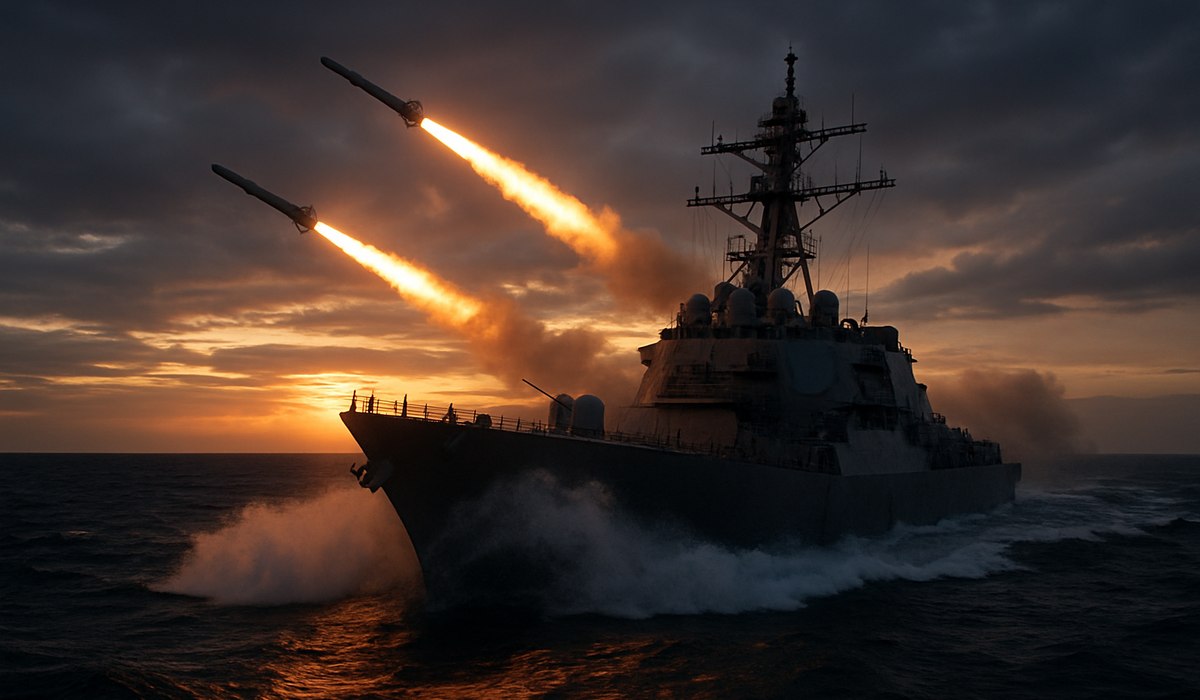
Image generated by AI
What the Iran Conflict Reveals About Naval Firepower Demands
The Trump-class battleship concept has shifted from theoretical defense discussion to urgent operational necessity. In February 2026, U.S. and Israeli forces launched coordinated strikes against Iran, with American military assets expending over 850 Tomahawk cruise missiles within the first four weeks alone. This sustained bombardment campaign exposed a fundamental vulnerability: existing naval platforms cannot maintain the firepower density required for prolonged, high-intensity regional conflicts. Pentagon officials now openly acknowledge that current missile stockpile levels and production capacity cannot sustain operations at this tempo indefinitely, forcing defense planners to reconsider the Trump-class arsenal ship proposal with fresh urgency.
The Iran conflict became a live-fire demonstration of 21st-century naval warfare economics. Traditional naval strike doctrine, developed during the Cold War, assumed shorter engagement windows and lower sustained fire rates. Today's precision-guided munitions are expensive, time-consuming to produce, and deplete rapidly under combat conditions. The Trump-class battleship directly addresses this operational gap by concentrating massive firepower into a single, advanced platform capable of persistent regional presence without requiring frequent logistical replenishment.
Trump-Class Battleship: Arsenal Ship Not Traditional Warship
The Trump-class battleship bears no resemblance to the heavily armored, gun-armed battleships that dominated naval warfare through World War II. Instead, the formal designation BBG(X) describes a 30,000-to-40,000-ton arsenal ship—a specialized surface combatant optimized for missile deployment and command functions rather than direct naval engagement. This fundamental distinction matters for naval strategists evaluating the platform's tactical role and survivability in contested waters.
The proposed Trump-class battleship design includes approximately 128 vertical launch system (VLS) cells capable of firing multiple munition types: Tomahawk cruise missiles, Standard Missile (SM-series) air defense interceptors, and emerging hypersonic Conventional Prompt Strike weapons. This concentrated firepower capacity exceeds the combined armament of most contemporary destroyer squadrons. Beyond missiles, the design incorporates developmental systems including electromagnetic railguns and high-energy laser weapons, plus advanced sensors built around the AN/SPY-6 radar architecture. Naval leadership stresses that the Trump-class battleship concept represents genuine capability advancement, not nostalgic warship design revival.
Rear Admiral Derek Trinque emphasized that the Trump-class battleship addresses modern naval warfare requirements rather than resurrecting obsolete designs. The ship would serve dual roles: sustained offensive firepower delivery and command-and-control functions as Ticonderoga-class cruisers retire from service. This multifaceted mission profile justifies the substantial hull size and weapons investment in an era of declining naval budgets.
Missile Stockpile Crisis and Production Capacity Challenges
The Iran conflict exposed uncomfortable truths about American precision munitions procurement. Tomahawk cruise missile production currently operates at approximately 30 units monthly—insufficient to replace combat expenditures during sustained high-intensity operations. The 850-missile discharge in four weeks against Iran consumed nearly one year's production capacity in a single tactical campaign. This mismatch between demand and supply drives defense policy discussions about industrial base expansion, long-range procurement strategies, and platform design requirements.
The Trump-class battleship concept directly acknowledges this production constraint. Rather than distributing missiles across numerous smaller platforms requiring coordinated strike planning, the arsenal ship concentrates maximum firepower in a single hull capable of independent operation. This design philosophy reduces the number of ships required to maintain regional deterrence, potentially offsetting the development and construction costs through reduced operational footprints. Navy planners argue that fewer, larger, heavily-armed vessels require less overall escort support and logistics infrastructure than equivalent firepower distributed across multiple destroyers and cruisers.
Current Arleigh Burke-class destroyers carry 90-to-96 VLS cells, while retiring Ticonderoga-class cruisers carry 122 cells. As the cruiser fleet diminishes, total available shipboard missile capacity shrinks despite construction of new destroyers. The Trump-class battleship reverses this trend by fielding vessels carrying 128 cells—restoring capacity lost through platform retirement while introducing advanced sensor and weapon systems unavailable on aging designs.
Strategic Risks of Concentrating Weapons in Single Platforms
Naval strategists debate whether concentrating overwhelming firepower in individual Trump-class battleship hulls creates unacceptable vulnerability. Modern anti-ship missile technology has advanced dramatically since the Cold War, with hypersonic weapons, saturation attacks, and electromagnetic warfare posing existential threats to large, heavily-armed surface combatants. A single Trump-class battleship destroyed or severely damaged could eliminate more offensive capacity than the loss of three or four conventional destroyers, potentially shifting regional military balance instantaneously.
Critics argue that distributed force structures provide greater resilience than concentrated arsenal platforms. However, operational logistics and sustained combat duration favor larger platforms. The Trump-class battleship design incorporates advanced defensive systems: layered air defense through SM-series missiles, directed-energy weapons against incoming threats, and signature-reduction features improving survivability. Navy officials contend these defensive systems, combined with advanced sensors and electronic warfare capabilities, provide adequate protection for the platform's offensive advantages.
The platform design also emphasizes command-and-control functions, enabling the Trump-class battleship to coordinate strike packages involving carrier aviation, submarine forces, and allied maritime assets. This networked warfare approach multiplies effective firepower beyond the ship's organic weapons systems, theoretically justifying the concentrated design despite survivability concerns.
Cruise Itinerary at a Glance
| Aspect | Details |
|---|---|
| Ship Class | Trump-Class Arsenal Ship (BBG(X)) |
| Displacement | 30,000-40,000 tons |
| Vertical Launch Cells | 128 VLS cells |
| Primary Munitions | Tomahawk cruise missiles, SM-series interceptors |
| Advanced Weapons | Hypersonic Conventional Prompt Strike, electromagnetic railguns |
| Sensor Suite | AN/SPY-6 radar architecture |
| Status as of April 2026 | Concept phase; formal production awaiting congressional approval |
| Estimated Development Cost | $10-15 billion (preliminary estimates) |
What This Means for Military and Policy Observers
The Trump-class battleship debate carries implications beyond naval warfare doctrine. Defense industrial base capacity, military budget allocation, and strategic deterrence all intersect within this platform concept. For observers monitoring naval development, several actionable insights emerge from the Iran conflict revelations:
-
Precision munitions supply chains require immediate expansion. Current production rates cannot sustain high-intensity regional conflicts without rapid industrial mobilization. Defense contractors must invest in manufacturing facility expansion before the next major conflict erupts.
-
Fleet composition urgently needs reassessment. Declining Ticonderoga-class cruiser numbers create genuine capability gaps that planned destroyer construction cannot fully address. The Trump-class battleship represents one potential solution among several viable alternatives.
-
Hypersonic weapons development directly impacts naval platform design. As hypersonic munitions mature, naval ships must be designed from inception to deploy these weapons effectively. Retrofitting existing destroyers proves significantly more costly than purpose-built arsenal platforms.
-
Alliance interoperability requires standardized missile systems. The Trump-class battleship's diverse munitions capacity enables coalition warfare with allied naval forces. This flexibility strengthens regional partnerships and burden-sharing arrangements.
-
Congressional approval will determine platform feasibility. Despite Pentagon advocacy, budget constraints and competing procurement priorities may limit Trump-class battleship construction to 2-3 hulls rather than full fleet architecture.
FAQ
What exactly is a Trump-class battleship in 2026?
The Trump-class battleship, formally designated BBG(X), is an arsenal ship—not a traditional battleship. It
Raushan Kumar
Founder & Lead Developer
Full-stack developer with 11+ years of experience and a passionate traveller. Raushan built Nomad Lawyer from the ground up with a vision to create the best travel and law experience on the web.
Learn more about our team →