
Travelers Across Germany Face Continued Airline Disruptions as Lufthansa, United , and Swiss International Ground Four Major Flights Frankfurt Airport Hindering Travel to Tokyo, Chicago, London, Geneva, and More Key Destinations – New Update
Frankfurt Airport flight cancellations hit Lufthansa, United, and Swiss Air, disrupting travel to Tokyo, Chicago, London

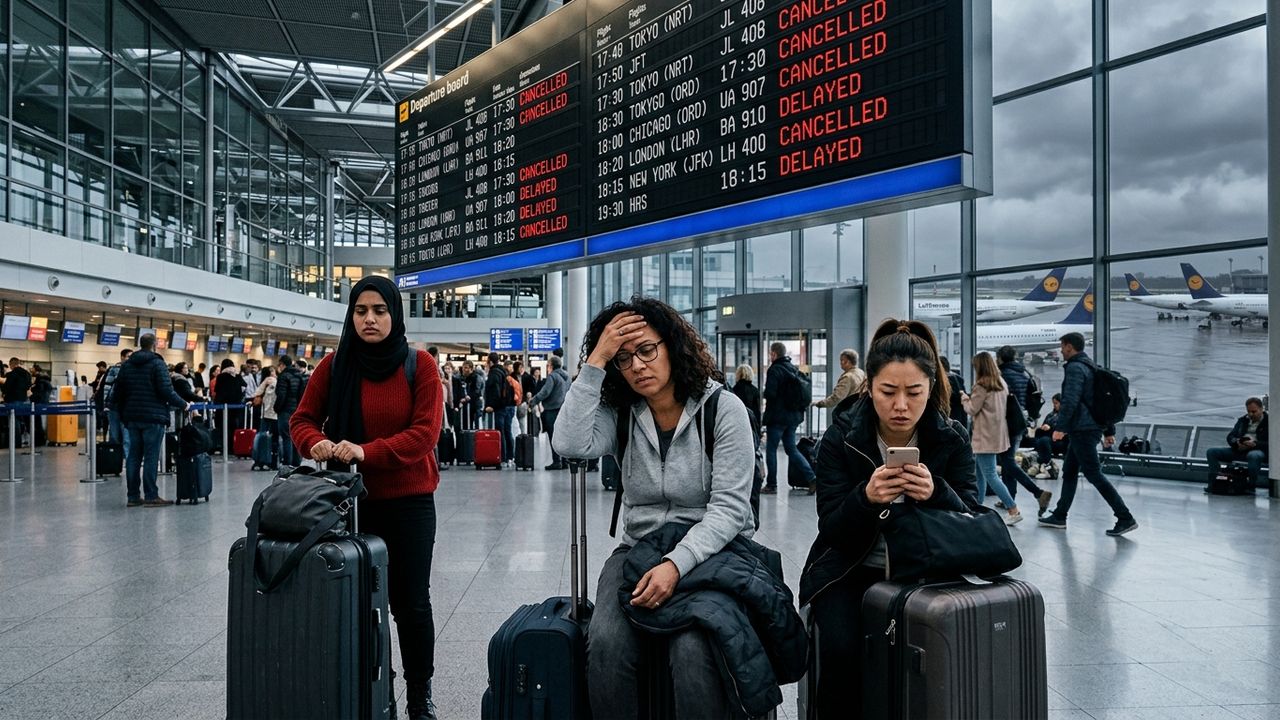
Image generated by AI
[Frankfurt, June 23, 2026] — Major aviation disruptions struck Frankfurt International Airport (FRA) as four high-profile international flights were grounded, affecting critical travel corridors to Asia, North America, and Europe. The cancellations, involving Lufthansa, United Airlines, and Swiss International Air Lines, have triggered widespread schedule adjustments for passengers traveling to Tokyo, Chicago, London, and Geneva.
Operational Instability at Europe's Primary Aviation Hub
Frankfurt Airport serves as one of the most vital transit points in the global aviation network, meaning that even a small number of grounded aircraft can create significant ripple effects. Industry observers note that the recent cancellation of four major departures underscores the operational pressures currently facing the hub. Because Frankfurt is a primary gateway for both intercontinental long-haul flights and high-frequency regional hops, these disruptions have impacted a diverse demographic of travelers, from corporate executives to international tourists.
The grounded flights spanned a variety of aircraft types, including wide-body jets designed for transoceanic travel and narrow-body aircraft used for short-haul European connectivity. This variety suggests that the disruptions were not limited to a specific fleet issue but rather reflected broader operational challenges within the airport's ecosystem.
Long-Haul Disruptions Affecting Tokyo and Chicago Routes
The most significant impact was felt on intercontinental routes, where the loss of a single flight can displace hundreds of passengers and disrupt complex connecting itineraries. According to flight tracking data, Lufthansa was forced to cancel flight DLH716, a Boeing 747-8 service destined for Tokyo International (Haneda). This specific route is a cornerstone of the connectivity between Germany and Japan, and its removal from the schedule has placed additional strain on an already high-demand corridor.
Simultaneously, transatlantic travel was hindered by the cancellation of United Airlines flight UAL906. Utilizing a Boeing 787-9 Dreamliner, this service was scheduled to transport passengers from Frankfurt to Chicago O’Hare International Airport. As a primary link between Europe and the American Midwest, the cancellation of this flight significantly reduced capacity on a key gateway route, leaving business travelers and connecting passengers to seek alternative arrangements.
Short-Haul Interruptions Across London and Geneva
While the long-haul cancellations grabbed headlines, regional European connectivity also suffered. Lufthansa grounded flight LHX904, an Airbus A320neo scheduled for London Heathrow. Given that the Frankfurt-London route is one of the busiest in the world for financial and corporate travel, the cancellation disrupted a high-frequency link between two of the world's leading economic hubs.
Further complicating the regional network, Swiss International Air Lines cancelled flight SWR1081. This service, operated by a Bombardier CS300, was intended for Geneva Cointrin International Airport. This route is essential for institutional and diplomatic travel between Germany and Switzerland, meaning the cancellation had implications beyond standard leisure travel.
Detailed Flight Cancellation Data
The following table provides a comprehensive breakdown of the affected services, including aircraft types and scheduled departure times.
| Flight Code | Airline | Aircraft | Destination | Scheduled Departure | Status |
|---|---|---|---|---|---|
| DLH716 | Lufthansa | B748 | Tokyo International (Haneda) | Tue 02:05 PM CEST | Cancelled |
| LHX904 | Lufthansa | A20N | London Heathrow | Tue 10:00 AM CEST | Cancelled |
| UAL906 | United Airlines | B78X | Chicago O’Hare Intl | Mon 12:40 PM CEST | Cancelled |
| SWR1081 | Swiss International Air Lines | BCS3 | Geneva Cointrin Intl | Mon 08:10 AM CEST | Cancelled |
Passenger Impact and Network Cascading Effects
The fallout from these cancellations extended far beyond the immediate loss of four flights. Because Frankfurt operates as a "hub-and-spoke" system, passengers arriving from other cities to catch these departing flights found themselves stranded. Reports indicate that travelers faced several critical challenges:
- Limited Rebooking Options: With high seasonal demand, finding available seats on alternative flights has proven difficult, forcing some passengers to wait days for the next available departure.
- Missed Global Connections: Many passengers on the Tokyo and Chicago flights were utilizing Frankfurt as a transit point; the cancellations resulted in missed onward connections across multiple continents.
- Logistical Delays: Extended layovers have increased the burden on airport infrastructure, leading to overcrowded lounges and hotels.
- Corporate Disruption: The loss of the London and Geneva services specifically impacted diplomatic and business schedules, where timing is often critical.
Strategic Response from Involved Carriers
Lufthansa, United Airlines, and Swiss International Air Lines are currently working to mitigate the damage through standard operational recovery protocols. Industry sources indicate that airlines are prioritizing the rebooking of passengers through alliance partners to clear the backlog of stranded travelers.
Furthermore, the carriers are managing "aircraft rotation" challenges. When a flight is cancelled, the aircraft is often out of position for its next scheduled leg, potentially causing a chain reaction of further delays. Fleet managers are currently coordinating the reallocation of crews and aircraft to ensure that subsequent schedules are not further compromised.
The diversity of the aircraft involved—ranging from the massive Boeing 747-8 to the regional Bombardier CS300—indicates that the operational failure was not tied to a specific aircraft model or technical fault within one fleet, but was likely a systemic issue at the hub level.
The fragility of the global aviation network is highlighted by these events. When a central node like Frankfurt experiences instability, the effects are felt globally, from the Midwest of the United States to the heart of Japan. As airlines continue to operate at near-maximum capacity, the margin for error remains slim, making these operational disruptions a significant concern for international travel stability.
Related Travel Guides
Disclaimer
This article is for informational and educational purposes only. It does not constitute legal, financial, or professional advice. While we strive to provide accurate and up-to-date information, travel policies, regulations, and conditions change rapidly. Always verify information with official sources before making travel decisions. Nomad Lawyer makes no representations about the accuracy, reliability, completeness, or suitability of the information provided. Readers should consult qualified professionals for advice specific to their circumstances. The views expressed in this article are those of the author and do not necessarily reflect the views of Nomad Lawyer.
Kunal K Choudhary
Co-Founder & Contributor
A passionate traveller and tech enthusiast. Kunal contributes to the vision and growth of Nomad Lawyer, bringing fresh perspectives and driving the community forward.
Learn more about our team →