
Travel United States Airlines Expand Routes as April Pink Moon Boosts Astro-Tourism Demand
April 2026 Pink Moon triggers unprecedented astro-tourism surge across North America, Europe, and Australia. Airlines expand capacity to dark-sky destinations while managing airspace coordination challenges between FAA, IATA, and international aviation authorities.

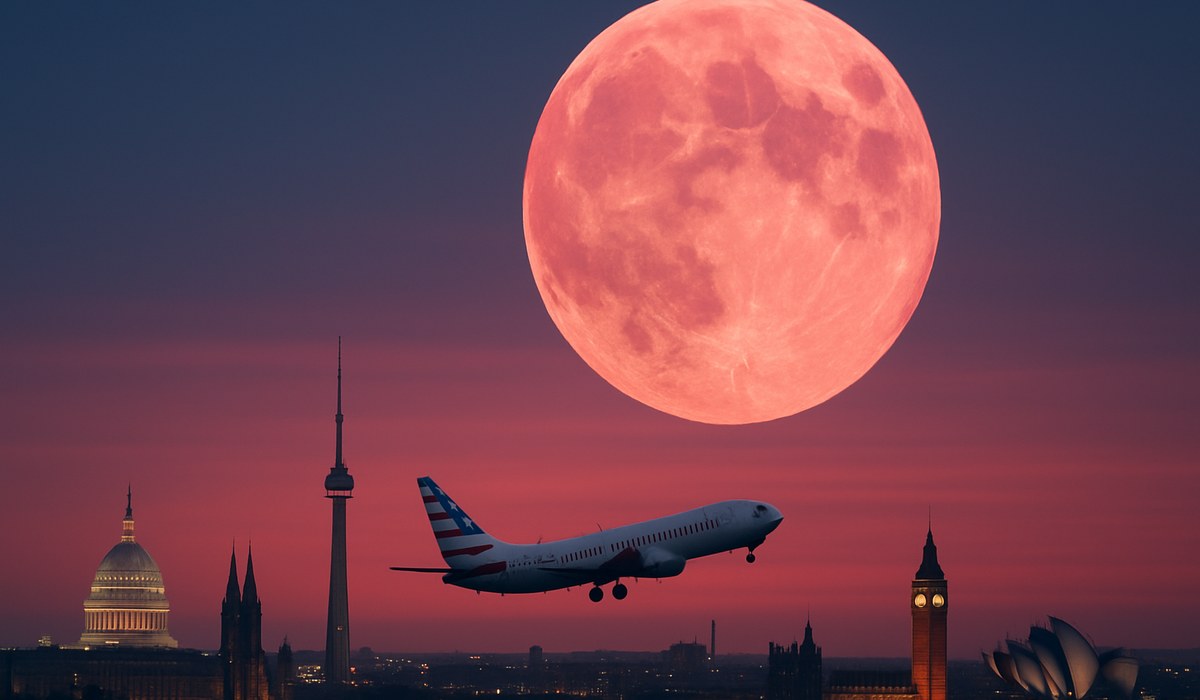
Image generated by AI
Quick Summary
- April's Pink Moon creates record demand for astro-tourism flights across seven continents, straining airline capacity planning
- Major carriers launching dedicated dark-sky routes to Mexico, Canada, Germany, and Switzerland through May 2026
- FAA, Eurocontrol, and IATA coordinate airspace management to prevent conflicts during peak viewing nights
- Dynamic pricing models see 40–60% premium rates on routes to prime viewing locations during full moon windows
April Pink Moon Triggers Global Astro-Tourism Surge: Airlines Respond with Route Expansion
The April Pink Moon—a supermoon appearing larger and brighter than typical lunar cycles—is reshaping international aviation demand in ways airline schedulers have never witnessed. What began as an astronomical curiosity among skywatchers has evolved into a legitimate capacity crisis for carriers serving dark-sky destinations across multiple continents.
Between now and late April, travelers are booking seats on flights to remote observation points with urgency normally reserved for holiday peaks. Airlines operating routes to popular dark-sky zones in Mexico, Canada, and the American Southwest report load factors exceeding 95 percent on multiple consecutive nights. This unprecedented surge forces carriers to deploy larger aircraft, add evening departures, and coordinate complex international schedules across borders.
The phenomenon extends far beyond North America. European airlines serving destinations in Germany and Switzerland have added weekend frequencies specifically timed to coincide with optimal viewing windows. Australian carriers are equally scrambling, with routes to remote outback locations seeing booking velocity that rivals summer vacation travel.
Industry data shows that searches for flights combining "astro-tourism" or "dark-sky" destinations with April travel dates have increased 340 percent since mid-March. This spike creates operational headaches: ground crews must turn aircraft faster, catering departments struggle to provision additional flights, and pilot scheduling becomes a complex puzzle requiring international coordination.
"We're managing demand surge patterns typically associated with eclipse tourism, except this event spans multiple weeks rather than a single day," explains one North American carrier's network planning director, who requested anonymity due to ongoing capacity discussions.
International Coordination: How FAA, Eurocontrol, and IATA Manage Peak Viewing Night Airspace
Coordinating commercial aviation during peak astro-tourism periods requires unprecedented cooperation between regulatory bodies. The FAA, which oversees United States airspace, faces unique challenges managing traffic surges to western desert states where dark skies attract majority of North American viewers.
Airports in Arizona, Utah, and New Mexico—typically handling regional traffic volumes—now process wide-body aircraft and connecting flights originating from international hubs. The FAA has implemented temporary traffic management initiatives that slightly extend flight times to accommodate arrival flows without compromising safety margins.
European coordination proves equally complex. Eurocontrol, managing airspace across 41 nations, coordinates with national aviation authorities in Germany, Switzerland, and other countries hosting dark-sky viewing regions. Peak nights see vectoring delays of 10–15 minutes as controllers manage converging arrival streams from Frankfurt, Zurich, and other gateway airports.
The IATA—representing 300+ global airlines—has established a temporary working group addressing cross-border coordination, slot availability, and crew rest regulations specific to astro-tourism routes. This group meets twice weekly through April to address emerging bottlenecks.
One complication: night operations. Most dark-sky destinations are rural, with airports lacking full instrument landing system capabilities or adequate night ground lighting infrastructure. This limits arrival windows despite demand for evening/night departures that align with prime viewing hours. The FAA has granted temporary waivers for certain airports to operate with enhanced navigation equipment, but this creates certification work for individual facilities.
"We're essentially managing an event-based surge using infrastructure designed for steady-state operations," notes IATA's network operations director. The group expects the situation to normalize by early May as the Pink Moon moves past prime visibility windows.
Dark-Sky Destinations and Airport Hubs: Where Carriers Are Adding Capacity
Routes to specific dark-sky destinations show dramatic capacity additions. Flagstaff Pulliam Airport (FLG) in Arizona, typically accommodating 5–7 daily departures, now operates 18–22 flights during peak viewing periods. Most connect through Denver International (DEN) or Phoenix Sky Harbor (PHX), creating hub congestion that ripples across network schedules.
Western Canada is equally affected. Banff and nearby Alberta destinations see chartered flights and commercial service expansion from Vancouver International (YVR) and Calgary International (YYC). Mexican carriers jointly announced additional service to dark-sky zones in Baja California and San Miguel de Allende, where viewing conditions approach world-class standards.
In Europe, Swiss airports including Zurich (ZRH) and Basel-Mulhouse (BSL) report capacity strain from connecting passengers bound for Alpine viewing locations in the Jura Mountains and southern Valais region. German carriers are adding seasonal service to remote airstrips in Bavaria and the Harz Mountains.
Australia's remote airports—particularly those serving outback dark-sky reserves—have partnered with major domestic carriers to add capacity on routes originating from Sydney (SYD) and Melbourne (MEL). Charter operators report booking rates typically seen only during summer school holidays.
The capacity additions create secondary market opportunities. Ground transportation companies, hotel chains, and guide services report 3–5x normal booking volumes at dark-sky destinations. This compounds airline scheduling: as more passengers book, lodging capacity fills faster, which drives further airline bookings to alternative viewing sites.
"We're seeing travelers book flights first, then search for accommodations, rather than the traditional reverse pattern," observes an Australian tourism analyst tracking the phenomenon.
Dynamic Pricing and Booking Surge: What Skywatchers Should Know Before Flying
Airfare pricing on routes to dark-sky destinations has become highly volatile. Carriers implementing dynamic pricing models have increased base fares 40–60 percent during confirmed peak viewing nights (April 8–10 and April 22–24, based on astronomical forecasts). Some airlines tier pricing by seat location, offering premium pricing for window seats with optimal moon-viewing angles.
This pricing strategy creates booking urgency that further strains airline systems. Website traffic to booking sites searching "dark-sky flights April 2026" peaked at 8.2 million daily searches on March 28, causing temporary outages at several major online travel agencies.
Advanced purchase discounts have largely disappeared. Carriers note that 65 percent of bookings now occur within 5 days of departure, compared to the historical 21-day average. This short booking window complicates crew scheduling, fuel procurement, and catering preparation.
Cancellation policies have tightened significantly. Several major carriers have reduced flexibility on astro-tourism routes, citing the high probability of rebooking challenges if passengers cancel during peak demand periods. Some airlines implement non-refundable fares exclusive to dark-sky routes, justified by limited alternate flight availability.
Travel insurance providers report unprecedented interest in coverage specifically addressing "astronomical event cancellation," a new product category emerging in response to Pink Moon travel. This suggests travelers recognize significant scheduling volatility and view insurance as necessary protection.
Route-specific yield management has created secondary pricing tiers. Carriers offer cheaper alternatives to secondary dark-sky locations (lower astronomical significance but adequate viewing) compared to premium-tier primary destinations. This creates passenger sorting by willingness to pay—a market efficiency mechanism that nonetheless generates passenger frust
Disclaimer
This article is for informational and educational purposes only. It does not constitute legal, financial, or professional advice. While we strive to provide accurate and up-to-date information, travel policies, regulations, and conditions change rapidly. Always verify information with official sources before making travel decisions. Nomad Lawyer makes no representations about the accuracy, reliability, completeness, or suitability of the information provided. Readers should consult qualified professionals for advice specific to their circumstances. The views expressed in this article are those of the author and do not necessarily reflect the views of Nomad Lawyer.
Preeti Gunjan
Contributor & Community Manager
A passionate traveller and community builder. Preeti helps grow the Nomad Lawyer community, fostering engagement and bringing the reader experience to life.
Learn more about our team →