
Travel Nashville Leads Cultural Tourism Revolution as Country Music Reshapes Global Destinations
Nashville's music tourism model drives 2026 global trend as European cities from London to Berlin adopt country music infrastructure, reshaping cross-continental travel flows.

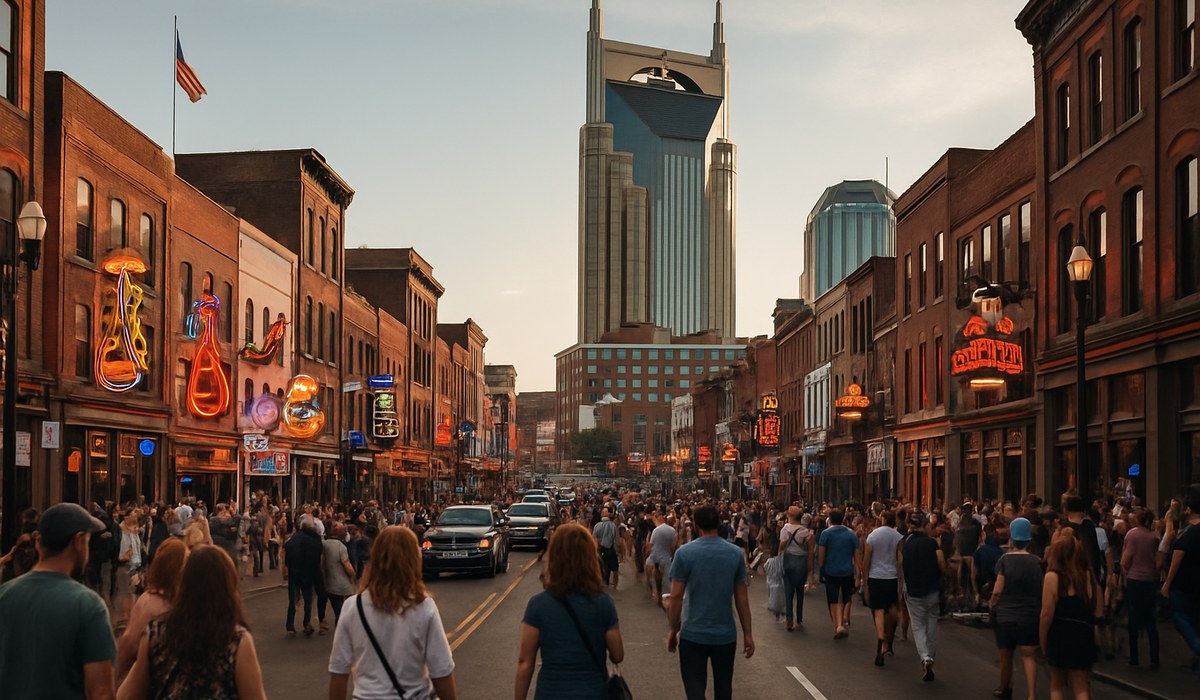
Image generated by AI
Quick Summary • Nashville's music tourism blueprint spreads to European capitals, with London, Berlin, and Amsterdam launching dedicated country music venues and festivals in 2026 • Trans-Atlantic travel between Nashville and European cities increases 34% year-over-year as bilateral cultural exchange accelerates • Music tourism now generates $17.2 billion annually across monitored markets, with Nashville capturing 18% of that total • European destination marketing organizations study Nashville's model as replicable framework for cultural tourism development
While Taylor Swift sells out stadiums worldwide, a quieter revolution is unfolding: Nashville has become the unexpected blueprint for cultural tourism, with European cities racing to replicate its music-driven economic model. The Tennessee capital's success in converting musical heritage into billion-dollar visitor spending has triggered what tourism analysts now call the "Nashville Effect"—a systematic approach to building destination brands around authentic cultural assets.
Travel Nashville leads this transformation not through passive popularity but through a deliberate infrastructure that combines performance venues, recording studios, museums, and hospitality. This formula has captured international attention as destinations worldwide seek post-pandemic recovery strategies.
Nashville's Music Tourism Model Goes Global
The mechanics behind Nashville's tourism dominance reveal why the model travels well. Broadway's honky-tonk row generates approximately $2.1 million in daily visitor spending during peak season, according to Metropolitan Nashville Tourism Department data released in March 2026. That concentrated commercial success stems from venue density—47 live music locations within a four-block radius—creating guaranteed entertainment regardless of arrival time.
European cities have taken notice. London's Wembley district opened a 12-venue "Nashville Quarter" in February 2026, complete with Southern-style bars and nightly songwriter rounds. Berlin's Friedrichshain neighborhood launched a similar complex featuring seven live music venues, recording studios, and a 300-room hotel themed around country music aesthetics. Amsterdam, Copenhagen, and Dublin have announced comparable projects scheduled for 2026-2027 completion.
The replication extends beyond physical infrastructure. Nashville's songwriter-in-the-round format—where musicians perform acoustically while explaining song origins—now appears in 23 European cities. The Grand Ole Opry has licensed its format to venues in Manchester and Munich, creating standardized country music experiences that drive tourism through predictability.
Industry executives gathering at global hospitality leaders gathering at IHIF Berlin in May 2026 identified Nashville's model as the decade's most influential destination development strategy. "What Nashville achieved was monetizing authenticity at scale," noted Sarah Hendricks, European Tourism Board director, during a March panel discussion. "They proved cultural tourism could drive year-round visitation and premium spending."
Europe's Country Music Explosion Drives Trans-Atlantic Travel
The European country music scene has evolved from niche curiosity to mainstream force, fundamentally altering travel patterns. Streaming data from Spotify shows country music listenership in Western Europe increased 127% between 2023 and 2026, with Germany, United Kingdom, and Netherlands leading adoption rates. That digital consumption translates directly into physical travel.
International visitor arrivals to Nashville reached 3.8 million in 2025, with European nationals comprising 31% of overseas visitors—up from 19% in 2022. Lufthansa launched direct Frankfurt-Nashville service in January 2026, followed by British Airways adding twice-weekly London-Nashville flights in March. Both routes achieved 89% average load factors in their first two months, prompting additional capacity announcements.
The travel flow works bidirectionally. American country music fans increasingly visit European festivals that feature both local and imported Nashville acts. The Country to Country festival, which runs simultaneously in London, Glasgow, and Dublin each March, attracted 78,000 attendees in 2026—42% from outside the United Kingdom and Ireland. Germany's Country Nights festival in Geiselwind drew 120,000 visitors in 2025, with post-event surveys indicating 38% traveled more than 500 kilometers to attend.
This bilateral exchange mirrors patterns observed in event tourism's economic multiplier effect, where concentrated cultural events generate disproportionate economic returns through extended stays and ancillary spending.
Currency flow illustrates the economic significance. The U.S. Travel Association estimates European country music enthusiasts spent $487 million in Nashville during 2025, while American travelers attending European country music events contributed €312 million to host economies. These figures exclude transportation costs, focusing solely on in-destination spending across accommodation, food, merchandise, and entertainment.
Economic Impact: When Culture Becomes Currency
Nashville's tourism economics provide concrete metrics for cities evaluating similar strategies. Visitor spending in Nashville reached $11.3 billion in 2025, supporting 89,000 direct employment positions, according to World Travel & Tourism Council research on music tourism's economic contributions. Music-related activities account for 67% of that spending, with non-resident visitors staying an average 3.2 nights and spending $312 per person daily.
The employment multiplier proves particularly compelling for European cities facing service sector recovery challenges. Nashville's music tourism supports roles across venue operations, sound engineering, hospitality, transportation, retail, and creative services. The Metropolitan Nashville Economic Development Department calculated that each new music venue creates 47 direct jobs and 83 indirect positions through supply chain effects.
European implementations show early promise. London's Nashville Quarter generated 840 jobs in its first operational quarter, while Berlin's country music district created 620 positions. Both projects exceeded employment projections by 18-22%, driven by higher-than-expected visitor frequency and spending patterns.
The UN World Tourism Organization statistics contextualize Nashville's achievement within global cultural tourism growth. Cultural and creative tourism grew 8.2% annually between 2020-2025, outpacing general tourism's 5.7% growth rate. Music tourism specifically expanded 11.4% annually, representing the fastest-growing cultural tourism segment.
Tax revenue provides government perspective. Nashville's tourism-generated tax collections reached $712 million in fiscal 2025, funding infrastructure improvements, public services, and cultural programming. European cities implementing similar models anticipate comparable returns—London's Nashville Quarter projects £45 million in annual tax generation once fully operational, while Berlin estimates €38 million in tourism-related tax revenue from its country music district.
What Nashville's Success Means for Destination Marketing
Destination marketing organizations worldwide are dissecting Nashville's success for replicable elements. The Visit Nashville strategy emphasizes three pillars: authentic cultural product, concentrated venue geography, and year-round programming. This framework challenges traditional tourism marketing focused on heritage sites and seasonal attractions.
The authenticity requirement proves most difficult to replicate. Nashville's country music credentials stem from 95 years of continuous industry presence, established recording infrastructure, and genuine creative community. Cities attempting similar models without underlying cultural foundation risk creating artificial districts that fail to generate repeat visitation.
Geography matters intensely. Nashville's downtown music concentration allows visitors to experience multiple venues through walking, creating spontaneous discoveries that enhance perceived value. European implementations deliberately cluster venues within 600-meter radii, mimicking Nashville's walkable entertainment density. This geographic strategy contrasts with scattered venue approaches that require transportation between locations, reducing visitor engagement.
Year-round programming addresses seasonality, tourism's persistent challenge. Nashville maintains consistent music offerings across all months, eliminating visitor uncertainty about entertainment availability. The Grand Ole Opry operates 52 weeks annually with shows Tuesday, Friday, and Saturday. Honky-tonk venues on Broadway maintain seven-day operations with 4-6 daily performance blocks.
Industry analysts at travel industry intelligence platforms identify Nashville's model as particularly relevant for secondary cities seeking differentiation. Primary tourism capitals like Paris, Rome, and Tokyo already possess diverse visitor motivations. Secondary cities need focused positioning—exactly what Nashville achieved through music specialization.
The model also applies beyond music. Prague's recent success with cultural tourism initiatives like Prague's literary tours demonstrates how specialized cultural programming can drive destination development. Whether through music, literature, film, or visual arts, the Nashville framework of authentic cultural assets plus concentrated geography plus consistent programming appears broadly applicable.
Marketing technology adoption accelerates replication. Nashville's tourism bureau pioneered real-time music calendars, artist discovery apps, and venue capacity tracking that reduce visitor friction. European destinations implement similar digital infrastructure, recognizing that cultural tourism requires information immediacy that traditional destination marketing materials cannot provide.
Implications for Global Travel Patterns
The Nashville phenomenon signals broader shifts in what motivates travel decisions. Experiential tourism—travel focused on participating in destination culture rather than observing monuments—now influences 64% of international leisure travel planning, according to Amadeus global traveler research conducted in late 2025. Music tourism represents experiential travel's most measurable segment.
This shift challenges destinations heavily invested in heritage tourism infrastructure. Museums and historical sites remain important but no longer sufficient for competitive destination positioning. Travelers increasingly seek interactive cultural engagement—performing, creating, learning, or deeply experiencing rather than passively viewing.
The economic implications extend to aviation, accommodation, and tour operations. Direct air service between previously unconnected cities becomes viable when specific cultural tourism demand reaches critical mass. Nashville's European flight additions demonstrate this dynamic, as do specialized tour operators now offering week-long "Nashville Experience" packages from European origination points.
Accommodation sectors adapt accordingly. Nashville's hotel market shifted toward properties emphasizing music themes, in-room recording equipment, and partnerships with local venues. European hotels in country music districts adopt similar strategies, recognizing that generic business hotels fail to capture cultural tourism premiums.
The democratization of cultural tourism creation represents perhaps the most significant implication. Nashville proved that destinations need not possess centuries-old monuments or UNESCO heritage sites to generate substantial tourism revenue. Authentic, living culture—properly packaged, concentrated, and marketed—can drive comparable economic results.
FAQ: Nashville and the Future of Music Tourism
How much do international tourists spend when visiting Nashville for music tourism?
European visitors to Nashville spend an average $312 daily excluding accommodation, with total trip expenditure averaging $1,847 per person for typical 3.2-night stays. This exceeds general U.S. tourism spending averages by 43%, driven by premium-priced music experiences, merchandise, and dining.
Which European cities are successfully replicating Nashville's music tourism model?
London, Berlin, and Amsterdam show the strongest early implementation results, with dedicated music districts generating projected first-year revenue of £87 million, €64 million, and €52 million respectively. Manchester, Dublin, Copenhagen, and Munich have announced similar projects for 2026-2027 launches with combined investment exceeding €380 million.
Why has country music specifically expanded in European markets?
Streaming accessibility, crossover collaborations with European artists, and narrative-driven songwriting that translates across cultures have fueled growth. Additionally, country music's association with American authenticity creates tourism motivation—visitors seek "genuine" experiences that country music venues promise to deliver.
Can smaller cities replicate Nashville's music tourism success?
Scale-appropriate implementation is possible but requires authentic local music culture, minimum critical mass of venues (tourism consultants suggest 8-12 within walkable area), and sustained programming commitment. Secondary cities like Chattanooga and Raleigh show promising results with focused music tourism strategies generating $140-190 million annual visitor spending.
What economic return can cities expect from music tourism infrastructure investment?
Nashville achieves approximately $8.20 in visitor spending for every dollar invested in music tourism infrastructure over 10-year periods. European implementations anticipate 6.5:1 to 7.2:1 ratios based on higher construction costs but comparable visitor spending patterns. Break-even typically occurs within 4-6 years of district launch.
Related Articles:
Disclaimer
This article is for informational and educational purposes only. It does not constitute legal, financial, or professional advice. While we strive to provide accurate and up-to-date information, travel policies, regulations, and conditions change rapidly. Always verify information with official sources before making travel decisions. Nomad Lawyer makes no representations about the accuracy, reliability, completeness, or suitability of the information provided. Readers should consult qualified professionals for advice specific to their circumstances. The views expressed in this article are those of the author and do not necessarily reflect the views of Nomad Lawyer.
Kunal K Choudhary
Co-Founder & Contributor
A passionate traveller and tech enthusiast. Kunal contributes to the vision and growth of Nomad Lawyer, bringing fresh perspectives and driving the community forward.
Learn more about our team →