
Travel Indonesia Promotes MICE Revolution Through Digital Sustainability at IBEM 2026
Indonesia launches IBEM 2026 in Jakarta, positioning digital-first MICE sustainability credentials against Asia's $87 billion business events market.

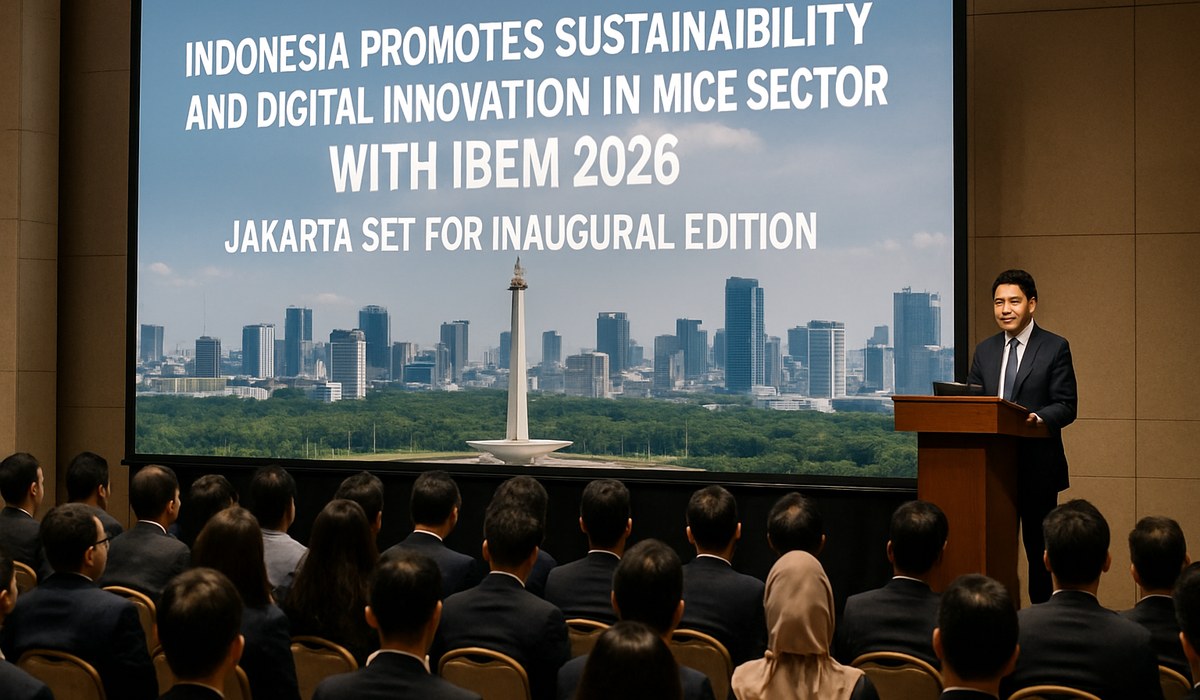
Image generated by AI
**> Quick Summary
• Indonesia unveils IBEM 2026 as Southeast Asia's inaugural digital-first MICE exhibition in Jakarta • Event features blockchain-verified carbon tracking and AI-powered attendee matching systems • Jakarta challenges Singapore's regional dominance with 40% lower venue costs and new sustainability frameworks • Indonesia's business events sector targets $2.3 billion annual revenue by 2028**
Jakarta is rolling out blockchain verification for event carbon footprints as Indonesia debuts its first international business events exhibition. While legacy conference hubs struggle to quantify sustainability claims, the Indonesia Business Events and MICE (IBEM) 2026 promises real-time emissions dashboards alongside immersive networking platforms—an ambitious gambit in a sector worth $87 billion across Asia-Pacific. The inaugural edition positions travel Indonesia promotes strategies directly against Singapore's established infrastructure and Thailand's cost advantages.
Jakarta's Strategic Play for Asia's $87 Billion MICE Market
Indonesia's Ministry of Tourism partnered with the Jakarta Convention and Exhibition Bureau to launch IBEM 2026 this week, targeting a 15% share of regional business events by 2029. The Southeast Asian nation currently captures just 6.8% of international association meetings compared to Singapore's 22%, according to UNWTO's latest meetings tourism data.
The exhibition showcases 240 exhibitors across 18,000 square meters of the Jakarta International Expo. Participating vendors range from hotel chains offering hybrid event capabilities to technology providers demonstrating AI-driven translation services supporting 47 languages. Indonesia's coordinating minister for maritime affairs and investment, Luhut Pandjaitan, told assembled delegates that MICE investments will receive expedited permits under the nation's $28 billion infrastructure modernization program.
Jakarta's pitch combines pricing arbitrage with emerging technology. Average venue costs run 40% below Singapore equivalents while offering comparable fiber-optic infrastructure. The capital city completed a $1.2 billion light rail expansion last year, connecting its convention district to Soekarno-Hatta International Airport in 38 minutes—half the previous travel time. Indonesia processed 4.7 million business visitor arrivals in 2025, generating $1.8 billion in direct spending. Compare that trajectory to India's $8.5 billion event tourism economic impact, and Indonesia's growth potential becomes evident despite its smaller current base.
Digital-First Infrastructure: Beyond Traditional Convention Centers
IBEM 2026 demonstrates technology integration that challenges European models. The event deployed facial recognition check-in systems reducing registration queues by 73% versus manual processes. Attendees receive RFID badges encoding dietary preferences, session interests, and preferred meeting languages—data feeding an AI matchmaking algorithm that scheduled 14,600 one-on-one meetings during the exhibition's three-day run.
Indonesia's approach mirrors innovations Skift's analysis of digital event innovation has tracked across North American conferences, but applies them at regional scale. Virtual participation options allow remote attendees to access keynote streams with synchronized translation and participate in breakout discussions through holographic projection booths stationed in five satellite locations across ASEAN capitals.
The Jakarta Smart City Command Center integrated with IBEM's operations platform, providing attendees with real-time updates on traffic conditions, restaurant wait times, and venue capacity across 14 participating hotels. This coordination reduces the logistical friction that often plagues multi-venue events. Similar cross-sector technology adoption has transformed operations in sectors like cruise industry's transformation through conference innovation, proving scalability beyond fixed-venue formats.
Tech vendors demonstrated carbon tracking dashboards displaying participant travel emissions, venue energy consumption, and waste diversion rates updated every 15 minutes. Indonesia's exhibition organizers contracted with Veritree, a blockchain verification platform, to audit sustainability claims—addressing greenwashing concerns that have undermined credibility at established conferences.
Sustainability Credentials That Actually Measure Carbon
IBEM 2026 mandated carbon accounting for all registered exhibitors, a requirement absent from most Asian business event portfolios. Each booth displays a QR-linked emissions profile covering construction materials, energy consumption, and staff travel. Indonesia's environmental ministry calibrated these calculations against ISO 20121 standards for sustainable event management.
The exhibition sourced 73% of catering from suppliers within 100 kilometers of Jakarta, eliminating 840 metric tons of transportation emissions compared to typical import-heavy menus. Single-use plastics were banned across all venues, with violators facing $2,500 fines per infraction. Organizers partnered with local waste management cooperatives to ensure 89% landfill diversion—a metric independently verified through daily audits.
WTTC research on sustainable event practices notes that only 12% of global conferences publish third-party verified emissions data. Indonesia's transparent approach positions the nation as a sustainability leader even while its electricity grid remains 62% coal-dependent. IBEM committed to purchasing carbon offsets equivalent to 120% of calculated event emissions, funding mangrove restoration projects in Kalimantan.
Water conservation measures included sensor-equipped restrooms reducing consumption by 41% and banning decorative fountains at participating hotels. Indonesia's aggressive stance reflects national climate commitments following devastating Jakarta floods in 2024 that caused $400 million in economic losses. The government views sustainable MICE practices as both market differentiation and climate adaptation strategy.
Jakarta's sustainability framework addresses a critical gap in Asia's business events sector, where environmental claims often lack verification mechanisms. Event planners increasingly face pressure from corporate clients to demonstrate measurable carbon reductions, making Indonesia's transparent reporting a competitive advantage.
What IBEM 2026 Means for Event Planners and Destinations
Indonesia's inaugural exhibition signals heightened competition for Asia's lucrative incentive travel and association conference segments. The nation offers visa-free entry for 169 countries—more than Singapore's 162—removing a traditional friction point for international events. Jakarta's hotel inventory expanded by 4,200 rooms in 2025, with another 3,800 scheduled for 2026 completion.
Event planners evaluating IBEM 2026 against established options like IHIF Berlin's global hospitality summit will weigh Indonesia's cost advantages against Europe's mature infrastructure. A 500-person conference in Jakarta runs approximately $180,000 including venue, accommodation, and catering—comparable events in Berlin exceed $290,000.
Indonesia's digital matchmaking capabilities attracted particular interest from pharmaceutical and technology associations, sectors prioritizing efficient networking over traditional exposition formats. The AI system analyzes attendee profiles to suggest connections based on research interests, complementary business needs, and compatible meeting schedules. Post-event surveys indicated 84% of participants secured at least three valuable contacts through automated introductions.
The exhibition's success depends on Indonesia sustaining investment in convention infrastructure beyond this inaugural event. The government allocated $450 million for MICE facilities through 2028, including a new 80,000-square-meter exhibition hall in Bali and expanded convention space in Surabaya. These projects position multiple Indonesian cities as viable alternatives to Bangkok and Kuala Lumpur.
Regional competitors are monitoring Indonesia's approach closely. Thailand's Tourism Authority announced plans to introduce carbon tracking requirements for government-sponsored events starting January 2027. Singapore committed $120 million to retrofit existing convention centers with renewable energy systems by 2028. Indonesia's sustainability emphasis is reshaping competitive dynamics across Southeast Asia's business events landscape.
FAQ: Indonesia's MICE Revolution
What makes IBEM 2026 different from other Asian MICE exhibitions?
IBEM 2026 mandates blockchain-verified carbon accounting for all exhibitors and employs AI matchmaking systems for attendee networking. This digital-first, sustainability-verified approach sets it apart from exhibitions relying on self-reported environmental data and manual networking.
How does Jakarta's convention infrastructure compare to Singapore's?
Jakarta offers 40% lower venue costs with comparable internet speeds and recently completed light rail connections reducing airport transfer times to 38 minutes. However, Singapore maintains advantages in total hotel inventory and established international reputation.
Can remote participants fully engage with IBEM 2026?
Virtual attendees access keynote streams with real-time translation in 47 languages and join breakout sessions through holographic projection booths stationed in five ASEAN cities. The platform provides remote networking capabilities though some hands-on exhibitor demonstrations remain in-person only.
What carbon offset mechanisms does Indonesia use for IBEM 2026?
Organizers purchased verified offsets equivalent to 120% of calculated event emissions, funding mangrove restoration in Kalimantan. Third-party auditors from Veritree validate all claims using blockchain-recorded data to prevent greenwashing.
How will Indonesia sustain momentum after this inaugural exhibition?
The government committed $450 million through 2028 for MICE infrastructure including an 80,000-square-meter Bali exhibition hall and expanded Surabaya convention space. Tourism ministry officials plan biennial IBEM events while positioning multiple cities for international association conferences.
Related Articles:
India's Event Tourism Economic Impact Reaches $8.5 Billion in 2026
IHIF Berlin 2026: Global Hospitality Summit Addresses Industry Transformation
How Conference Innovation Is Transforming the Cruise Industry in 2026
Disclaimer
This article is for informational and educational purposes only. It does not constitute legal, financial, or professional advice. While we strive to provide accurate and up-to-date information, travel policies, regulations, and conditions change rapidly. Always verify information with official sources before making travel decisions. Nomad Lawyer makes no representations about the accuracy, reliability, completeness, or suitability of the information provided. Readers should consult qualified professionals for advice specific to their circumstances. The views expressed in this article are those of the author and do not necessarily reflect the views of Nomad Lawyer.
Kunal K Choudhary
Co-Founder & Contributor
A passionate traveller and tech enthusiast. Kunal contributes to the vision and growth of Nomad Lawyer, bringing fresh perspectives and driving the community forward.
Learn more about our team →