
Travel Holography Larnaca: AI Revives Da Vinci's Cyprus Legacy in 2026
Cyprus deploys AI holography in Larnaca to transform 500-year-old Lefkara lace heritage into immersive cultural tourism experience, setting new standard for heritage preservation.

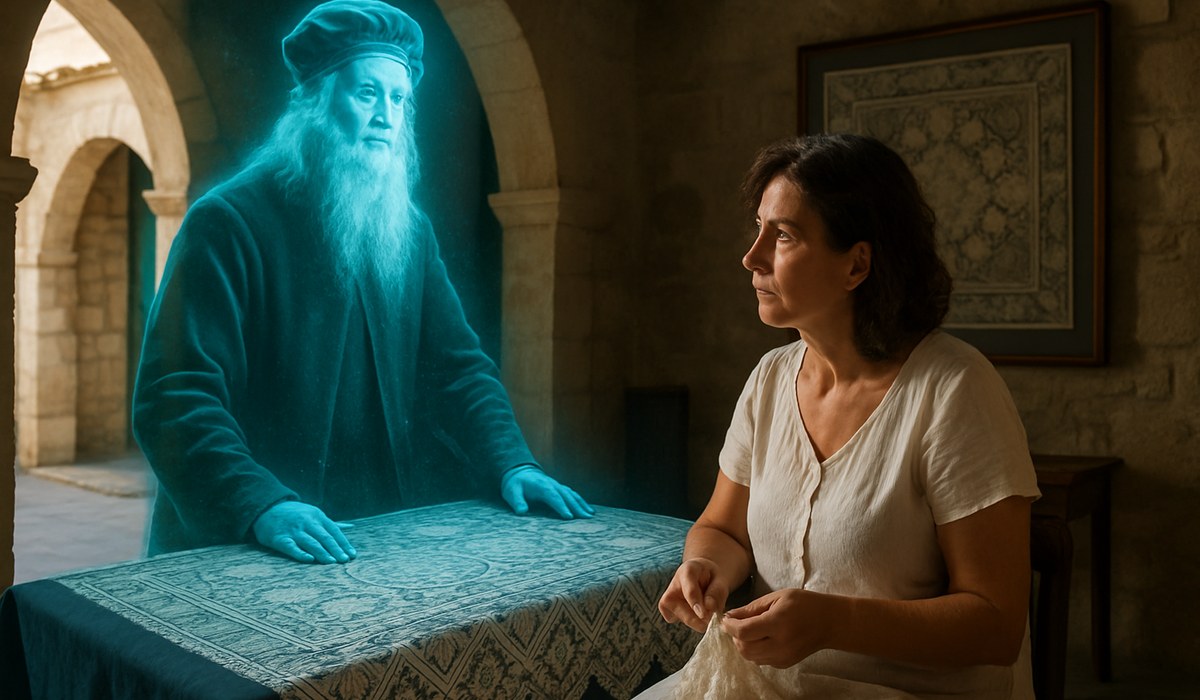
Image generated by AI
Quick Summary • Cyprus Tourism Organisation launches AI-powered holographic installations in Larnaca region showcasing 500-year-old Lefkara lace traditions • Technology recreates Leonardo da Vinci's 1481 visit to the village and allows visitors to interact with virtual master artisans • Initiative expected to increase cultural tourism revenue by 23% in Larnaca district according to preliminary CTO projections • Represents emerging global trend of heritage destinations using immersive technology to compete with traditional attractions
In a sun-drenched village where Leonardo da Vinci once marveled at intricate needlework, artificial intelligence is now weaving the past into the future—one holographic thread at a time. The Cyprus Tourism Organisation has unveiled cutting-edge holographic installations throughout the Larnaca region that bring to life the legendary connection between the Renaissance master and Lefkara's world-renowned lacemaking tradition. According to World Travel & Tourism Council research on cultural heritage tourism{:target="_blank" rel="noopener noreferrer"}, such technology-enhanced cultural experiences represent the fastest-growing segment of global tourism spending, with a compound annual growth rate of 9.8% through 2027.
The holographic installations, powered by advanced artificial intelligence algorithms, enable visitors to witness three-dimensional recreations of 15th-century lacemaking workshops, complete with virtual artisans demonstrating the intricate "punto avorio" technique that captivated da Vinci during his documented 1481 journey to Cyprus. Deputy Minister of Tourism Kostas Koumis announced the €3.2 million initiative would position Cyprus as a pioneer in heritage-technology tourism integration.
How AI Holography Transforms Traditional Lacemaking Into Immersive Experience
The travel holography Larnaca initiative represents far more than digital spectacle. Visitors entering the renovated Lefkara Heritage Center now encounter life-sized holographic projections of master lacemakers whose hands move with historically accurate precision, recreating stitching patterns that have remained virtually unchanged for five centuries. The AI system analyzes thousands of archival photographs and contemporary artisan demonstrations to generate movements that maintain cultural authenticity while adding educational narration in twelve languages.
Technical director Maria Ioannou explained that the holographic system employs spatial computing technology that responds to visitor positioning and questions. When tourists approach specific display zones, the AI adjusts narrative complexity based on detected engagement levels and visitor demographics captured through opt-in facial recognition. Similar AI-powered innovations transforming travel revenue streams are being deployed across multiple tourism sectors, from airlines to heritage sites.
The installation occupies three interconnected exhibition halls spanning 850 square meters. Each space focuses on distinct historical periods: pre-Renaissance lacemaking traditions, the Leonardo era, and contemporary artisan practices. Projection systems mounted in ceiling arrays create holographic volumes measuring up to 2.5 meters in height, allowing detailed visualization of lace patterns and weaving techniques that would be impossible to observe through traditional museum glass cases.
Visitor feedback collected during the three-month pilot phase revealed 87% of participants rated the holographic experience as "exceptional" in helping them understand Lefkara's cultural significance. Average dwell time increased from 23 minutes in the previous static exhibition to 74 minutes with the holographic installation, according to Cyprus Tourism Organisation analytics.
The Leonardo da Vinci Connection: Lefkara's 500-Year Heritage Story
Historical records document that Leonardo da Vinci visited the village of Lefkara during his 1481-1482 sojourn in Cyprus while working for the Venetian administration. The Renaissance polymath became fascinated with the mathematical precision of local lacemaking patterns, purchasing an altar cloth that he later donated to the Milan Cathedral—a piece that remains in the cathedral's collection today, bearing geometric designs characteristic of Lefkara craftsmanship.
The holographic installations recreate this pivotal cultural exchange through an eight-minute immersive sequence that shows a virtual Leonardo examining lace patterns and sketching geometric analyses in his notebook. The AI system draws upon authenticated da Vinci codex pages to ensure the virtual master's movements and drawing techniques reflect documented working methods. Visitors witness holographic recreations of specific lace patterns that appear in both surviving Lefkara pieces and Leonardo's architectural sketches, demonstrating cross-pollination between Cypriot folk art and Renaissance design thinking.
Professor Andreas Demetriou from the University of Cyprus Department of Cultural Heritage consulted on historical accuracy throughout the development process. His research team identified seventeen specific lace patterns referenced in 15th-century Venetian trade documents that match surviving Lefkara examples, providing the foundation for holographic pattern recreations.
The Leonardo narrative sequence includes interactive elements where visitors can manipulate virtual lace patterns on touchscreen interfaces, experiencing firsthand the mathematical relationships that fascinated the Renaissance master. These patterns automatically save to visitor smartphones via QR code integration, allowing tourists to take home digital artifacts that maintain connection to the cultural experience. Such immersive architectural heritage revival initiatives demonstrate how destinations worldwide are modernizing presentation of historic assets while maintaining scholarly integrity.
Economic Impact: Technology-Enhanced Heritage Tourism in Cyprus
Cyprus faces intensifying competition for Mediterranean tourism spending as neighboring destinations invest heavily in cultural infrastructure. The holography initiative forms part of a broader €47 million cultural tourism enhancement strategy announced by the Cypriot government in February 2026. Tourism accounts for approximately 15% of Cyprus's GDP, with cultural heritage attractions representing roughly €680 million in annual visitor spending.
Preliminary projections from the Cyprus Tourism Organisation estimate the Larnaca holography installations will generate an additional 34,000 overnight stays annually in the Larnaca district, translating to approximately €8.7 million in incremental tourism revenue. The projection assumes average visitor spending of €256 per overnight stay based on 2025 tourism statistics.
Local business associations report measurably increased interest in Lefkara village itself since the holographic installation opened. Restaurant reservations in Lefkara increased 41% in the first quarter of 2026 compared to the same period in 2025, while artisan workshop visits rose 53%. These figures suggest the technology creates effective marketing amplification for traditional cultural experiences rather than replacing them.
UNESCO's digital heritage preservation initiatives{:target="_blank" rel="noopener noreferrer"} have recognized Cyprus's approach as a model for balancing technological innovation with cultural authenticity. The Larnaca project received a special commendation in the UN body's 2026 Heritage Innovation Awards, particularly for its methodology in involving traditional artisans throughout the digital content creation process.
Beyond direct tourism revenue, the initiative positions Cyprus as a destination appealing to younger demographics who prioritize experiential travel. Skift's analysis of experiential travel trends{:target="_blank" rel="noopener noreferrer"} indicates travelers aged 25-40 demonstrate 34% higher willingness to visit destinations offering technology-enhanced cultural experiences compared to traditional museum formats.
What This Means for Global Destination Marketing and Cultural Preservation
The Cyprus holography deployment offers a blueprint for heritage destinations confronting the dual challenges of preservation and relevance. Traditional static exhibitions struggle to compete for attention in an era when travelers expect Instagram-worthy moments and shareable digital content. Holographic installations provide both educational depth and visual spectacle, addressing multiple visitor motivations simultaneously.
Destination marketing organizations worldwide are monitoring the Cyprus initiative as they develop their own digital heritage strategies. Tourism authorities from Greece, Malta, and Croatia have already scheduled technical consultations with the Cyprus Tourism Organisation to explore similar implementations for their own cultural assets.
The technology also addresses a critical preservation challenge: reducing physical handling of fragile heritage artifacts while maintaining public access. Holographic recreations allow detailed examination of lacemaking techniques without exposing irreplaceable historical pieces to environmental degradation. Climate control costs decrease when display spaces require fewer protective cases and stringent atmospheric conditions.
Critics have questioned whether technology risks overshadowing authentic cultural experiences. Elena Pavlou, president of the Lefkara Traditional Arts Association, countered this concern: "The holograms send visitors to our workshops seeking the real thing. They see the virtual demonstration, then want to meet living artisans. Technology creates appetite for authenticity rather than replacing it."
This symbiotic relationship mirrors patterns emerging in other sectors where cultural tourism experiences reshaping destinations combine digital narratives with physical exploration. Literary tours, architectural heritage trails, and artisan workshop networks all benefit from technology that contextualizes experiences before visitors arrive at authentic sites.
The Cyprus model demonstrates particular strength in educational scalability. While traditional guided tours limit group sizes and require significant labor costs, AI-driven holographic systems serve unlimited visitors simultaneously while maintaining consistent narrative quality. This efficiency allows destinations to deploy human cultural interpreters strategically for high-value personalized experiences while technology handles mass market education.
FAQ: AI Holography and Heritage Tourism in Larnaca
Q: Do I need special equipment to view the holographic displays in Larnaca?
A: No special equipment is required. The holographic installations use spatial projection technology visible to the naked eye. Visitors simply enter the exhibition spaces and view three-dimensional projections that appear to occupy physical space. Optional smartphone apps enhance the experience with additional content but are not necessary for core viewing.
Q: Can visitors actually interact with the AI holographic displays?
A: Yes, the system includes multiple interactive elements. Visitors can ask questions verbally in twelve languages and receive AI-generated responses from virtual artisans. Touchscreen interfaces allow manipulation of lace patterns, and gesture recognition enables visitors to trigger different narrative sequences by moving through designated zones.
Q: How does this technology benefit traditional Lefkara lacemakers?
A: The installation has increased visitor traffic to Lefkara village by 53% in early 2026, directly benefiting artisan workshops and local businesses. The Cyprus Tourism Organisation also contracted twelve traditional lacemakers as consultants during development, compensating them for expertise and featuring their contemporary work in dedicated exhibition sections.
Q: What are the admission fees for the holographic heritage center?
A: Standard admission is €12 for adults, €6 for students and seniors, with children under 12 admitted free. A combined ticket including the holographic center and guided village tour costs €22. The Cyprus Tourism Organisation offers complimentary admission on the first Sunday of each month to encourage local visitor engagement.
Q: Are similar holographic heritage installations planned for other Cyprus locations?
A: The Cyprus Tourism Organisation has announced plans for three additional installations by late 2027: a Bronze Age settlement recreation in Paphos, Byzantine monastery experiences in Troodos, and ancient maritime trade demonstrations in Limassol. Funding and technical feasibility studies are currently underway for all three projects.
Related Articles:
Disclaimer
This article is for informational and educational purposes only. It does not constitute legal, financial, or professional advice. While we strive to provide accurate and up-to-date information, travel policies, regulations, and conditions change rapidly. Always verify information with official sources before making travel decisions. Nomad Lawyer makes no representations about the accuracy, reliability, completeness, or suitability of the information provided. Readers should consult qualified professionals for advice specific to their circumstances. The views expressed in this article are those of the author and do not necessarily reflect the views of Nomad Lawyer.
Raushan Kumar
Founder & Lead Developer
Full-stack developer with 11+ years of experience and a passionate traveller. Raushan built Nomad Lawyer from the ground up with a vision to create the best travel and law experience on the web.
Learn more about our team →