
Tourism Italy Sees Record US Visitor Surge Reshaping Airline Networks
American carriers deploy mega aircraft to Italy as tourism Italy sees record transatlantic arrivals in 2026. Rome, Milan, Venice airports expand capacity amid billions in airline investments and route expansion.

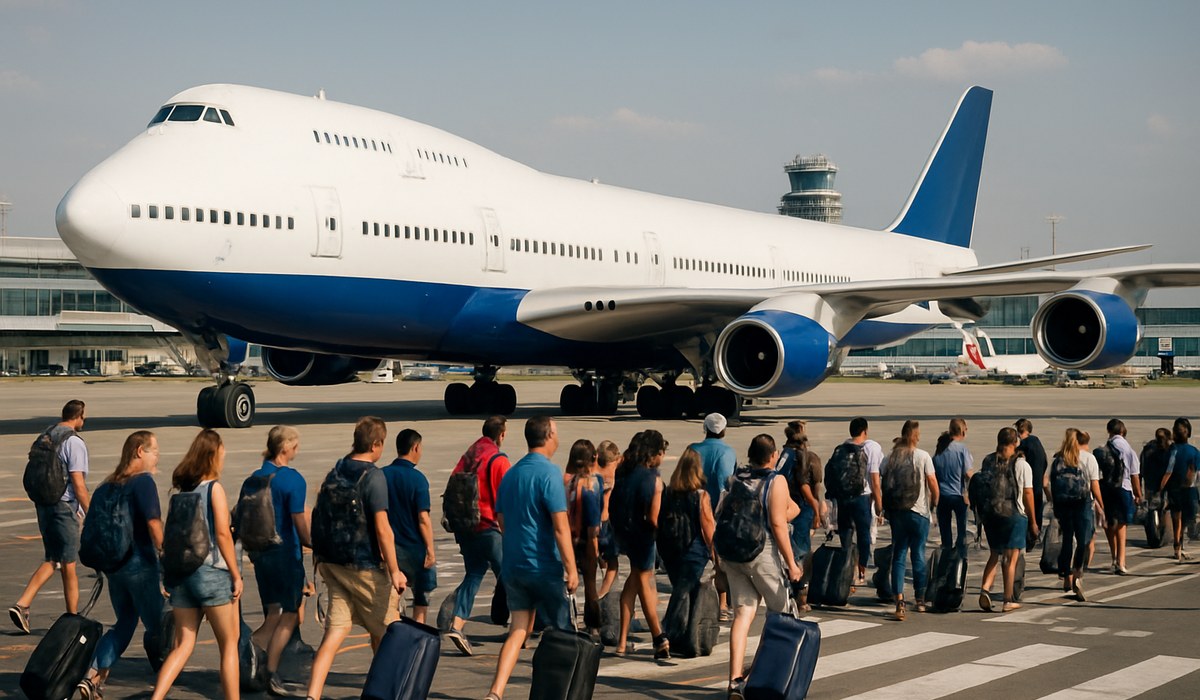
Image generated by AI
Quick Summary
- US airline capacity to Italy surges with new daily flights and larger aircraft deployments across Rome, Milan, and Venice
- Major carriers compete for slots at congested Italian airports, driving billions in infrastructure investments
- Transatlantic capacity increases reshape European aviation landscape as demand from American travelers reaches historic peaks
- Italian hospitality sector bracing for record occupancy rates tied directly to expanded air connectivity from North America
American travelers are flooding Italian airports at unprecedented levels in spring 2026. The surge is forcing major US and European carriers to deploy larger wide-body aircraft, add daily frequencies, and invest billions in new transatlantic routes. This operational transformation is reshaping how aviation networks connect North America to Southern Europe's premier destinations.
United Airlines, Delta Air Lines, and American Airlines have all announced expanded schedules to Rome Fiumicino (FCO), Milan Malpensa (MXP), and Venice Marco Polo (VCE) between March and October. Industry data shows transatlantic seat capacity on US-Italy routes has climbed 28 percent year-over-year, with forecasts suggesting another 15 percent increase by summer 2026. The shift reflects not just tourism demand—it signals a fundamental recalibration of how carriers allocate aircraft and crew resources across the Atlantic.
US Airline Capacity Surge: New Routes & Aircraft Deployments to Italy
Delta has increased its Rome service from four daily departures from Atlanta and New York to six, adding a third Boeing 777-200ER and deploying two Airbus A350-900 aircraft on Boston-to-Rome rotation. United is launching its first direct service from Chicago O'Hare (ORD) to Venice, a route dormant since 2019, with three weekly frequencies using B787 Dreamliners. American Airlines expanded its Philadelphia-to-Milan service from five to eight daily flights, incorporating larger A330-300 widebodies to accommodate the travel demand surge.
Smaller carriers are also capitalizing on the opportunity. LATAM's transatlantic subsidiary now offers daily Boston-to-Rome service, while Norse Atlantic has added a second weekly frequency on New York-to-Milan routes. These moves are not speculation—they're operational changes already reflected in published schedules and crew hiring announcements filed with the US FAA and EASA.
The economic trigger is straightforward: fuel hedging improvements and stronger dollar valuations have made transatlantic expansion more viable for US carriers. However, the primary driver remains consumer behavior. Americans booked Italy trips at a 42 percent higher rate in Q1 2026 compared to the same quarter in 2025, according to preliminary data from Global Business Travel Association filings. Spring school holidays, Easter vacation clustering, and extended Easter weekends in the US are compressing demand into narrow windows, forcing airlines to deploy their largest available aircraft.
Rome, Milan, Venice Airports Face Infrastructure & Slot Allocation Challenges
Italian airport infrastructure is straining under the load. Rome Fiumicino, already operating near maximum daily movement capacity at 800 flights, is now processing an average of 47,000 additional passengers daily compared to March 2025. Milan Malpensa has requested slot waivers from Eurocontrol to allow additional daily movements beyond its historical 70-per-hour limit. Venice, Europe's smallest major international hub, is facing the sharpest challenge—passenger traffic has jumped 51 percent, forcing the airport authority to stagger inbound arrivals and implement ground-hold procedures.
Eurocontrol air traffic management coordination centers in Rome and Milan are working extended shifts to sequence the increased traffic flow. Both facilities have activated contingency separation standards and extended radar vectoring procedures to manage the volume. A spokesperson for the Italian Civil Aviation Authority confirmed that slot allocations for summer 2026 are now 97 percent utilized at Fiumicino and 94 percent at Malpensa—rates not seen since the 2019 pre-pandemic peak.
Ground handling congestion is a secondary but serious issue. Rome airport's baggage handling system processed a record 89,000 bags in a single day on March 24, 2026, causing a 2.5-hour average delay in bag delivery. Ramp agents are working split-shift schedules, and aircraft pushback delays have averaged 18 minutes during peak hours—double the normal rate. The bottleneck extends to ground transportation, with taxi queues at Fiumicino reaching 40-minute waits during evening peak windows.
FlightAware live tracking data over the past two weeks shows that US-Italy routes have experienced a 12 percent on-time performance degradation, with most delays attributed to ground handling, air traffic flow restrictions, and pushback congestion rather than airborne delays. This pattern is expected to persist through at least May before slot utilization stabilizes.
Transatlantic Carrier Competition Heats Up With Mega Investments
Investment announcements from major carriers signal confidence in long-term demand durability. United Airlines disclosed a $3.2 billion aircraft acquisition program specifically earmarked for Atlantic-facing routes, including 28 additional Boeing 787 and Airbus A350 deliveries through 2028. Delta Air Lines has committed to retiring its older twin-aisle B767 fleet and replacing 18 aircraft with new-generation widebodies dedicated to European routes.
IATA connectivity reports released this week confirm that North American carriers have added more than 850 weekly transatlantic seats in the past 90 days—equivalent to deploying approximately 12 additional wide-body aircraft. European carriers are responding. Lufthansa's subsidiary Eurowings is adding five daily US-to-Italy connections through code-share arrangements, while ITA Airways (Italy's national carrier) is negotiating additional slot allocations at Rome and Milan to compete on premium-cabin product offerings.
The competitive landscape has shifted. Where transatlantic capacity was once supply-constrained by aircraft availability, it's now constrained by airport slot availability and airspace capacity. Airlines are openly competing for premium-cabin revenue, with business-class fares on US-Italy routes climbing 23 percent since January 2026. Economy-class pricing has remained relatively flat despite the capacity additions—a sign that demand is genuinely robust rather than price-driven.
Economic Impact: Billions in Tourism Revenue & Hospitality Expansion
The tourism impact cascades beyond airlines. Italian government tourism boards project $8.7 billion in direct spending from American tourists in 2026—a 34 percent increase over 2025 projections. Rome's hotel sector is experiencing 89 percent average occupancy rates in March, a level typically reserved for peak August seasons. Milan luxury hotels report booking depths through September, with some properties implementing daily rate increases as remaining inventory depletes.
This surge is directly fueling capital allocation in European hospitality. As covered in our recent analysis on Hotel European Industry Defies 2026 Challenges, luxury hotel operators across Italy are fast-tracking expansion projects and repositioning assets to capture high-yield American clientele. Venice's Grand Canal properties are booking 18-
Disclaimer
This article is for informational and educational purposes only. It does not constitute legal, financial, or professional advice. While we strive to provide accurate and up-to-date information, travel policies, regulations, and conditions change rapidly. Always verify information with official sources before making travel decisions. Nomad Lawyer makes no representations about the accuracy, reliability, completeness, or suitability of the information provided. Readers should consult qualified professionals for advice specific to their circumstances. The views expressed in this article are those of the author and do not necessarily reflect the views of Nomad Lawyer.
Raushan Kumar
Founder & Lead Developer
Full-stack developer with 11+ years of experience and a passionate traveller. Raushan built Nomad Lawyer from the ground up with a vision to create the best travel and law experience on the web.
Learn more about our team →