
Toronto Pearson Airport Chaos: 62 Cancellations and 200+ Delays Halt Canada-U.S. Travel Network
Toronto Pearson International Airport experienced severe operational collapse with 62 canceled flights and 200+ delays, affecting Jazz, Air Canada, Endeavor Air, Porter Airlines. Disruptions radiate across North America from New York to Miami, Washington to Vancouver.

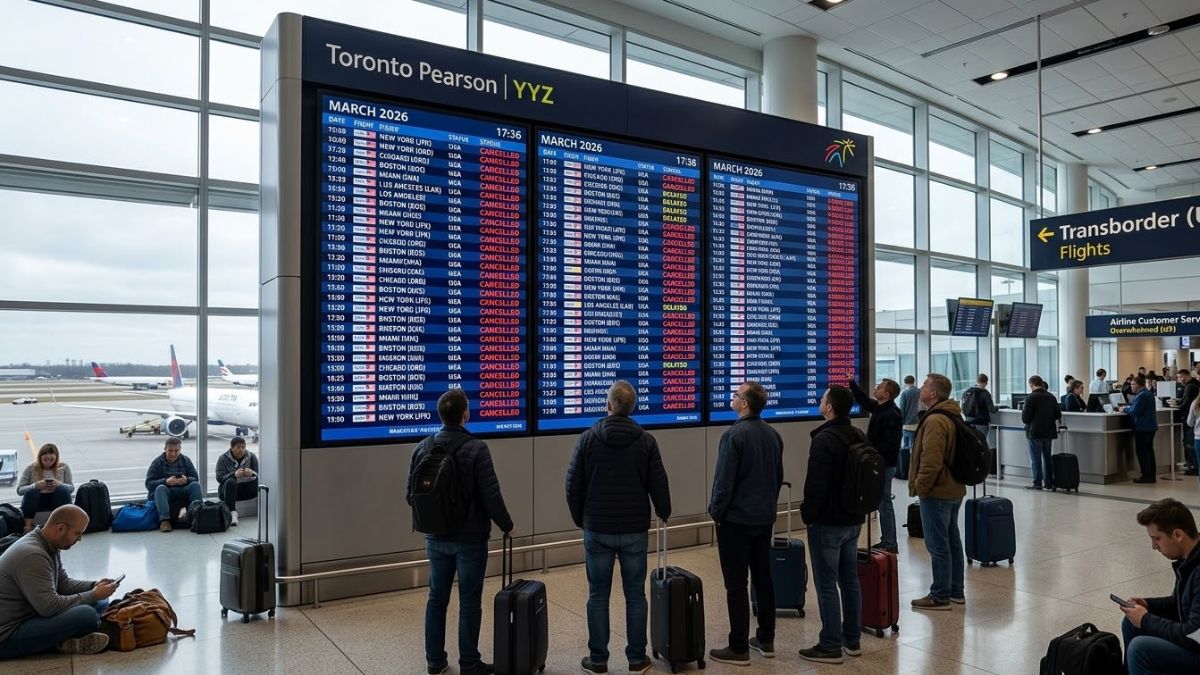
Image generated with AI
Quick Summary
- Toronto Pearson International Airport (YYZ) experienced catastrophic disruptions with 62 flights canceled and 200+ delayed affecting Canada-U.S. connectivity
- Primary carriers impacted: Jazz Air (ACA) 19 cancellations, Air Canada Rouge 13, Endeavor Air (DAL) 12, Air Canada 6, Porter Airlines 4, plus PSA, Republic, American Airlines
- Network-wide collapse: Disruptions cascading to 50+ North American airports from New York, Boston, Washington D.C., Miami, Orlando, Chicago, Los Angeles to Vancouver, Calgary, Montreal plus Caribbean and international destinations
- Root causes: Weather cascades, maintenance backlogs, air traffic control constraints at major hub — passengers advised to contact airlines immediately for rebooking via FlightAware
Toronto Pearson International Airport descended into unprecedented operational crisis, canceling 62 flights and delaying 200+ additional departures in a coordinated meltdown affecting Canada's primary international gateway. The disruption, emanating from the airline industry's single busiest hub in Canadian airspace, rippled across 50+ North American airports from coast to coast, effectively shutting down cross-border connectivity for thousands of travelers.
The cascade proved particularly brutal for regional carriers like Jazz Air (operating as Air Canada Express), which canceled 19 flights (representing nearly 30% operational disruption). Air Canada Rouge grounded 13 additional flights, while Endeavor Air (operating as Delta Connection) canceled 12 services despite smaller presence at YYZ.
The Scope of the Collapse: 262 Total Disruptions Across Toronto Pearson
The magnitude proved staggering. Toronto Pearson recorded 33 canceled flights (approximately 5% of all daily operations), establishing the airport as the central disruption hub. Yet the concurrent 200+ delays created a secondary crisis as flight sequences broke throughout the day, triggering cascade failures across the continental network.
The disruption pattern revealed systemic vulnerability rather than isolated aircraft failures. Multiple carriers simultaneously grounded flights, indicating weather-driven ATC delays, maintenance backlogs, or airport infrastructure constraints affecting the entire system equally.
Cancellation Breakdown: Which Carriers Hit Hardest
| Carrier | Canceled Flights | Delayed Flights | % Cancellation Rate |
|---|---|---|---|
| Jazz Air (ACA) | 19 | 23 | ~30% |
| Air Canada Rouge (ACA) | 13 | 13 | ~25% |
| Endeavor Air (DAL) | 12 | 3 | ~18% |
| Air Canada | 6 | 63 | ~9% |
| Porter Airlines | 4 | 22 | ~20% |
| PSA Airlines (AAL) | 4 | 3 | ~15% |
| Republic Airways | 2 | 10 | ~12% |
| American Airlines | 1 | 4 | ~5% |
Jazz Air's 19 cancellations represent the most catastrophic single-carrier impact, reflecting Air Canada Express's role as primary feeder for mainline connectivity at YYZ. The regional carrier's near-30% operational collapse suggests aircraft maintenance issues or crew scheduling cascades compounded by upstream weather.
Air Canada Rouge's 13 cancellations proved equally devastating for Air Canada's leisure-focused subsidiary, particularly disrupting Caribbean and warm-weather destination routes.
Network Ripple Effects: From Atlantic to Pacific
Toronto Pearson's disruption didn't remain localized. Flights bound for 50+ North American destinations experienced secondary disruptions as YYZ's operational failure cascaded downstream:
Canadian Destinations Hit
- Vancouver (YVR) — multiple delayed connections
- Calgary (YYC) — cross-country hop delays
- Montreal (YUL) — secondary hub experiencing inbound delays
- Edmonton (YEG), Halifax (YHZ), Winnipeg (YWG) — feeder airport congestion
- Sudbury (YSN), Sault Ste. Marie (YAM), Timmins (YTS) — regional airports recording 100% cancellation rates on small scheduled counts
U.S. Destinations Devastated
- New York (LaGuardia KLGA, Newark KEWR, JFK KJFK) — major disruptions affecting three-airport metro
- Washington D.C. (Reagan National KDCA) — business travel chaos
- Miami (KMIA), Orlando (KMCO), Fort Lauderdale (KFLL), Tampa (KTPA), Fort Myers (KRSW) — Caribbean gateway airports blocked
- Chicago O'Hare (KORD) — Midwest hub ripple effects
- Boston (KBOS), Philadelphia (KPHL), Charlotte (KCLT) — East Coast secondary hubs
- Los Angeles (KLAX), San Francisco (KSFG), Phoenix (KPHX) — West Coast connections interrupted
- Dallas-Fort Worth (KDFW), Houston (KIAH), Austin (KAUS) — Texas connectivity disrupted
- Las Vegas (KLAS) — leisure travel chaos
Caribbean and Central America Gateways Blocked
- Cancun (CCLM)
- Puerto Vallarta (PVRM)
- Montego Bay (KMOB)
- Punta Cana (MDPP)
- George Town (MWCR) — Cayman Islands access disrupted
- Nassau (MYNN) — Bahamas connectivity halted
International Routes Affected
- London (EGLL, EGLC) — European connectivity compromised
- Frankfurt (EDDF) — Lufthansa hub connections disrupted
- Paris (ORLY) — Air France network affected
- Dubai (OMDB) — Middle East connectivity blocked
- Tokyo (NARITA), Seoul (INCHEON) — Asia-Pacific connections interrupted
- Delhi (VIDP) — India routes affected
Root Causes: The Perfect Storm of Operational Failure
Toronto Pearson officials attributed the cascading disaster to overlapping constraints. Severe weather systems across Eastern Canada and the northeastern U.S. created upstream gridlock. Aircraft rotations from weather-delayed morning flights missed afternoon departure windows. Unscheduled maintenance discovered on critical aircraft pulled equipment from service during peak traffic. Air traffic control delays, amplified by capacity constraints at YYZ's single runway system during peak demand, backed up departures uncontrollably.
The convergence proved irreversible. Unlike major airports with multiple runways and operational redundancy, Toronto Pearson's single active runway became the bottleneck — one slow inbound aircraft cascaded into hours of departure delays, forcing preemptive cancellations rather than compounding waits.
Passenger Impact: Thousands Stranded Across Two Countries
Approximately 15,000-20,000 passengers suffered direct disruption. Families arriving 3+ hours early for flights discovered gates closing before boarding began. Business travelers missed critical meetings. International tourists lost first nights of expensive vacation bookings.
Rebooking systems overwhelmed: Airline customer service centers reported 3-4 hour hold times as agents attempted to process rebooking requests for cancelled flights. Many passengers discovered next-available flights booked solid 24-48 hours ahead.
Hotel and ground transportation cascades: Stranded passengers seeking overnight accommodations found Toronto hotels fully booked within 2 hours. Ride-sharing surges priced transportation 3-5x normal rates.
North American Tourism & Business Impact
The disruption rippled through tourism and commerce:
- Caribbean operators saw same-day cancellations from Toronto tourists
- Florida attractions (Disney World, Universal) lost international visitor attendance
- Business meetings rescheduled or shifted to digital platforms across U.S. and Canada
- International conferences disrupted as attendees missed connection windows
Passenger Rights Under Canadian Aviation Regulations
Affected passengers qualify for protection under Canadian Transportation Agency (CTA) Regulations:
- Rebooking: Airlines must rebook on next available flight at no charge
- Care and accommodation: For delays exceeding 3 hours, airlines must provide:
- Meals and refreshments
- Hotel accommodations (if overnight stay required)
- Ground transportation
- Compensation: Varies by delay length and cause classification, ranging from CAD $200-$2,400
Weather and mechanical issues typically qualify as "extraordinary circumstances," potentially limiting compensation but preserving rebooking and care rights.
Frequently Asked Questions
Q: What caused the mass cancellations? A: Convergence of weather delays, maintenance issues, and air traffic control capacity constraints at Toronto Pearson's single active runway.
Q: How long will recovery take? A: Typically 24-72 hours. Cascading delays often create secondary disruption waves. Expect elevated delay percentages for 48-96 hours.
Q: Should I avoid Toronto Pearson for upcoming travel? A: Consider alternative routing if possible. However, YYZ remains essential for transcontinental and transatlantic connections — rebooking often requires accepting YYZ regardless.
Q: What are my compensation rights? A: Contact CTA directly or have your airline calculate entitlements. Documentation: retain all receipts and screenshots of flight status.
Q: Can I claim expenses incurred due to delays? A: Yes, under specific conditions. Submit meal, hotel, and transportation receipts to the airline within 60 days, with proof of flight cancellation/delay via FlightAware.
Q: Which airlines are most affected? A: Jazz Air (19 cancellations), Air Canada Rouge (13), and Endeavor Air (12) experienced the highest volumes. Smaller carriers like Porter Airlines also faced significant disruptions.
Pro Tips for Minimizing Disruption Risk
- Book with maximum connection buffers — 4+ hour layovers absorb downstream delays
- Avoid peak periods — early morning and evening flights face highest cascade risk
- Monitor weather patterns — 48 hours pre-departure, check Environment Canada forecasts for Toronto/New York corridor
- Use airline apps obsessively — rebooking often requires immediate action as alternatives disappear rapidly
- Consider alternative gateways — Montreal (YUL) or Ottawa (YOW) sometimes offer better connectivity during YYZ constraints
Bottom Line
Toronto Pearson's March 2026 disruption exposed critical vulnerabilities in North American aviation infrastructure. A single major hub's operational failure cascades across 50+ airports within hours, affecting thousands and rippling through tourism and commerce.
Airlines must balance growth demands against infrastructure reality. Toronto Pearson's single active runway represents the continent's most critical bottleneck — any disruption becomes systemwide failure. As covered by CNN Travel, Reuters, and The Points Guy, infrastructure investment and operational redundancy remain critical gaps in North American aviation planning.
For travelers, the lesson remains harsh: build flexibility into plans, monitor weather proactively, and recognize that major hub disruptions remain inevitable consequences of current system design.
Fly with caution. Toronto Pearson remains strategically critical but operationally vulnerable. Plan accordingly.
Disclaimer
This article is for informational and educational purposes only. It does not constitute legal, financial, or professional advice. While we strive to provide accurate and up-to-date information, travel policies, regulations, and conditions change rapidly. Always verify information with official sources before making travel decisions. Nomad Lawyer makes no representations about the accuracy, reliability, completeness, or suitability of the information provided. Readers should consult qualified professionals for advice specific to their circumstances. The views expressed in this article are those of the author and do not necessarily reflect the views of Nomad Lawyer.
Preeti Gunjan
Contributor & Community Manager
A passionate traveller and community builder. Preeti helps grow the Nomad Lawyer community, fostering engagement and bringing the reader experience to life.
Learn more about our team →