
Historic British Cold War Strike Aircraft Demonstrates Capabilities That Modern F-35 Fighters Still Struggle to Match
Breaking airline news and aviation industry updates for 2026.

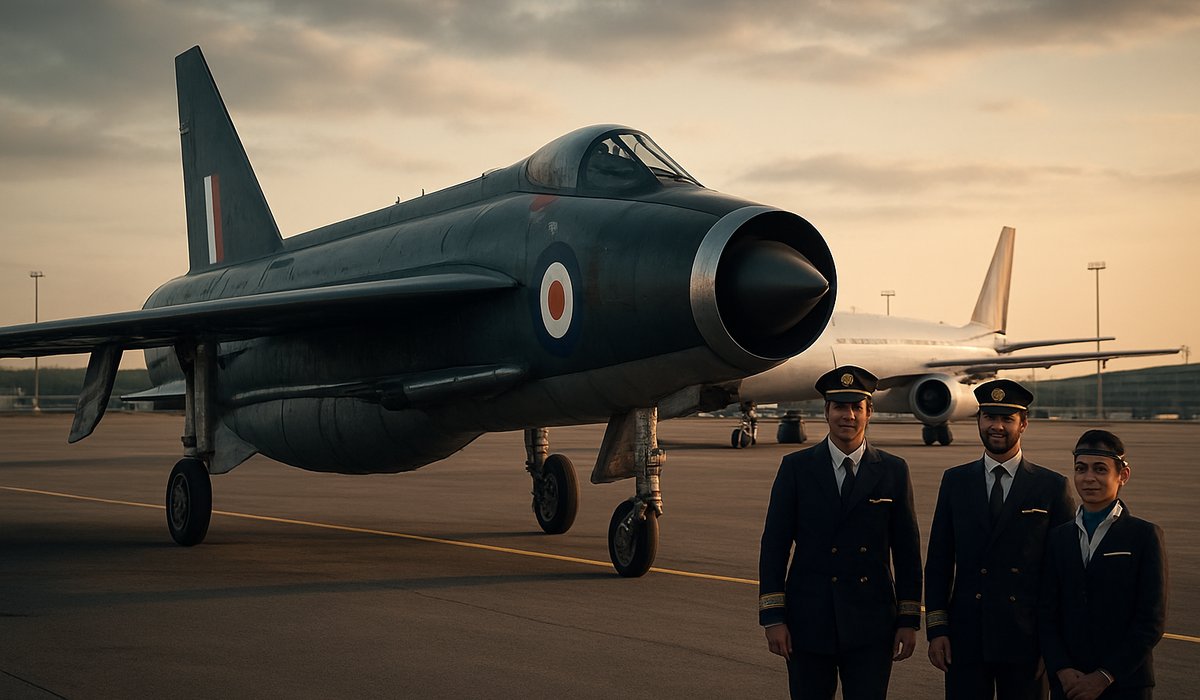
Image generated by AI
Historic British Cold War Strike Aircraft Demonstrates Capabilities That Modern F-35 Fighters Still Struggle to Match
The BAC TSR.2's revolutionary design from the 1960s raises questions about contemporary military aviation priorities and defense spending
A Cold War Engineering Marvel Outpaces Contemporary Defense Solutions
More than six decades after its maiden flight, the British Aircraft Corporation's TSR.2 remains a sobering reminder of what advanced military aviation engineering can achieve—and why successive generations of aircraft development have failed to substantially improve upon its foundational capabilities.
The TSR.2, introduced during the height of Cold War nuclear tensions in 1964, was engineered as a rapid-response platform for tactical nuclear strikes. The aircraft's Mach 2 performance envelope and low-level penetration abilities represented a quantum leap in military aviation technology at the time. Yet today, despite tens of billions spent on the F-35 fighter program, Western air forces are still chasing performance metrics that the British jet achieved nearly half a century ago.
Engineering Innovation Under Existential Pressure
The TSR.2's development occurred within a geopolitical climate dominated by mutual nuclear deterrence fears and the perceived necessity for instantaneous strike capabilities. Military planners throughout the 1960s recognized that any conflict scenario could escalate rapidly, driving demand for aircraft that could deliver payloads at supersonic speeds while operating from dispersed, austere airfields.
The aircraft's design incorporated innovations in avionics, aerodynamics, and systems integration that would influence combat aircraft development for decades. Its ability to conduct low-altitude missions at high velocity—a demanding profile that challenges airframes and pilot physiology alike—established performance benchmarks that became industry standards.
The Contemporary Comparison Problem
The F-35, developed over the past two decades at costs exceeding $1.7 trillion across all variants and international orders, prioritizes multirole capability, networked operations, and stealth characteristics over raw speed performance. However, this philosophical shift in military aviation doctrine has resulted in a platform with a maximum speed of Mach 1.6—measurably slower than the 1964 British design.
Defense analysts and military strategists continue debating whether this performance trade-off represents genuine progress or an expensive compromise. The TSR.2's eventual cancellation—a politically contentious decision—meant that its technological achievements were never fully realized operationally, leaving historians and engineers to speculate about its potential impact on Cold War deterrence strategies.
FAQ: Cold War Aviation and Modern Defense Technology
Why was the TSR.2 cancelled if it was so advanced? Political and budgetary decisions, combined with shifting strategic priorities toward collaborative NATO systems, led to the program's termination in 1965.
How does the F-35 compare to the TSR.2 in practical military applications? While slower, the F-35 offers stealth capabilities, advanced sensors, and networked warfare integration that the 1960s aircraft lacked entirely.
What can the TSR.2 teach modern defense planners? The aircraft demonstrates that performance excellence and engineering innovation don't guarantee program success without sustained political and financial support.
Are there plans to revive supersonic tactical aircraft? Several nations are exploring next-generation combat aircraft concepts, some revisiting speed as a primary capability factor.
Related Travel Guides
-
Lufthansa Boeing Airbus Widebody Order: 20 Aircraft Expansion Through 2034
-
Massive Paris Travel Disruption: Six Major Flights Cancelled at Charles de Gaulle
External Resources
Disclaimer
This article is for informational and educational purposes only. It does not constitute legal, financial, or professional advice. While we strive to provide accurate and up-to-date information, travel policies, regulations, and conditions change rapidly. Always verify information with official sources before making travel decisions. Nomad Lawyer makes no representations about the accuracy, reliability, completeness, or suitability of the information provided. Readers should consult qualified professionals for advice specific to their circumstances. The views expressed in this article are those of the author and do not necessarily reflect the views of Nomad Lawyer.
Raushan Kumar
Founder & Lead Developer
Full-stack developer with 11+ years of experience and a passionate traveller. Raushan built Nomad Lawyer from the ground up with a vision to create the best travel and law experience on the web.
Learn more about our team →