
Thailand Draws Japan, China and 14 Nations to Ubon Ratchathani Candle Procession 2026 Expanding Global Buddhist Heritage Appeal
Thailand transforms the Ubon Ratchathani Candle Procession into a global cultural spectacle, drawing artists from 14 countries to showcase Buddhist heritage and cross-border creativity.

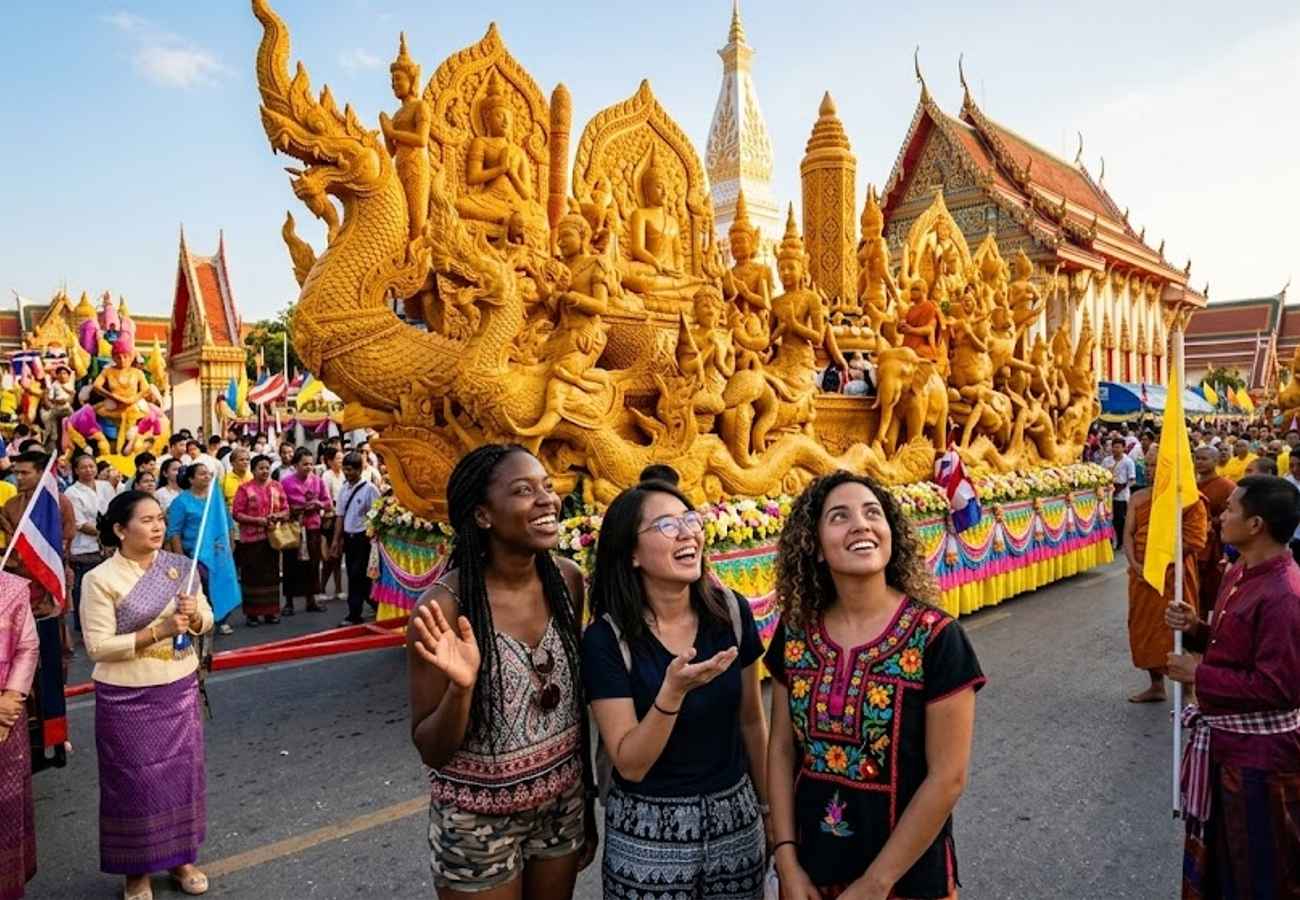
Image generated by AI
Thailand is turning a centuries-old Buddhist Lent ceremony into a global heritage spectacle, pulling artists from 14 countries to reshape how the world experiences cultural tourism.
The Ubon Ratchathani Candle Procession has outgrown its regional roots, becoming a cross-border platform where wax sculpture, religious devotion, and international diplomacy converge.
The Ubon Ratchathani Candle Procession, held annually in northeastern Thailand before the Buddhist Lent period known as Khao Phansa, has entered a new phase of international visibility. What began as a deeply religious observance—where local temples and artisans crafted giant wax sculptures to offer to monks beginning their three-month retreat—now functions as a major cultural tourism engine drawing participants from across Asia, Europe, and the Americas.
The Tourism Authority of Thailand (TAT) has positioned the festival as a signature heritage experience, leveraging it to promote secondary destinations beyond the usual Bangkok–Phuket–Chiang Mai circuit. The strategy aligns with broader travel trend shifts: modern visitors increasingly seek authentic, story-driven experiences over conventional sightseeing. This festival delivers exactly that combination—religious tradition, artisanal craftsmanship, and now, international artistic collaboration.
From Regional Ceremony to Global Cultural Platform
The transformation is neither accidental nor superficial. TAT has systematically promoted the procession through its official tourism channels, framing it as an exercise in soft power. The event combines three elements that resonate with contemporary travellers: living heritage, creative craftsmanship, and community participation.
Each year, thousands of visitors gather to witness enormous carved and moulded wax sculptures paraded through Ubon Ratchathani Province. Local temples, schools, and professional artisans spend weeks preparing these intricate works. The sculptures represent scenes from Buddhist teachings, local folklore, and Isan cultural identity.
The introduction of international candle-carving participants has added a layer of cross-cultural creativity. Artists from countries with their own Buddhist heritage—such as Japan, China, India, Nepal, and South Korea—bring techniques and themes that complement the Thai tradition. European and Latin American participants introduce entirely different sculptural interpretations, creating a visual dialogue between distinct artistic schools.
Why International Participation Matters for Thai Tourism
The inclusion of foreign artists serves multiple strategic purposes. It elevates the festival from a domestic religious event to an internationally recognised cultural attraction. It also supports Thailand's broader tourism diversification goal of encouraging longer visitor stays and dispersing tourism revenue to lesser-known provinces.
Ubon Ratchathani, located in the Isan region, has historically received less international attention than Thailand's coastal and northern destinations. The candle procession changes that equation by giving the province a distinctive, time-specific reason to visit. International media coverage generated by foreign participants further amplifies this visibility.
The festival also functions as cultural diplomacy. Rather than diluting local traditions, international contributions reinforce the message that Thai heritage is open to global engagement. Asian participants often share Buddhist cultural connections, while European and American artists bring fresh aesthetic perspectives that contrast with and highlight the Thai sculptural style.
Countries Participating in the Ubon Ratchathani Candle Procession
The international scope of the festival becomes clear when examining the full list of participating nations. Previous editions have included artists and cultural representatives from 14 countries across four continents, each contributing distinct artistic approaches.
| Country | Region | Participation Type | Contribution to Festival | Importance |
|---|---|---|---|---|
| Thailand | Southeast Asia | Host nation and largest participant | Local temples, artisans, schools and communities create giant carved and moulded wax sculptures for the main procession | Core cultural identity of the festival; represents Isan heritage and Buddhist traditions |
| Japan | East Asia | International candle-carving participant | Artists have joined wax sculpture activities showcasing Japanese artistic techniques | Strengthened cultural exchange between Thailand and Japan |
| China | East Asia | International wax-carving participant | Chinese artists participated in international candle sculpture competitions in previous editions | Added wider Asian cultural representation |
| India | South Asia | International wax-carving participant | Indian artists participated in international candle sculpture activities | Created a Buddhist and historical cultural connection between India and Thailand |
| South Korea | East Asia | International artist participation | South Korean artists contributed candle sculpture designs | Expanded Northeast Asian cultural cooperation |
| Nepal | South Asia | International artist participation | Nepalese representatives participated in previous international candle-art activities | Added Himalayan Buddhist cultural links |
| Taiwan | East Asia | International artist participation | Taiwanese artists joined international candle carving programmes | Supported regional creative exchange |
| Romania | Europe | International candle-art participation | Romanian artists participated in previous festival editions | Introduced European artistic perspectives |
| Turkey | Eurasia | International candle-art participation | Turkish artists joined international wax sculpture activities | Increased Europe–Asia cultural participation |
| Germany | Europe | International candle-art participation | German artists participated in international candle carving events | Represented European craftsmanship |
| Argentina | South America | International artist participation | Argentine representatives participated in earlier international competitions | Expanded festival reach beyond Asia and Europe |
| Italy | Europe | International candle-carving participant | Italian artists participated in previous international wax carving competitions | Added European artistic influence |
| Ukraine | Eastern Europe | International candle-carving participant | Ukrainian artists participated in previous editions | Demonstrated wider global cultural engagement |
| Luxembourg | Europe | International candle-carving participant | Luxembourg representatives joined earlier international competitions | Added representation from smaller European nations |
| Mexico | North America | International candle-carving participant | Mexican artists participated in previous international activities | Extended festival participation into the Americas |
The Festival's Strategic Significance for Heritage Tourism
The Ubon Ratchathani Candle Procession reflects a deliberate shift in how Thailand approaches cultural tourism. Rather than relying solely on beach resorts and urban entertainment, the country is investing in living traditions that offer visitors meaningful engagement with local communities.
The timing of the festival—before Khao Phansa, when Buddhist monks begin their annual three-month period of study and meditation—gives the event both religious weight and seasonal predictability. Visitors can plan trips around a fixed cultural moment that combines spiritual significance with visual spectacle.
For Ubon Ratchathani specifically, the international dimension has created recognition that would be difficult to achieve through conventional marketing alone. Visitors are drawn not only by the procession itself but by the opportunity to witness a tradition that actively engages with global cultures while maintaining its core religious purpose.
The participation pattern also reveals something about how cultural festivals can scale internationally. Asian countries with shared Buddhist heritage contribute through thematic and spiritual connections. European and Latin American participants bring technical and aesthetic diversity. The result is a festival that feels both locally authentic and globally connected—a combination that increasingly defines successful heritage tourism destinations.
Thailand is proving that ancient traditions need not remain frozen in place; they can become bridges between cultures when given the right platform.
Key Takeaways
- The Ubon Ratchathani Candle Procession has evolved from a regional Buddhist Lent ceremony into an international cultural tourism event with participation from 14 countries.
- The Tourism Authority of Thailand promotes the festival as a signature heritage experience to drive tourism to secondary destinations beyond Bangkok, Phuket, and Chiang Mai.
- International artists from Japan, China, India, South Korea, Nepal, Taiwan, Romania, Turkey, Germany, Argentina, Italy, Ukraine, Luxembourg, and Mexico have contributed to candle-carving activities.
- The festival takes place before Khao Phansa, the three-month Buddhist Lent period, combining religious devotion with artistic spectacle.
- The event supports Thailand's broader strategy of using cultural soft power to encourage longer visitor stays and diversify tourism revenue across provinces.
Frequently Asked Questions
What is the Ubon Ratchathani Candle Procession? It is an annual Buddhist festival held in Ubon Ratchathani Province in northeastern Thailand before the Khao Phansa Lent period, featuring giant carved wax sculptures paraded through the city as offerings to monks.
When does the festival take place? The procession occurs before the Buddhist Lent period known locally as Khao Phansa, when monks begin their three-month retreat of study and meditation. The exact dates vary each year based on the lunar calendar.
Which countries have participated in the international candle-carving activities? Previous editions have included artists from Thailand, Japan, China, India, South Korea, Nepal, Taiwan, Romania, Turkey, Germany, Argentina, Italy, Ukraine, Luxembourg, and Mexico.
Why is the Tourism Authority of Thailand promoting this festival internationally? TAT uses the event to showcase lesser-known destinations, promote heritage tourism, extend visitor stays, and diversify tourism beyond major cities like Bangkok, Phuket, and Chiang Mai.
Can international visitors attend the Ubon Ratchathani Candle Procession? Yes, the festival is open to the public and attracts thousands of domestic and international visitors who come to view the wax sculptures, traditional performances, and cultural displays.
Related Travel Guides
Disclaimer
This article is for informational and educational purposes only. It does not constitute legal, financial, or professional advice. While we strive to provide accurate and up-to-date information, travel policies, regulations, and conditions change rapidly. Always verify information with official sources before making travel decisions. Nomad Lawyer makes no representations about the accuracy, reliability, completeness, or suitability of the information provided. Readers should consult qualified professionals for advice specific to their circumstances. The views expressed in this article are those of the author and do not necessarily reflect the views of Nomad Lawyer.
Raushan Kumar
Founder & Lead Developer
Full-stack developer with 11+ years of experience and a passionate traveller. Raushan built Nomad Lawyer from the ground up with a vision to create the best travel and law experience on the web.
Learn more about our team →