
Travel Thailand Prepares: Airlines Deploy Emergency Fleets for Record Songkran Holiday
Thailand airlines slash fares and deploy extra aircraft as Songkran 2026 threatens to break all domestic travel records with millions expected to fly.

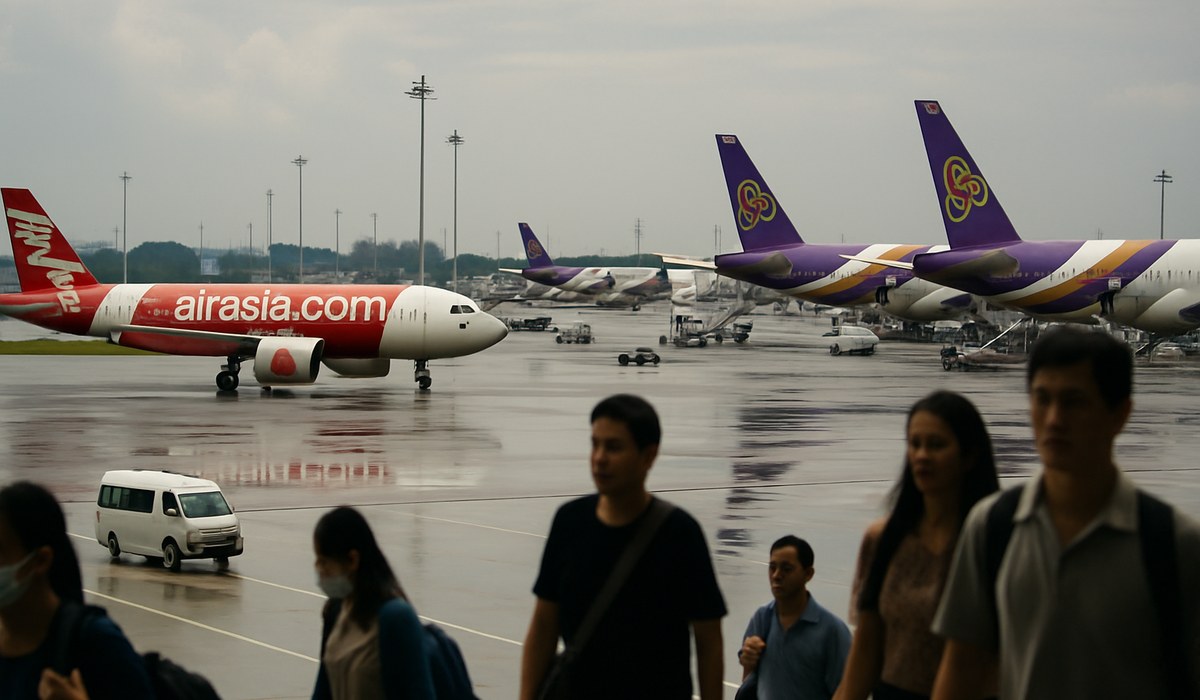
Image generated by AI
Quick Summary • Thai airlines are activating reserve aircraft fleets to accommodate anticipated record-breaking Songkran passenger volumes • Domestic airfares have dropped up to 35% on major routes as carriers compete for holiday travelers • Bangkok-Chiang Mai and Bangkok-Phuket routes will see double their normal daily flight frequencies • Aviation authorities project 4.2 million domestic passengers during the 10-day Songkran travel window
As Thailand braces for what could become the busiest Songkran holiday in aviation history, airlines are slashing fares and deploying emergency aircraft fleets to handle an expected surge of millions of domestic travelers. The traditional Thai New Year celebration, scheduled for mid-April 2026, has prompted the nation's carriers to implement unprecedented capacity expansions across the country's most popular routes.
Travel Thailand prepares for an aviation challenge unlike any in recent memory. Industry analysts forecast passenger volumes will eclipse 2025 figures by at least 18%, driven by strengthened domestic consumer confidence and pent-up demand following the recent fuel crisis affecting Southeast Asian carriers that temporarily dampened earlier travel plans.
Airlines Deploy Extra Aircraft as Songkran Demand Soars
Thai Airways, Bangkok Airways, and low-cost carriers including Nok Air and Thai AirAsia have collectively committed 47 additional aircraft to domestic service during the April 10-20 Songkran travel corridor. This represents a 42% increase in available seat-kilometers compared to standard April capacity.
Thai Airways spokesperson Narathip Saengkum confirmed the national carrier will reactivate three Boeing 777-200 aircraft currently in reserve status at Bangkok's Suvarnabhumi Airport (BKK). "We're converting these wide-body jets for high-density domestic configuration on trunk routes," Saengkum stated during a March 27 press briefing. "Each aircraft will operate six daily rotations between Bangkok and our northern hubs."
Bangkok Airways has taken a different tactical approach, leasing four ATR 72-600 turboprops from regional partners to bolster service to island destinations. The carrier will launch temporary direct routes connecting Samui (USM) with Krabi (KBV) and Chiang Rai (CEI) exclusively for the holiday period.
Low-cost carrier Thai Lion Air announced it will position aircraft overnight at secondary airports including Hat Yai (HDY) and Udon Thani (UTH) to maximize aircraft utilization rates. The airline projects it will complete 340 additional flight sectors during the 10-day window, according to data from FlightAware's real-time tracking systems monitoring Southeast Asian operations.
Fare Wars Heat Up on Popular Domestic Routes
Competitive pricing has become the dominant market strategy as carriers battle for market share during Thailand's most lucrative domestic travel period. Round-trip fares on the Bangkok-Chiang Mai corridor have plummeted to ฿1,890 ($52 USD) for travel during the traditional Songkran dates of April 13-15, representing a 35% reduction compared to March baseline pricing.
The Bangkok-Phuket route, Thailand's busiest domestic air corridor, shows similar discounting patterns. Thai AirAsia has advertised promotional one-way tickets starting at ฿790 ($22 USD) for early morning departures, while Nok Air countered with bundled family packages offering four seats for the price of three on select flights.
"We're seeing the most aggressive fare environment since pre-pandemic 2019," said Siriwan Boonmee, aviation analyst at Kasikorn Securities. "Carriers recognize that capturing market share during Songkran establishes customer loyalty for the remainder of the year."
This pricing warfare comes as operators work to rebuild margins strained by earlier operational challenges. The competitive landscape mirrors strategies observed in other markets, including Caribbean airlines restructuring vacation packages to stimulate demand during their own peak seasons.
Regional route pricing shows even steeper discounts. Chiang Mai-Phuket service, traditionally a premium-priced connection, now features promotional fares at ฿1,450 ($40 USD) one-way through multiple carriers. Hat Yai-Bangkok flights have dropped below ฿1,000 ($28 USD) for travelers willing to book connecting itineraries instead of nonstop service.
How Thailand's Carriers Are Managing Record Passenger Volumes
Airport infrastructure preparations have accelerated in parallel with airline capacity additions. Airports of Thailand (AOT) confirmed it will staff 320 additional check-in counters across its six major hubs during peak travel days, with particular emphasis on Don Mueang International Airport (DMK), which handles the majority of domestic low-cost carrier operations.
Suvarnabhumi Airport will implement extended operating hours for domestic terminals, opening check-in facilities at 03:00 local time instead of the standard 04:30 start. Security screening lanes will increase from 32 to 48 during morning departure waves between 06:00-10:00.
"Our modeling indicates peak hour passenger throughput will reach 15,400 travelers at Don Mueang on April 12," explained AOT operational director Prasert Wongsiri. "That's 63% above our normal April Saturday volume."
Ground handling companies have recruited temporary staff and cross-trained employees from cargo operations to assist with passenger services. Bangkok Flight Services, which handles ground operations for multiple carriers, has hired 580 seasonal workers specifically for the Songkran period.
According to IATA's Asia-Pacific traffic data, Thailand's domestic aviation market has grown at a compound annual rate of 7.2% since 2021, with seasonal spikes during Songkran and December holidays driving disproportionate shares of annual growth. The organization forecasts Thai domestic passenger numbers will reach 63 million in 2026, with approximately 6.7% concentrated in the April travel window.
Airlines have implemented dynamic scheduling systems to optimize aircraft rotations. Thai Smile Airways is using predictive analytics to anticipate demand shifts and has prepared contingency flight plans that can be activated within 48 hours if bookings exceed projections on specific routes.
What Travelers Need to Know Before Booking Songkran Flights
Advance booking has become critical for passengers hoping to secure seats during the most desirable travel dates. Industry data shows that 78% of April 13-15 domestic flight inventory had been reserved by March 26, leaving limited options for last-minute travelers.
Flexibility offers significant savings. Flights departing April 11 or April 16-17 show availability rates above 40% and fares averaging 22% lower than peak-date pricing. Early morning departures before 07:00 consistently offer better availability and pricing compared to midday options.
Travelers should verify baggage policies carefully, as promotional fares often exclude checked luggage. Most low-cost carriers charge ฿400-600 ($11-17 USD) per bag for baggage added after initial booking, compared to ฿200-300 ($6-8 USD) when included during purchase.
Health considerations remain relevant for Songkran travelers, particularly given the festival's water-based celebrations. The CDC dengue travel advisory has identified elevated mosquito-borne illness risks during Thailand's hot season, recommending travelers take appropriate precautions during outdoor festival activities.
Airport arrival timing requires adjustment during this period. AOT recommends domestic passengers arrive 2.5 hours before departure for Songkran-period flights, versus the standard 90-minute recommendation. Security queues at Don Mueang have measured 45-60 minutes during 2025 Songkran peak hours.
Travel insurance purchases have increased 34% year-over-year for April Thailand bookings, according to insurance comparison platform RabbitCare. Policies covering flight delays, cancellations, and medical emergencies during the water festival period cost ฿180-450 ($5-12 USD) for seven-day domestic coverage.
Passengers should monitor flight status through airline apps rather than relying solely on airport displays, as gate changes and minor schedule adjustments occur frequently during high-density operations. FlightAware mobile notifications provide real-time updates for travelers who register their flight details.
FAQ: Thailand Songkran Flight Information
When is the absolute peak travel day for Songkran 2026 flights? April 12 shows the highest booking density across Thai domestic routes, with Friday departures allowing travelers to maximize the long weekend. Morning flights on this date typically sell out 4-6 weeks in advance.
Are there any routes with better availability than Bangkok connections? Regional point-to-point routes like Chiang Mai-Phuket, Hat Yai-Krabi, and Udon Thani-Samui show better seat availability since most travelers route through Bangkok. These direct connections often cost more but save significant travel time.
How likely are flight delays during the Songkran travel rush? Historical performance data shows on-time rates drop to 68% during peak Songkran days, compared to Thailand's annual average of 82%. Weather factors and congested airspace contribute to delays averaging 35-40 minutes when they occur.
Can I expect better deals if I wait to book closer to April? Contrary to typical airline pricing patterns, Songkran fares generally increase as departure dates approach due to high demand. Seats remaining two weeks before travel often carry 40-60% premiums over early-bird pricing.
What happens if my flight gets cancelled during Songkran? Thai airlines must offer rebooking or refunds per Department of Civil Aviation regulations. However, rebooking options become extremely limited during sold-out periods, making travel insurance particularly valuable for this travel window.
Thailand's aviation sector is demonstrating remarkable operational agility as it mobilizes to serve record-breaking domestic demand during Songkran 2026. The combination of expanded capacity, competitive pricing, and improved infrastructure coordination positions Thai carriers to deliver what could become the nation's most successful holiday travel period in modern aviation history. Travelers who plan ahead, remain flexible on dates, and monitor their flight status closely will find abundant options for experiencing Thailand's most celebrated cultural festival.
Related Articles:
Disclaimer
This article is for informational and educational purposes only. It does not constitute legal, financial, or professional advice. While we strive to provide accurate and up-to-date information, travel policies, regulations, and conditions change rapidly. Always verify information with official sources before making travel decisions. Nomad Lawyer makes no representations about the accuracy, reliability, completeness, or suitability of the information provided. Readers should consult qualified professionals for advice specific to their circumstances. The views expressed in this article are those of the author and do not necessarily reflect the views of Nomad Lawyer.
Kunal K Choudhary
Co-Founder & Contributor
A passionate traveller and tech enthusiast. Kunal contributes to the vision and growth of Nomad Lawyer, bringing fresh perspectives and driving the community forward.
Learn more about our team →