
Storm-Driven Delays Snarl Chicago O'Hare Flights: March 26 Update
Storm-driven delays snarl over 240 flights at Chicago O'Hare on March 26, 2026, affecting United, American, Delta and regional carriers across North America and Europe. Thunderstorms combined with staffing constraints create cascading disruptions.

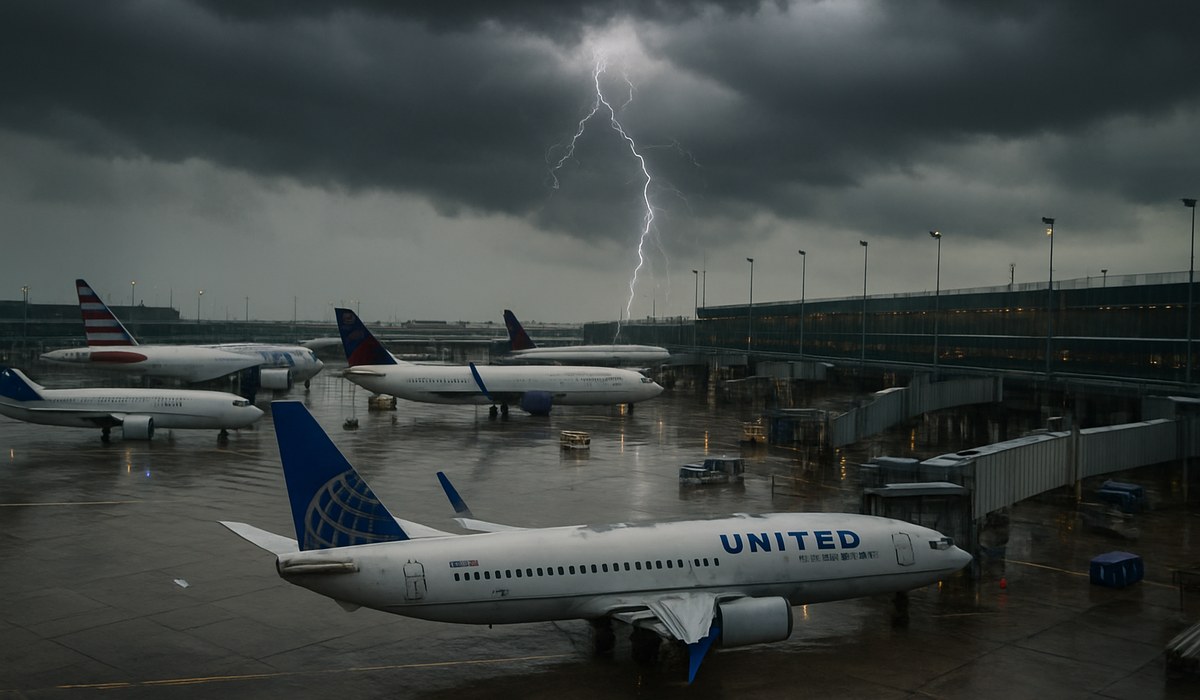
Image generated by AI
Chicago O'Hare International Airport (ORD) faced widespread disruptions on March 26, 2026, as severe thunderstorms combined with air traffic control staffing constraints created a cascade of cancellations and delays affecting thousands of passengers. Real-time tracking data documented 21 flight cancellations and approximately 242 delays across United, American, Delta, SkyWest, Republic, PSA and other carriers, with ripple effects extending to destinations across the continental United States, Canada, Mexico and Europe. The storm-driven delays snarl revealed vulnerability in hub operations when weather and operational pressures align.
Severe Thunderstorms Trigger Ground Delays at Chicago's Largest Hub
Atmospheric conditions over northern Illinois on March 26 deteriorated rapidly as afternoon and evening thunderstorms moved through the region. Moderate to heavy rain, gusty winds exceeding 30 mph and reduced ceiling heights created hazardous conditions for aircraft arrivals and departures at ORD. The Federal Aviation Administration (FAA) implemented ground delay programs beginning mid-afternoon, restricting the flow of traffic into Chicago airspace and directing airlines to hold departures at origin airports.
These meteorological factors forced air traffic controllers to reduce arrival rates significantly. When storms of this intensity affect a major hub, the safety-first approach means accepting longer taxi times, extended holding patterns and eventual cascading delays throughout the network. According to FlightAware, real-time flight tracking showed status updates on hundreds of flights by 8 p.m. local time, with most revisions indicating pushbacks or gate reassignments rather than immediate cancellations. Travelers monitoring departure boards experienced frequent updates as dispatchers calculated revised departure windows based on runway availability and inbound traffic flows.
United Airlines and Regional Partners Absorb Majority of Disruptions
United Airlines, which operates its primary hub at O'Hare, bore the largest operational burden as storm-driven delays snarl mounted throughout the day. United mainline flights and United Express services operated by regional affiliates including SkyWest Airlines and Republic Airways recorded the highest concentration of delays and cancellations among all carriers at ORD.
In preparation for the severe weather, United issued a travel waiver effective for itineraries involving Chicago on March 26. The waiver permitted eligible passengers to reschedule flights to alternative dates without incurring change fees, a standard industry response designed to encourage voluntary rebooking before automated systems become overwhelmed. Regional carriers like PSA Airlines, SkyWest and Republic operate critical feeder flights connecting smaller Midwest airports to United's hub. These regional routes often face earlier cancellations during capacity constraints because airlines prioritize longer-haul services carrying higher passenger loads and generating international connections.
The operational mathematics at ORD meant that United Express flights to cities like Milwaukee (MKE), St. Louis (STL) and Indianapolis (IND) experienced disproportionate cancellations. When available gate space and ground equipment become scarce, regional turboprops and regional jets—the workhorses of feeder networks—are the first to face schedule reductions.
American, Delta Navigate Crowded Ramp Conditions and Gate Shortages
American Airlines, which has expanded its Chicago presence over recent years, faced particular pressure given its already-dense schedule at ORD relative to available infrastructure. With limited gate flexibility, even short-duration weather disruptions force cascading delays across American's afternoon and evening departures. Crowded ramp areas meant longer taxi times, increased aircraft holding patterns near the terminal and extended turnaround times between flights.
Delta Air Lines and other national carriers operating smaller networks at Chicago experienced similar network constraints. Despite operating fewer daily flights than hub carriers, these airlines depend on the same congested airspace and runways. The FAA's ground delay programs applied uniformly to all operators, meaning carriers with international service to Europe or transborder routes to Canada and Mexico faced identical restrictions. A two-hour delay at Chicago for a Delta flight to London (LHR) or Mexico City (MEX) compresses connection windows and creates schedule conflicts downstream.
Smaller carriers including Southwest Airlines, JetBlue and Spirit Airlines, while less affected numerically, still recorded weather-related delays as the disruption persisted into evening. Each airline's network dependency on Chicago varied, but none escaped the bottleneck entirely.
Air Traffic Control Staffing Amplifies Storm-Driven Delays Impact
Beyond meteorological factors, ongoing staffing constraints at Chicago Air Traffic Control Center added operational vulnerability on March 26. Discussions among aviation professionals throughout early March highlighted concerns about controller availability during peak travel periods. When reduced visibility and convective weather demand maximum focus from approach and departure controllers, any staffing shortfall becomes operationally significant.
Staffing-related ground delay programs existed at ORD independent of the storm, meaning the weather event compounded an already-constrained system. Airlines and air traffic managers coordinate capacity during such dual pressures, but the result is inevitably tighter margins and less flexibility for schedule recovery. Controllers managing Chicago's complex departure flows faced intensified workload managing storm avoidance, spacing requirements and ground holding instructions simultaneously.
Cascading Network Effects Reach Across North America and International Routes
The geographic centrality of O'Hare to Midwest and Great Lakes regions meant that 21 cancellations and 242 delays created exponential downstream disruptions. Aircraft scheduled to operate multiple rotations per day arrived late to subsequent assignments in Denver (DEN), Atlanta (ATL), New York (JFK/LGA/EWR) and Boston (BOS). Crews exceeded duty-time limitations, forcing further schedule adjustments and potential cancellations on flights departing other cities hours after the Chicago disruption began.
Transnational routes proved particularly vulnerable. A flight from Chicago to Montreal (YUL) delayed by 90 minutes risks missing a connection onward to Toronto (YYZ) or a transatlantic departure to Dublin (DUB). Similarly, delayed arrivals into Chicago from Houston (IAH) or Miami (MIA) compress connection windows for passengers with tight transfer times. Airlines prioritize passengers in premium cabins and frequent-flyer elites during irregular operations, but the volume of schedule conflicts on March 26 inevitably meant some missed connections and involuntary rebooking on next-available flights.
Traveler Action Checklist
-
Verify your flight status immediately – Visit FlightAware or your airline's app to confirm real-time departure and arrival times. Refresh every 15-30 minutes during active disruption windows.
-
Request waiver eligibility – If your airline issued a travel waiver for March 26 itineraries, contact customer service or access the waiver through your booking confirmation and reschedule proactively without fees.
-
Adjust arrival timing at airport – Allow 30-45 minutes additional time for check-in, security and gate changes. Storm disruptions typically produce multiple gate reassignments.
-
Document delays and cancellations – Retain boarding passes, gate change notices and written communication from your airline. The U.S. Department of Transportation recognizes weather as a force majeure event, but documentation supports future service recovery negotiations.
-
Monitor crew and equipment rotations – If delayed, your aircraft may arrive from another city. Expect updates as turnaround crews and maintenance checks are completed. Realistic delays may be 2-3 hours or longer during severe weather.
-
Confirm connection feasibility – If connecting through Chicago, check whether your inbound flight delay jeopardizes an onward departure. Rebook voluntarily if connection time drops below 90 minutes for domestic or 120 minutes for international.
-
Understand passenger rights per U.S. DOT – Review policies at US DOT Aircraft Consumer Protection to know entitlements for meals, hotels and rebooking during storm-related disruptions.
Key Operational Data: Chicago O'Hare March 26, 2026
| Metric | Count/Details |
|---|---|
| Total Flight Cancellations | 21 across all carriers |
| Total Delays Recorded | 242+ flights with departure delays |
| Primary Affected Carriers | United, American, Delta, SkyWest, Republic, PSA |
| Weather Cause | Severe thunderstorms, gusty winds (30+ mph), low ceilings |
| Ground Delay Program Duration | Afternoon through evening hours |
| Staffing Factor | Air traffic control capacity constraints noted |
| Geographic Impact Radius | Midwest, Great Lakes, transnational routes to Canada/Mexico/Europe |
| Runway Availability | Reduced due to weather protocols and aircraft spacing requirements |
| Peak Disruption Period | 2:00 p.m. to 8:00 p.m. Central Time |
What This Means for Travelers
Storm-driven delays snarl Chicago's operations when severe weather and operational constraints converge, creating broad travel uncertainty. For passengers booked on flights through ORD on days with thunderstorm activity, expectations should align with reality: expect 30-90 minute delays as routine, and plan ground time accordingly.
Connecting passengers face the highest risk. If your itinerary includes Chicago as a transfer point with tight spacing (under two hours for domestic connections), proactively work with your airline to either book later connecting flights or reroute via alternative hubs. Airlines rarely deny rebooking requests during irregular operations when meteorological factors are documented.
Crew and equipment constraints compound weather disruptions. Airlines operate with minimal buffer aircraft on normal days. When O'Hare operations snarl, recovery timelines extend 12-24 hours as crews exceed rest requirements and maintenance backlogs accumulate. Book flexibility into leisure travel or request non-refundable ticket holds if business travel forces same-day rebooking.
International travelers connecting through Chicago should maintain awareness of duty-time rules affecting crew assignments. A delayed inbound flight from the West Coast may force crew changes in Chicago, triggering further delay. European carriers operating Chicago-Europe routes build more recovery time into schedules than domestic operators, but disruption propagation remains inevitable during major weather events.
Frequently Asked Questions
What causes storm-driven delays at Chicago O'Hare on March 26, 2026? Severe thunderstorms with moderate-to-heavy rain, gusty winds exceeding 30 mph and low cloud ceilings created hazardous conditions for aircraft operations. The FAA implemented ground delay programs restricting traffic flow into Chicago airspace. Combined with air traffic control staffing constraints already present, the weather event significantly reduced runway capacity and arrival rates throughout the afternoon and evening.
How many flights experienced storm-driven delays snarl at ORD on March 26? Real-time tracking data documented 21 flight cancellations and approximately 242 delays across all airlines operating at Chicago O'Hare. United Airlines, American Airlines and regional carriers including SkyWest and Republic recorded the majority of disruptions. Network effects created additional delays at hub connections in Atlanta, Dallas, Denver and eastern airports as delayed aircraft and crews affected downstream rotations.
Can I get a refund or compensation if my flight was cancelled due to storm-driven delays? Weather-related cancellations and delays are classified as "acts of God" under U.S. Department of Transportation regulations, exempting airlines from monetary compensation requirements. However, airlines must provide rebooking on alternative flights or carriers at no additional charge. You may pursue refunds if you elect not to rebook. Review your airline's specific policy and U.S. DOT consumer protections for meal and accommodation entitlements during extended delays.
Which airlines were most affected by March 26 storm-driven delays at Chicago? United Airlines and its regional partners (SkyWest, Republic, PSA) bore the largest operational impact, followed by American Airlines and Delta. United operates its largest hub at ORD, meaning a higher concentration of cancelled and delayed flights on the carrier. All airlines sharing Chicago airspace were subject to identical FAA ground delay programs and runway constraints, though hub operators with denser schedules experienced greater cumulative passenger impact.
Related Travel Guides
Chicago O'Hare Terminal Guide: Navigating ORD During Delays
Connecting Flight Missed: Your Legal Rights and Rebooking Options
Severe Weather Flight Delays: What Airlines Must Provide
Disclaimer
Disclaimer
This article is for informational and educational purposes only. It does not constitute legal, financial, or professional advice. While we strive to provide accurate and up-to-date information, travel policies, regulations, and conditions change rapidly. Always verify information with official sources before making travel decisions. Nomad Lawyer makes no representations about the accuracy, reliability, completeness, or suitability of the information provided. Readers should consult qualified professionals for advice specific to their circumstances. The views expressed in this article are those of the author and do not necessarily reflect the views of Nomad Lawyer.
Raushan Kumar
Founder & Lead Developer
Full-stack developer with 11+ years of experience and a passionate traveller. Raushan built Nomad Lawyer from the ground up with a vision to create the best travel and law experience on the web.
Learn more about our team →