
St. Lucia Becomes Caribbean's Premier Farm-to-Table Destination With Revolutionary Agri-Tourism Integration in 2026
St. Lucia transforms tourism through agri-tourism-hospitality integration, offering visitors authentic farm experiences, culinary workshops, and direct farmer engagement that redefine Caribbean travel.

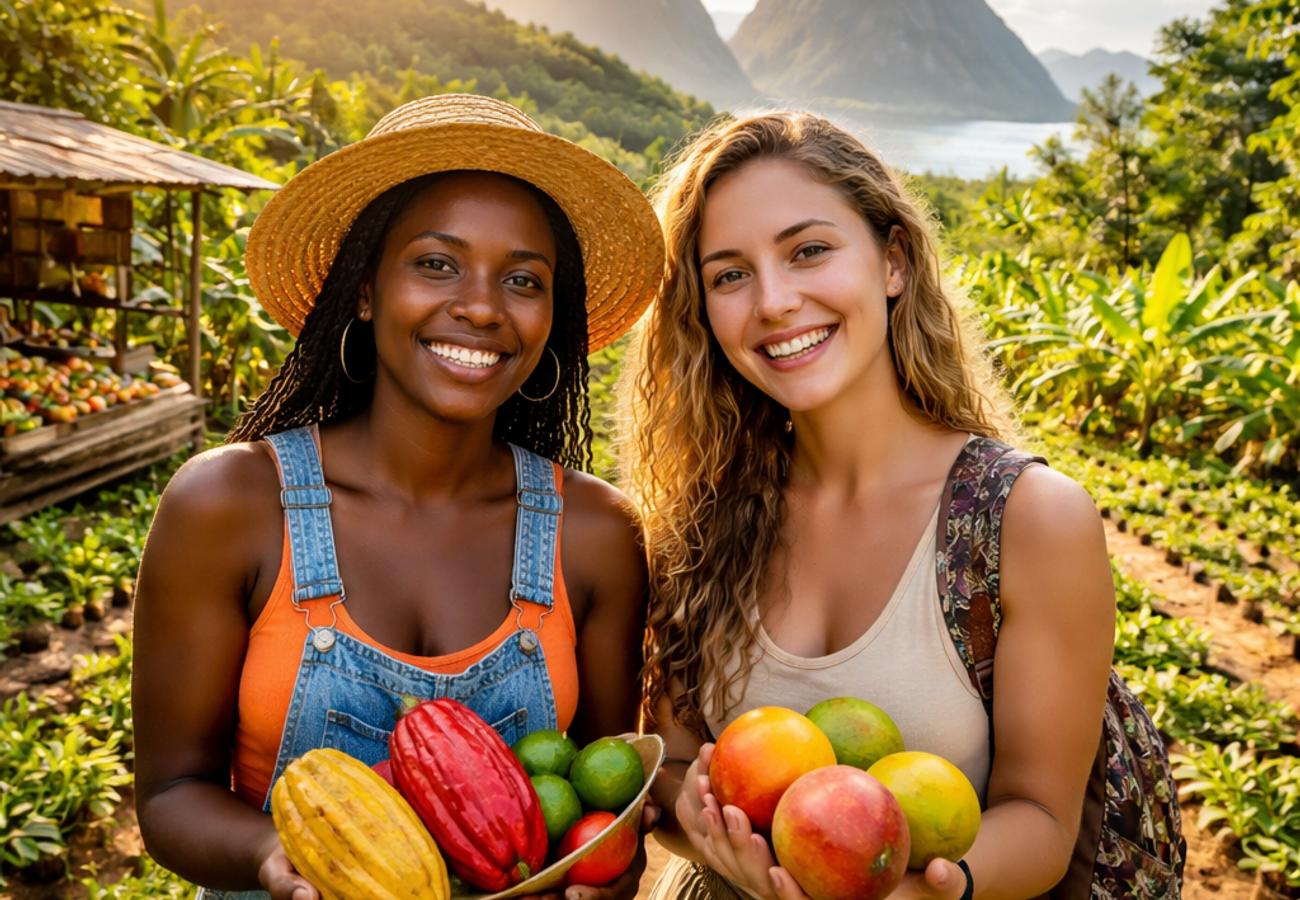
Image generated by AI
A Caribbean Pivot: When Tourism Met Agriculture
St. Lucia is no longer just another sun-and-sand destination. The island is quietly engineering a tourism revolution—one that transforms every farm visit, every meal, and every interaction into a gateway to authentic Caribbean life.
What started as a whisper in the hospitality sector has become a roar: travellers are exhausted by generic resort experiences. They crave meaning. Connection. Stories. And St. Lucia has answers.
The island is systematically weaving agriculture, hospitality, and tourism into what industry experts call the agri-tourism-hospitality nexus—a framework that positions farmers as cultural ambassadors, chefs as storytellers, and every dining table as a classroom in Caribbean identity.
Reddit: "Finally, a destination where your dinner actually comes from the farm you visited yesterday. This is what travel should feel like." — r/travel
How Agriculture Became the Soul of St. Lucia Tourism
The transformation begins with a simple truth: St. Lucia's verdant landscapes and rich culinary heritage are no longer mere backdrops. They are the main attraction.
Traditional farming isn't treated as rustic nostalgia anymore—it's positioned as premium cultural content. Local crops, centuries-old preparation techniques, and regionally significant culinary products become the foundation of curated travel experiences. Visitors don't just eat local mangoes; they meet the farmers who grew them, learn the planting cycles, and understand why St. Lucian produce tastes incomparably better.
This circular ecosystem works because all three pillars reinforce each other. Agriculture provides authenticity and raw material. Hospitality translates that authenticity into immersive experiences. Tourism scales these experiences globally, attracting discerning travellers willing to pay premium prices for genuine engagement.
The result? Farmers gain direct market access and sustainable livelihoods. Hospitality operators differentiate themselves through terroir-driven identities. Tourism stakeholders tap into the fastest-growing travel segment: experiential and culinary tourism.
The Death of Commoditized Dining
Here's where St. Lucia's model gets genuinely revolutionary: meals are no longer transactional.
Every dish is tethered to its origin story. Visitors learn which farm produced the ingredients, observe traditional preparation methods, and engage directly with producers. A simple plate of breadfruit becomes a participatory cultural experience—one that's nearly impossible to replicate elsewhere.
This de-commoditization strategy creates experiences of genuine scarcity. You can't eat St. Lucian farm-to-table cuisine anywhere except St. Lucia. That uniqueness justifies premium pricing while simultaneously preserving cultural practices that might otherwise fade into obsolescence.
When meals are linked to geographic and social context, every bite reinforces destination value. Tourists don't just consume food; they consume identity, history, and place.
Narrative-Driven Consumption: The Stories Behind Every Bite
Tourism in St. Lucia now operates on narrative architecture. Storytelling isn't added flavor—it's the main course.
Farm tours become cultural lessons. Culinary demonstrations transform into interactive workshops where visitors craft traditional recipes alongside locals. Farmers' market visits evolve into anthropological expeditions. Every activity is deliberately designed to help travellers grasp the cultural and historical significance of St. Lucian food traditions.
This narrative layer fundamentally changes visitor psychology. A farm tour stops being a photo opportunity and becomes an intellectual and emotional experience. Visitors don't just see the island; they understand it.
And they talk about it. Extensively. Research from hospitality sectors shows that experiential travelers generate 3-5 times more user-generated content than traditional tourists. Each visitor becomes an unpaid ambassador, broadcasting their St. Lucia story across social platforms and among their personal networks.
Multi-Sensory Place-Making: The Five-Sense Strategy
St. Lucia's agri-tourism model engages all five senses simultaneously.
Visual beauty comes from verdant agricultural landscapes. Aroma drifts from spice gardens and cooking demonstrations. Texture emerges through hands-on farm work and culinary preparation. Taste, obviously, dominates the dining experience. Sound arrives through ambient design, local music, and the rhythms of community life.
This multi-sensory immersion creates neurological stickiness. Experiences that engage multiple sensory pathways generate stronger memory formation and deeper emotional attachment. Visitors don't simply remember St. Lucia—they feel it viscerally.
That sensory depth drives repeat visitation. Studies on destination loyalty demonstrate that emotionally connected travellers visit 2-3 times more frequently than those with surface-level experiences.
Real Economic Impact: Who Benefits and How
The agri-tourism-hospitality nexus isn't merely theoretical. It's generating tangible economic outcomes for multiple stakeholders.
Farmers transition from commodity producers to premium market suppliers. Instead of selling bulk crops to middlemen at razor-thin margins, they supply high-value hospitality experiences at considerably higher price points. This sustainability enables intergenerational farming—younger St. Lucians now see agriculture as economically viable.
Hospitality operators acquire defensible competitive advantage. A hotel that sources exclusively from local farms and tells those stories effectively becomes irreplaceable. Competitors cannot simply copy this model overnight; it requires deep community relationships, agricultural partnerships, and narrative development.
Tourism businesses expand their market appeal. Agri-tourism itineraries attract affluent, culturally-engaged travellers—segments that spend 40-60% more than conventional beach tourists and stay 2-3 days longer on average.
Communities maintain cultural integrity while generating economic opportunity. Tourism dollars flow directly into local agriculture, food preparation, and hospitality services—sectors where community members already hold expertise.
The Global Context: Why This Matters Now
This model arrives at a precise historical moment. Global travel patterns have shifted fundamentally.
Millennials and Gen-Z travelers—now the dominant market segment—explicitly reject commoditized tourism. Recent travel research indicates that 72% of younger travellers prioritize authenticity and cultural engagement over luxury amenities. They want meaning more than marble.
St. Lucia's agri-tourism integration directly addresses this demand inversion. The island isn't building larger resorts; it's building deeper connections.
This positions St. Lucia advantageously against competitors. Bahamas, Jamaica, and Barbados still operate largely on traditional resort models. St. Lucia is moving faster toward the future of travel—a future where experiences matter more than thread count.
The Sustainability Equation
There's a conservation angle too. When tourism directly subsidizes agriculture, there's economic incentive to preserve farmland rather than develop it into sprawl.
The agri-tourism model also creates incentive for biodiversity preservation. Unique, regionally-specific crops and traditional farming practices become competitive assets rather than economic liabilities. St. Lucia farmers have financial reasons to maintain heirloom varieties and sustainable techniques.
This reframes conservation from an environmental cost into an economic benefit—a paradigm shift that typically proves far more durable than guilt-based sustainability messaging.
What Travelers Should Expect in 2026 and Beyond
If you're planning a St. Lucia trip, understand that the island is deliberately positioning itself differently.
Expect farm experiences that involve actual work—not staged photoshoots. Anticipate culinary workshops where you prepare authentic meals using ingredients you sourced that morning. Count on meaningful conversations with farmers, hospitality professionals, and community members who view tourism as opportunity rather than intrusion.
Expect premium pricing reflective of genuine, irreplaceable experiences. But also expect corresponding depth of memory and genuine life enrichment.
St. Lucia is betting that modern travellers will pay substantially more for authenticity than for conventional luxury. The early data suggests the bet is winning.
St. Lucia didn't invent farm-to-table tourism—it industrialized it into a destination strategy.
Related Travel Guides
Disclaimer
This article is for informational and educational purposes only. It does not constitute legal, financial, or professional advice. While we strive to provide accurate and up-to-date information, travel policies, regulations, and conditions change rapidly. Always verify information with official sources before making travel decisions. Nomad Lawyer makes no representations about the accuracy, reliability, completeness, or suitability of the information provided. Readers should consult qualified professionals for advice specific to their circumstances. The views expressed in this article are those of the author and do not necessarily reflect the views of Nomad Lawyer.
Preeti Gunjan
Contributor & Community Manager
A passionate traveller and community builder. Preeti helps grow the Nomad Lawyer community, fostering engagement and bringing the reader experience to life.
Learn more about our team →