
Spain Renfe Strike Monday June 29: 320 Train Cancellations Hit High-Speed, Regional Routes Across Spain
A nationwide Renfe strike on June 29, 2026 removes 320 trains from service, disrupting high-speed, long-distance, and regional connections across Spain during peak summer travel season.

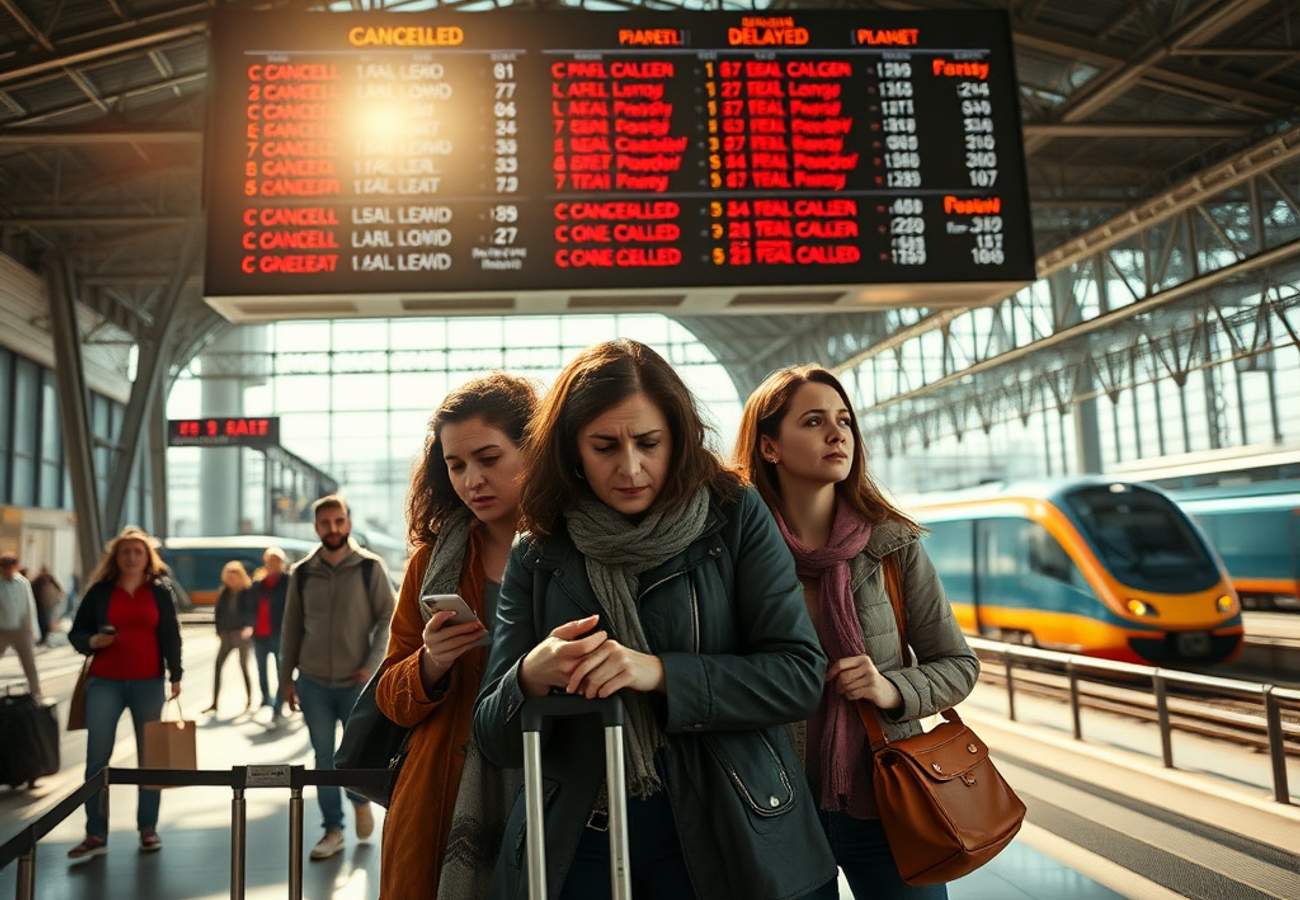
Image generated by AI
Spain's Monday Rail Meltdown: What 320 Missing Trains Actually Means
Spain faces a critical transportation crisis on Monday, June 29, 2026, as a nationwide Renfe strike paralyzes the country's rail network. The disruption will pull 320 trains from service across all categories—high-speed, long-distance, regional, and commuter—creating cascading delays and cancellations that will ripple through summer tourism, business travel, and domestic mobility during one of the year's busiest travel windows.
This isn't a minor operational hiccup. This is a full-day strike running from 00:00 to 23:59, affecting millions of potential passengers and upending the careful logistics of tour operators, travel agents, and corporate travel planners across the continent.
The Numbers That Matter: Where The 320 Cancellations Hit Hardest
The official minimum-service framework provides limited protection. Renfe will operate just 682 protected trains across all categories, leaving a gap of 320 services removed from Monday's schedule entirely.
Here's the breakdown by category:
Alta Velocidad and Larga Distancia (High-Speed & Long-Distance): Of the 360 affected trains, only 262 are protected—a 73% service rate. That means 98 intercity trains vanish, cutting into Madrid-Barcelona, Madrid-Seville, Valencia, and Málaga connections that business travellers and holiday-makers depend on.
Media Distancia (Regional Rail): This category takes the heaviest hit. 642 regional trains are affected, with only 420 protected—a 65% service rate. The 222 missing regional trains devastate connections to secondary cities, provincial capitals, heritage towns, and rural destinations where road alternatives are sparse or nonexistent.
Cercanías (Commuter Rail): Protection varies by time. Peak hours (06:00-09:00, 13:30-15:30, 18:30-20:30) maintain 75% service, while off-peak hours drop to 50%. This punishes afternoon arrivals, late-night transfers, and visitors using commuter networks to reach suburban hotels and conference venues.
Rodalies (Catalonia's Regional Network): Barcelona operates under separate rules. Peak protection sits at 66% (06:30-09:30, 16:00-20:00), while off-peak drops to 33%—the sharpest cuts in the entire network.
Reddit: "I'm supposed to arrive in Barcelona on Monday afternoon. Should I just rebook?" — r/travel
Which Routes Get Hit First
Madrid emerges as ground zero. The capital's commuter network carries the nation's heaviest daily volumes. While peak windows maintain 75% service, the surrounding hours face 50% capacity, meaning any traveller arriving outside rush hour faces sparse options.
Barcelona compounds the problem with its lower Rodalies protection (66% peak, 33% off-peak). A business delegate or leisure traveller landing at Barcelona-El Prat Airport after noon could face a 90-minute wait for the next available train to the city centre.
Valencia, Seville, Málaga, Córdoba, and Granada all depend on long-distance or regional connections that lose 25-35% of their Monday schedule. For tour groups relying on fixed rail timings to hotels, museums, and coastal resorts, a single missed connection can unravel an entire day's itinerary.
Catalonia's Costa Brava extensions face particular risk. Media Distancia reductions mean village-level access becomes congested, forcing passengers toward coach alternatives or multi-hour delays.
The Real Impact: Compression, Not Just Cancellation
The danger isn't only that trains won't run. It's that remaining services become overwhelmed.
When 98 high-speed trains vanish, travellers don't disappear—they compress into the 262 remaining slots. Tickets sell out. Seats vanish. Standing-room-only cars fill beyond comfort. Checked luggage gets delayed. Connection buffers evaporate.
For escorted tour groups moving between cities on Monday, this compression creates three downstream problems: late arrivals (hotels hold rooms until 18:00), missed dining reservations (guides can't wait for delayed trains), and broken itinerary sequencing (day-two activities start without yesterday's stragglers).
Media Distancia: The Forgotten Network That Matters Most
Media Distancia suffers the largest absolute impact: 222 cancelled services. These aren't glamorous high-speed trains. They're the workhorses connecting Spain's interior—the trains that move families to provincial capitals, students to universities, tourists to heritage sites, and regional economies to major markets.
A Media Distancia train from Madrid to Cuenca (a UNESCO World Heritage site) that normally runs four times daily might be reduced to two or three departures. A regional connection from Salamanca to smaller Castilian towns could vanish entirely Monday. Rural tourism—increasingly important to Spain's regional development strategy—faces immediate damage.
Travel agents selling multi-city itineraries should flag regional legs as the highest-risk segment. Rebooking flexibility becomes critical.
Catalonia's Separate Rules Create A Dual-Standard Problem
Catalonia operates its own minimum-service framework for Rodalies, creating a two-tier disruption across Spain.
Rodalies protection at 66% peak and 33% off-peak is the most exposed level nationwide. This means Barcelona-based packages, Costa Brava connections, and cruise pre-/post-stays face sharper disruption than equivalent services in Madrid or Valencia.
A tourist arriving by air on Monday afternoon (outside Rodalies peak) might wait 45-60 minutes for the next train to Barcelona's city centre. A group checking into a suburban hotel needs a backup transport plan.
Inbound operators cannot rely on national Renfe updates alone. Rodalies-specific live information and station-level alerts are essential Monday monitoring tools.
Peak Windows And Off-Peak Cliffs: Timing Is Everything
The strike doesn't hit uniformly. Timing dictates outcome.
Commuter peak hours (Madrid: 06:00-09:00, 13:30-15:30, 18:30-20:30) maintain 75% Cercanías service. A business traveller catching a 08:00 train faces minor delays. A leisure passenger arriving at Atocha Station at 14:00 faces a manageable wait.
Off-peak hours (everything else) drop to 50% Cercanías service. A family arriving at 19:45 might face 30-minute wait. An international visitor landing at Adolfo Suárez Airport at 15:10 encounters a visibility gap—outside peak protection, entering the afternoon sag before evening peak resumes.
For Barcelona Rodalies, the off-peak cliff is steeper: 33% service outside 06:30-09:30 and 16:00-20:00. This creates acute risk for afternoon arrivals and late-evening transfers.
What Travel Companies Should Do Right Now
First: Check every Monday booking touching Renfe, Rodalies, or Cercanías. Highlight clients whose itineraries depend on regional or commuter rail.
Second: Pre-position rebooking alternatives. Identify afternoon coach services, car rental availability, and air-rail combinations that can absorb displaced passengers.
Third: Communicate early. Send alerts to affected clients by Sunday evening. Passive notification creates panic. Proactive options build confidence.
Fourth: Brief tour guides and hotel concierges. Late arrivals happen. Backup catering, staggered check-ins, and revised activity timings need coordination.
Fifth: Monitor official Renfe alerts and regional operator updates Monday morning. Live service data changes as the day unfolds. A 08:00 cancellation might free capacity for 10:00 rebooking.
A Second Strike Looms: July 15 Creates Double Jeopardy
The 15 July 2026 strike date adds uncertainty to forward bookings. If minimum-service rules remain unchanged, late-month tourism faces identical disruption patterns. Clients booking multi-week Spanish itineraries should receive explicit notice.
Some tour operators are already preemptively reshuffling July departures. Corporate travel managers report cautious rebooking away from July 15-16 movements.
The Bigger Picture: When Infrastructure Fails, Tourism Bleeds
Spain's tourism economy has recovered strongly post-pandemic, but it remains sensitive to capacity shocks. Rail is not a luxury—it's foundational infrastructure for:
- City-break dispersal (spreading tourists beyond Madrid/Barcelona to secondary markets)
- Cruise pre-/post-stays (getting passengers from ports to inland experiences)
- MICE delegate flows (moving conference attendees between venues)
- Domestic weekend mobility (supporting Spanish families and regional cohesion)
When 320 trains vanish, that infrastructure fractures. Tourism doesn't stop—it gets displaced, compressed, and delayed. Hotel revenues shift. Attraction throughput drops. Guide schedules misalign.
The economic impact extends beyond Renfe. Coaches absorb passengers (capacity limits, price spikes). Hotels face overbooking as Tuesday arrivals pile up. Museums see no-shows from stranded groups.
What Happens After Monday?
Live Renfe service data will govern real outcomes. The official minimum-service framework is a floor, not a ceiling. If staff cooperation is poor, actual service could fall below protected levels. If passenger cooperation is excellent, departures might compress smoothly.
Tuesday 30 June should see normal service resume, assuming the strike ends at midnight Monday. However, passenger backlogs and equipment misplacement could create secondary delays Tuesday-Wednesday.
The 15 July strike remains unresolved. Union negotiations continue. Travellers should assume dual-date disruption until official notice confirms cancellation.
Spain's summer rail network just became a high-risk variable—monitor, pivot, and communicate.
Related Travel Guides
Disclaimer
This article is for informational and educational purposes only. It does not constitute legal, financial, or professional advice. While we strive to provide accurate and up-to-date information, travel policies, regulations, and conditions change rapidly. Always verify information with official sources before making travel decisions. Nomad Lawyer makes no representations about the accuracy, reliability, completeness, or suitability of the information provided. Readers should consult qualified professionals for advice specific to their circumstances. The views expressed in this article are those of the author and do not necessarily reflect the views of Nomad Lawyer.
Kunal K Choudhary
Co-Founder & Contributor
A passionate traveller and tech enthusiast. Kunal contributes to the vision and growth of Nomad Lawyer, bringing fresh perspectives and driving the community forward.
Learn more about our team →