
Breaking Airline News: Southwest Airlines Reverses Crucial Jumpseat Ban to Prevent Maintenance Shortages and Massive Travel Chaos
Breaking airline news: Amidst a terrifying era of severe operational fragility, Southwest Airlines frantically reverses a highly controversial Boeing 737 jumpseat ban, averting a massive union showdown and deploying mandatory safety training.

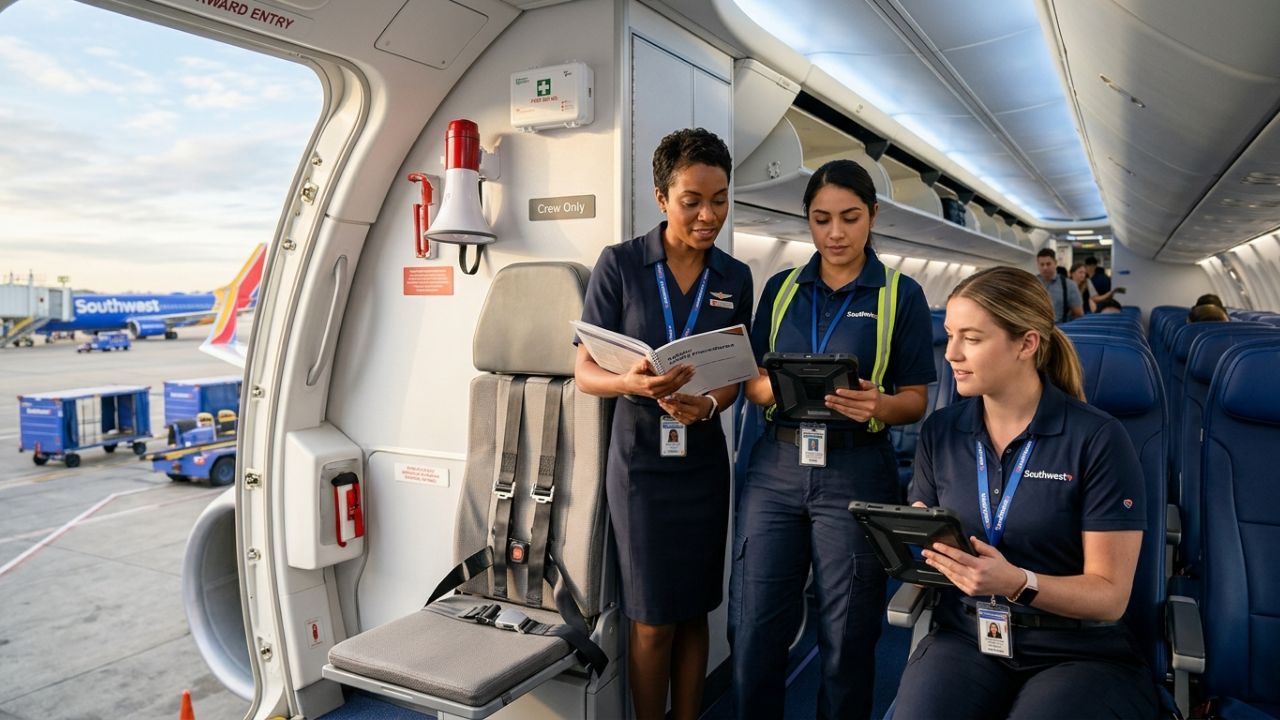
Image representing the intense strategic battle as global aviation authorities desperately deploy mandatory safety training and reverse jumpseat bans to combat severe transit friction and bypass paralyzing hub congestion.
Breaking Airline News: Southwest Airlines Reverses Crucial Jumpseat Ban to Prevent Maintenance Shortages and Massive Travel Chaos
As paralyzing terminal congestion, terrifying infrastructural fragility, and severe labor disputes violently threaten to completely choke highly complex domestic itineraries, Southwest Airlines has executed a brilliant high-stakes operational maneuver. In a desperate bid to physically and psychologically rescue the United States transit grid from the terrifying threat of extreme travel chaos triggered by severe maintenance shortages, the Dallas-based carrier has aggressively reversed a highly controversial internal policy. Officially enacted this week, the airline has shattered a March restriction that previously limited spare Boeing 737 cabin jumpseats exclusively to flight attendants and pilots. Because regional and national airports rely heavily on commuting mechanics and operational staff to keep aircraft flying, this aggressive policy reversal did not remain localized; it violently rippled outward across Dallas, Houston, and the broader US network. By forcibly reinstating non-rev (non-revenue) jumpseat privileges for all employees—mandating a strict, newly deployed safety training module—Southwest has effectively neutralized a massive arbitration threat from its mechanics union. This operational paradigm shift is transforming modern logistical deployment, proving that actively maintaining workforce mobility is the ultimate defense against the agonizing misery historically defining major flight cancellations and massive airport disruptions.
In a harrowing display of modern aviation vulnerability, the sheer logistical nightmare of attempting to navigate essential corridors during peak travel seasons has historically forced airlines into terrifying transit scenarios when internal labor dynamics fail. For months, enduring the jumpseat restriction meant critical technical personnel were left physically stranded at the terminal when revenue flights sold out, staring at departure boards with intense anxiety as rolling delays threatened their ability to commute to vital maintenance bases. However, Southwest Airlines is aggressively fighting back against this structural paralysis. Recognizing that forcing mechanics to compete for non-existent passenger seats creates a massive, highly stressed operational bottleneck, the airline was forced to aggressively decompress the tension. By restoring access and enforcing a rigorous computer-based safety module, Southwest is offering its technical workforce the absolute freedom to physically shield themselves from the devastating effects of paralyzed transport networks, ensuring that critical aircraft repairs are not stalled by commuting failures.
Expanded Overview: The Massive Scale of the Transit Shield
The terrifying crisis of overwhelming passenger stress currently gripping complex global itineraries brutally exposes the severe limitations of flying through saturated hubs without an operational buffer. Recognizing that aggressively forcing critical staff off the aircraft leads directly to severe mechanical delays, Southwest has fundamentally rewritten its cabin safety protocols. The sheer scale of this internal realignment is immense. Jumpseat access is a highly valued, fiercely protected perk in the airline industry. By resolving this inter-union friction just ahead of a scheduled arbitration hearing, the airline preserved operational efficiency across its entire United States network, allowing employees to utilize these critical spare seats positioned near the aircraft doors to bypass severe travel disruptions.
Section-Wise Breakdown: The Operational Realignment
Breaking the Initial Gridlock: The Flight Attendant Ban
To fully grasp the massive operational friction defining this crisis, one must understand the initial March directive. The jumpseat ban was violently pushed into effect following intense pressure from the TWU 556 flight attendant union. With nearly a third of all Southwest flight attendants commuting via aircraft themselves, the union argued aggressively that untrained non-crew personnel occupying jumpseats could disrupt operations and compromise passenger safety during emergency evacuations. In the highly regulated United States airspace, uniform training in emergency procedures is paramount, leading to the temporary grounding of non-crew commuters.
Shattering Labor Bottlenecks: The Mechanics Union Intervention
The massive infrastructural anomaly defining this disruption was the swift, aggressive counter-attack by the AMFA 18 mechanics union. Citing a highly critical contractual clause mandating that its members must not be treated less favorably than other staff regarding jumpseat priority, the union forced Southwest to the brink of formal arbitration. Facing the terrifying prospect of a legally mandated, highly disruptive operational ruling, Southwest preemptively reversed the restriction, actively restoring access to all employee groups to prevent rolling flight cancellations triggered by stranded technical crews.
Deploying the Mandatory Training Shield
Looking beyond the immediate labor truce, the airline executed a massive safety deployment to satisfy the flight attendants. Southwest implemented an absolute, mandatory computer-based training program for any employee seeking non-rev jumpseat privileges. This critical module aggressively instructs mechanics and administrative staff on proper harness usage, appropriate conduct in proximity to cabin crew, and strict emergency evacuation protocols, effectively bridging the safety gap.
The Global Operational Standard
This internal United States battle heavily mirrors broader international aviation trends. While Southwest previously permitted broader use, global carriers deploy varied tactics to combat operational friction. Gulf carriers, including Emirates in Dubai, fiercely restrict jumpseat access to crew only. Conversely, across Europe and Asia, airlines frequently balance operational safety with employee travel privileges through mandatory certifications—a strategy Southwest is now directly mirroring to align with practices observed in the United Kingdom and the United Arab Emirates.
Southwest Jumpseat & Union Operational Matrix
To fully comprehend the massive logistical and strategic fallout of this new network integration, corporate travel managers and affected tourists must review the exact operational metrics defining the Southwest expansion. The following matrix provides a granular breakdown of the specific, officially verified strategic capacity data driving this massive disruption mitigation effort.
| Operational Policy Data | Verified Union Strategy |
|---|---|
| Operating Carrier / Aircraft | Southwest Airlines / Boeing 737 Fleet |
| Initial March Directive | Jumpseats restricted to Flight Attendants & Pilots only |
| Flight Attendant Union | TWU 556 (Driven by safety & evacuation concerns) |
| Mechanics Union | AMFA 18 (Triggered arbitration over contractual rights) |
| Current Operational Directive | Access Restored to All Non-Rev Employees |
| Mandatory Compliance Protocol | Computer-based harness & evacuation training module required |
Passenger Impact: Surviving the Intercontinental Jump
For the millions of global tourists attempting to navigate the rapidly expanding domestic transit corridors, this massive internal policy shift represents a highly anticipated lifeline against severe operational delays. The brutal reality of enduring a terrifyingly sudden cancellation due to "maintenance crew unavailability" inflicts intense psychological stress and completely destroys meticulously planned itineraries. By actively guaranteeing that mechanics can commute to outstation bases via jumpseats, Southwest drastically reduces passenger exposure to these terrifying, high-stress environments.
Survival Guide for Transit Travelers
While this policy is internal, passengers desperately preparing to navigate the modernized global network must understand how it affects their survival protocols:
- Acknowledge Operational Stability: When airlines resolve inter-union disputes regarding commuting rights, overall fleet reliability skyrockets. The restoration of mechanic jumpseat privileges directly translates to fewer mechanical delays at the gate.
- Recognize Cabin Dynamics: Passengers seated near jumpseats must acknowledge that non-uniformed personnel occupying these seats are highly trained airline employees fully certified in emergency evacuation protocols.
- Monitor Safety Regulations: As global safety standards shift across the United States and the United Kingdom, travelers must understand that airlines are actively tightening internal training to completely bypass the threat of regulatory grounding.
Industry Analysis: The Economics of Tactical Route Surges
From a strategic aviation perspective, the travel turmoil currently threatening global hubs highlights the terrifying vulnerability of airlines relying on fractured internal labor agreements. Industry analysts note that this massive reversal by Southwest is a highly aggressive, tactical response to rising mechanical demand that directly combats the threat of network failure. By reinstating access and introducing training, Southwest successfully satisfied multiple stakeholder interests, proving that balancing workforce perks with operational security is the absolute only way to prevent severe travel chaos from crippling the Boeing 737 fleet.
Conclusion: A Strategic Retreat to Ensure Aviation Survival
As the extremely critical travel season accelerates, the massive deployment of Southwest's jumpseat training module represents a massive warning to legacy carriers attempting to restrict employee mobility. The aggressive maneuvering proves that capturing market dominance requires terrifyingly swift and highly optimized logistical deployments, ensuring that the staff required to maintain the aircraft can actually board the flight. By acting aggressively to leverage these newly minted safety protocols, the airline can successfully survive the intense travel surges and completely avoid the paralyzing threat of maintenance-induced travel chaos.
Key Takeaways
- Massive Tactical Reversal: Southwest Airlines has aggressively reversed a March policy that banned mechanics and administrative staff from utilizing spare cabin jumpseats.
- Crushing the Labor Bottleneck: The AMFA 18 mechanics union forced the reversal under threat of arbitration, protecting their contractual rights to non-rev travel.
- Strategic Safety Deployment: To satisfy safety concerns raised by the TWU 556 flight attendant union, Southwest has deployed a mandatory computer-based harness and evacuation training module for all non-crew jumpseat users.
- Terminal Congestion Shield: By allowing technical staff to commute via jumpseats, Southwest actively reduces the threat of mechanical flight cancellations, protecting passengers from severe travel chaos.
- Global Alignment: This strategic shift aligns Southwest with international safety practices observed in Europe, Asia, and the United Arab Emirates regarding non-rev cabin protocols.
Related Travel Guides
Disclaimer
This article is for informational and educational purposes only. It does not constitute legal, financial, or professional advice. While we strive to provide accurate and up-to-date information, travel policies, regulations, and conditions change rapidly. Always verify information with official sources before making travel decisions. Nomad Lawyer makes no representations about the accuracy, reliability, completeness, or suitability of the information provided. Readers should consult qualified professionals for advice specific to their circumstances. The views expressed in this article are those of the author and do not necessarily reflect the views of Nomad Lawyer.
Kunal K Choudhary
Co-Founder & Contributor
A passionate traveller and tech enthusiast. Kunal contributes to the vision and growth of Nomad Lawyer, bringing fresh perspectives and driving the community forward.
Learn more about our team →