
Southwest Carry-On Rules Face TSA Scanner Friction: Why 24-Inch Bags Strain Next-Gen Airport Checkpoints

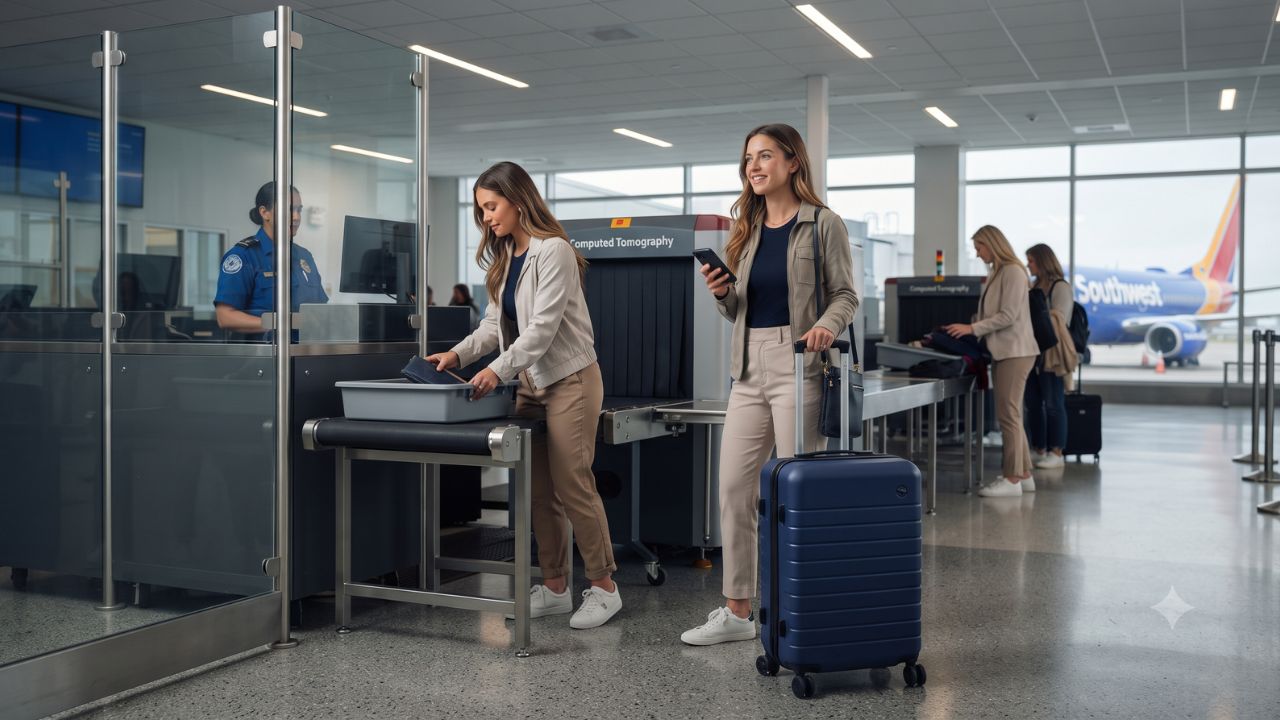
Offering approximately 38.5% more volume than its legacy competitors with a maximum cabin allowance of 3,840 cubic inches, Southwest Airlines' signature 24 × 16 × 10-inch carry-on policy is encountering an unexpected bottleneck at American airport security checkpoints. As the Transportation Security Administration (TSA) accelerates deployment of next-generation computed tomography (CT) scanners—many featuring tunnel apertures measuring approximately 24.5 by 16.5 inches—passengers carrying maximum-gauge roller bags face potential secondary screening delays, manual inspections, or forced counter check-in despite full compliance with airline rules.
The operational issue illustrates an institutional disconnect within civil aviation: commercial airlines determine the dimensions of baggage permitted inside aircraft passenger cabins, while federal security authorities mandate the physical architecture of checkpoint screening systems. Although no nationwide federal ban exists on 24-inch luggage, the razor-thin clearance between maximum-sized bags and CT screening portals creates practical friction for travelers seeking to avoid checked baggage fees.
The Dimensional Rift: Airline Allowances Versus Checkpoint Hardware Physics
The foundation of the controversy lies in the contrasting luggage limits established across major American airlines. Southwest Airlines maintains one of the most generous overhead baggage policies in the domestic industry. As of October 15, 2026, the carrier permits each passenger to board with one standard carry-on suitcase measuring up to 24 inches in length, 16 inches in width, and 10 inches in height (approximately 61 × 41 × 25 centimeters), alongside one smaller personal item designed to rest beneath the forward seat.
In contrast, network carriers such as American Airlines and Delta Air Lines enforce a strict 22 × 14 × 9-inch threshold. While a variance of two inches in length, two inches in width, and one inch in height might appear negligible on a boarding pass, the geometric consequence is substantial:
- Southwest Airlines: 50 total linear inches (24 + 16 + 10), yielding approximately 3,840 cubic inches of theoretical rectangular volume.
- American and Delta: 45 total linear inches (22 + 14 + 9), providing 2,772 cubic inches of theoretical rectangular volume.
This five-inch linear delta provides Southwest passengers with 1,068 additional cubic inches of packing space—a 38.5% volumetric advantage. Luggage manufacturers have capitalized on this allowance by engineering high-capacity, soft-sided expandable cases tailored specifically to Southwest’s sizing limits. However, when passengers expand external zippered gussets, overpack front pockets, or utilize protruding heavy-duty spinner wheels, the exterior dimensions frequently swell past 24.5 inches, directly conflicting with the physical aperture of newer checkpoint screening equipment.
The Mechanics of Computed Tomography: CPSS Architecture and Tunnel Tolerances
To replace aging two-dimensional X-ray machines, the TSA has been systematically procuring Computed Tomography systems, designated within federal procurement frameworks as Checkpoint Property Screening Systems (CPSS). Unlike legacy scanners that produce flat radiographic shadows, CT machines utilize rotating gantry sensors to capture hundreds of volumetric slices, generating three-dimensional, rotatable holographic models of bag interiors.
As demonstrated at the TSA's innovation checkpoint at Harry Reid International Airport in Las Vegas, CPSS installations significantly enhance passenger throughput by permitting travelers to leave laptop computers, large tablets, and compliant travel liquids inside their luggage. The Federal Aviation Administration (FAA) and Department of Homeland Security have supported this deployment across base, mid-sized, and full-sized terminal configurations.
However, dimensional tolerances within these advanced portals remain strict. Industry analysis published on October 12, 2026, highlighted that certain widely deployed CT scanner portals feature opening dimensions of roughly 24.5 inches by 16.5 inches. For a rigid suitcase measuring exactly 24 × 16 inches, the physical margin of clearance is less than half an inch. When such a case enters the scanner atop a plastic conveyor tray or tilts slightly along the roller bed, molded corner guards, rigid top handles, or extended wheels can brush against the internal tunnel curtains or housing, triggering sensor jams or conveyor stalls.
Carry-On Dimensions, Volume Capacities, and Checkpoint Compatibility Matrix
To clarify the structural differences across airline allowances and checkpoint scanning hardware, the following matrix details volumetric metrics and operational constraints:
| Carrier / Screening Authority | Published Exterior Carry-On Limit | Total Linear Dimensions | Theoretical Rectangular Volume | Nominal Checkpoint Tunnel Margin | Multi-Carrier Itinerary Risk |
|---|---|---|---|---|---|
| Southwest Airlines | 24 × 16 × 10 inches (61 × 41 × 25 cm) | 50 Linear Inches | ~3,840 cubic inches | Tight: Less than 0.5 inches on 24.5" apertures | High: Exceeds standard 22" cabin sizers |
| American Airlines | 22 × 14 × 9 inches (56 × 36 × 23 cm) | 45 Linear Inches | ~2,772 cubic inches | Ample: Clears 24.5" × 16.5" portals easily | Low: Industry standard baseline |
| Delta Air Lines | 22 × 14 × 9 inches (56 × 36 × 23 cm) | 45 Linear Inches | ~2,772 cubic inches | Ample: Fits standard CPSS trays and tunnels | Low: Broad domestic and global alignment |
| TSA CPSS CT Scanner | ~24.5 × 16.5-inch aperture opening | Varies by manufacturer | 3D Rotational Image Tunnel | Baseline hardware constraint for all flyers | Universal screening standard |
Operational Scenarios at the Checkpoint: What Happens When a Bag Stalls
When a passenger presents a maximum-allowance Southwest suitcase at a CT-equipped checkpoint, three primary operational outcomes can unfold:
- Standard Clearance: The bag enters the portal squarely within its designated tray, clears the internal sensor gantry without contact, and exits onto the automated roller lane without delay.
- Secondary Manual Inspection: Protruding hardware or overstuffed compartments brush the portal edges, prompting safety sensors to halt the conveyor. A Transportation Security Officer (TSO) must pull the bag for physical examination, adding three to eight minutes to checkpoint dwell time.
- Refusal of Machine Screening: If a rigid-shell case physically cannot clear the tunnel dimensions and no parallel legacy wide-body X-ray lane is operational, TSOs cannot clear the luggage electronically. In such rare instances, the passenger is directed to return landside to the Southwest check-in counter to surrender the piece as checked baggage.
The risk of being redirected to a ticket counter carries significant consequences for departing passengers. Exiting the security queue requires retracing steps through terminal departure halls, waiting in airline ticket queues, and navigating the security checkpoint a second time. During peak holiday corridors, this sequence can easily consume 45 to 60 minutes, turning a tight boarding window into a missed flight.
Expert Analysis: The Disconnect Between Airline Cabin Allowances and Federal Checkpoint Architecture
The tension between Southwest's generous carry-on policy and modern TSA screening hardware illustrates an acute regulatory failure to synchronize commercial airline incentives with federal security engineering. Commercial airlines leverage differentiated baggage allowances as strategic competitive weapons; by offering a 50-linear-inch allowance, Southwest attracts high-value business travelers and family vacationers determined to bypass checked baggage handling.
For travelers booking this route, the direct consequence is an unpredictable checkpoint journey where compliance with Southwest's contract of carriage provides zero legal guarantee of frictionless passage through TSA security lanes. A bag that passes without issue at a smaller regional airport utilizing legacy wide-aperture X-ray equipment may encounter immediate physical resistance when returning through a major hub equipped with modern, tightly contoured CT portals.
The pricing pressure this creates means that passengers who purchase non-flexible, basic economy fares—or those flying without elite loyalty credentials—face unexpected baggage fee liabilities if checkpoint screeners force them back to the ticket counter. While Southwest permits two complimentary checked bags on standard fares, connecting passengers who transition to partner airlines or those holding restrictive codeshare bookings may find themselves paying $35 to $40 per bag when an oversized carry-on is rejected by checkpoint scanners.
Additionally, this dynamic places an unfair burden on frontline security personnel. TSOs are charged with detecting explosive threats and contraband, not enforcing airline size limits. When an oversized bag jams a high-speed automated screening lane, the resulting queue deceleration penalizes every traveler in the security queue, highlighting the urgent need for harmonized equipment procurement standards across the Department of Homeland Security and commercial airlines.
Key Takeaways
- Generous Volume Differential: Southwest Airlines permits 24 × 16 × 10-inch carry-on bags (3,840 cubic inches), offering 38.5% more volume than American and Delta's 22 × 14 × 9-inch limits.
- Narrow Machine Clearance: Newer TSA CT scanners feature tunnel apertures averaging approximately 24.5 × 16.5 inches, leaving minimal margin for maximum-sized 24-inch suitcases.
- No National Prohibition: The TSA has enacted no nationwide ban on 24-inch luggage; issues stem from localized physical equipment clearances rather than regulatory rule changes.
- Checkpoint Reversal Risks: Luggage unable to pass through CT screening portals may be referred back to airline ticket counters for checked baggage handling, creating severe flight delay risks.
- Pre-Flight Measurement Advice: Passengers should measure packed luggage—including exterior pockets, wheels, and handles—before arriving at the airport to avoid checkpoint jams.
FAQ: Southwest Carry-On Dimensions and TSA CT Scanners 2026
What is Southwest Airlines' current carry-on size limit?
Southwest allows one carry-on bag measuring up to 24 × 16 × 10 inches (including wheels and handles) plus one personal item fitting beneath the seat in front, free of charge.
Did the TSA ban 24-inch carry-on luggage?
No. The TSA has not banned 24-inch suitcases. However, certain new CT screening machines have narrow tunnel apertures that can create physical clearance issues for overpacked maximum-sized bags.
What happens if my carry-on bag does not fit into the TSA scanner?
If a bag physically cannot clear the screening tunnel, TSA officers will attempt alternative screening methods or require the passenger to return to the airline counter to check the luggage.
Do other US airlines allow 24-inch carry-on suitcases?
Most major US carriers, including American Airlines, Delta Air Lines, and United Airlines, restrict standard carry-on bags to smaller 22 × 14 × 9-inch dimensions.
[In modern air travel, the true measure of your luggage is not what the airline promises, but what the checkpoint machine can swallow.]
Related Travel Guides
- Mexico Pacific Coast Travel Alert: Hurricane Simon and Tropical Storm Trudy Menace Puerto Vallarta and Manzanillo
- Breeze Airways Unlocks Tampa to St. Thomas Route: Catalyzing USVI Island-Hopping and Winter Escapes
- US Reissues Level 4 Yemen Travel Warning: Extreme Hostage Protocols Explicitly Encompass Socotra Island
Disclaimer
This article is for informational and educational purposes only. It does not constitute legal, financial, or professional advice. While we strive to provide accurate and up-to-date information, travel policies, regulations, and conditions change rapidly. Always verify information with official sources before making travel decisions. Nomad Lawyer makes no representations about the accuracy, reliability, completeness, or suitability of the information provided. Readers should consult qualified professionals for advice specific to their circumstances. The views expressed in this article are those of the author and do not necessarily reflect the views of Nomad Lawyer.
Kunal K Choudhary
Co-Founder & Contributor
A passionate traveller and tech enthusiast. Kunal contributes to the vision and growth of Nomad Lawyer, bringing fresh perspectives and driving the community forward.
Learn more about our team →