
Hollywood Burbank Airport Debuts US$1.3 Billion Replacement Terminal to Resolve Decades-Old Runway Safety Mandate

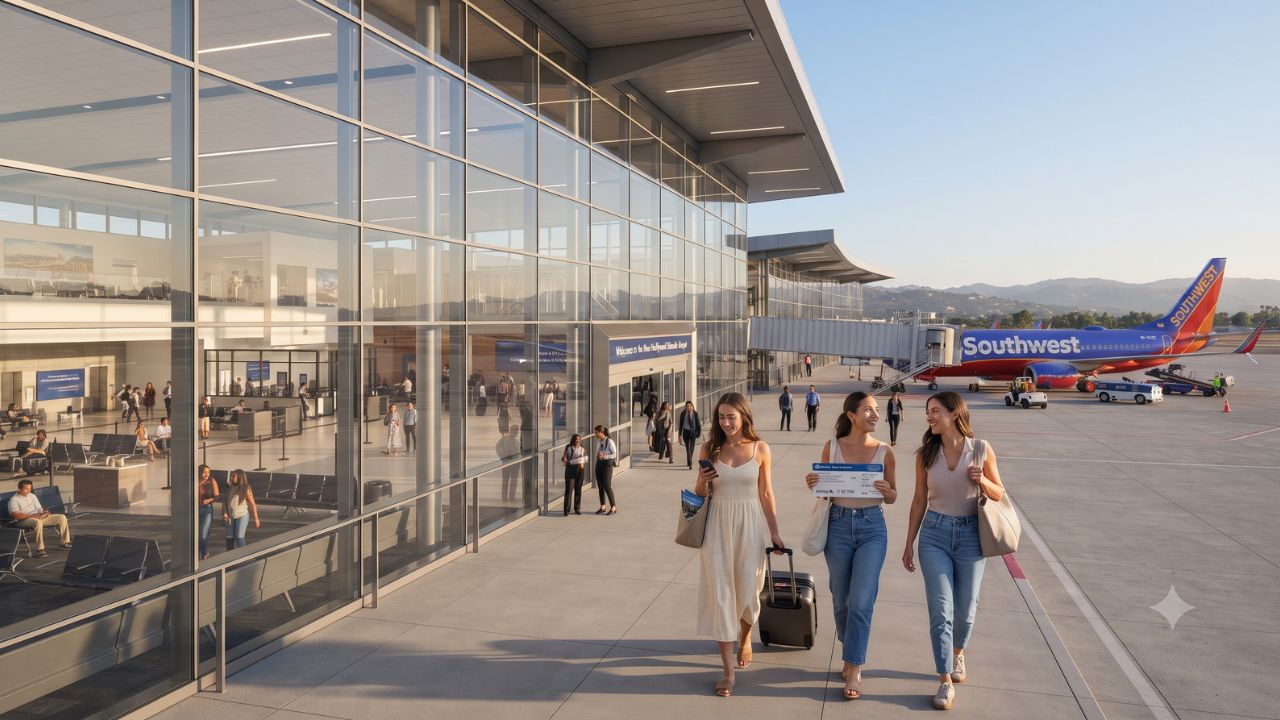
Positioned precisely 880 feet from active runway pavement—more than triple the 250-foot setback of its 1930 predecessor—Hollywood Burbank Airport’s newly inaugurated US$1.3 billion replacement passenger terminal resolves a decades-long federal safety noncompliance issue. Officially opened to passenger operations on 13 October 2026 under the capital development initiative known as Elevate BUR, the 355,000-square-foot facility replaces an antiquated complex that handled commercial flights for nearly a century in direct conflict with modern aerodrome design codes. While tripling the airport's interior footprint, the project deliberately caps total capacity at exactly 14 boarding gates, adhering to strict legal and civic agreements negotiated with surrounding municipalities.
The operational transfer represents a critical infrastructure benchmark for the Greater Los Angeles basin. Managed by the Burbank-Glendale-Pasadena Airport Authority, the new facility directly serves passenger flows across northern Los Angeles, the San Fernando Valley, Glendale, and Pasadena, providing rapid regional access to major entertainment media hubs including Universal Studios Hollywood and Warner Bros. Studio Tour Hollywood. By funding the US$1.3 billion transition through airport revenue bonds, passenger facility charges, airline user fees, and federal grants, the facility preserves its rapid-turnaround boutique status while bringing passenger processing into alignment with rigorous federal standards.
Elevate BUR: Regulatory Mandates and the 880-Foot Setback
The imperative behind replacing Hollywood Burbank Airport stems entirely from aviation safety enforcement. The original passenger terminal, erected in 1930 during the infancy of commercial aviation, stood approximately 250 feet from the centerline of Runway 15/33. Under structural design criteria enforced by the Federal Aviation Administration (FAA), modern air carrier airports must maintain strict Runway Safety Areas (RSAs) and object-free buffer zones to prevent catastrophic ground collisions in the event of an aircraft excursion or overshot landing.
For decades, Burbank operated under conditional federal waivers because building constraints prevented standard setbacks without acquiring new land or relocating the terminal entirely. The solution arrived when voters in the city of Burbank approved Measure B in 2016 by a decisive 70% majority, authorizing the airport authority to build a replacement facility on the adjacent "B-6" property northeast of the runway intersection.
Construction formally commenced in January 2024 following environmental reviews and inter-agency coordination. By establishing an 880-foot setback from runway operations, the new terminal satisfies all FAA safety mandates, integrates modern California seismic engineering, and clears the path for the systematic demolition of the 96-year-old historic terminal building.
Infrastructure Metrics: Terminal Footprint and Landside Overhaul
Despite expanding from an overcrowded footprint to 355,000 square feet, the airport authority maintained strict limits on aircraft capacity. In accordance with voter commitments, the terminal retains exactly 14 aircraft boarding gates, ensuring that the facility functions as a facility upgrade rather than an uncontrolled volume expansion. Hollywood Burbank served approximately 6.2 million passengers in 2025, with carrier operations dominated by Southwest Airlines alongside domestic network carriers.
Landside accessibility has undergone an equally extensive reconfiguration. The opening of the replacement terminal on 13 October 2026 triggered the permanent closure of Parking Lot E, following the previous shutdown of Lot C in August 2026. A newly constructed multi-level parking garage now delivers approximately 2,000 vehicle stalls directly adjacent to the passenger hall, supplemented by 310 dedicated electric vehicle charging ports.
Regional multi-modal connectivity is facilitated via dedicated airport shuttles connecting directly with Metrolink commuter trains and Amtrak Pacific Surfliner rail services at Burbank Airport-South and Burbank Airport-North stations.
| Facility Component | Legacy 1930 Facility | Replacement 2026 Terminal | Operational Change & Traveler Impact |
|---|---|---|---|
| Runway Setback Distance | ~250 feet | ~880 feet | Meets modern FAA runway safety perimeter mandates |
| Total Terminal Floor Area | Constrained footprint | ~355,000 sq. ft. | Vastly expanded circulation, concessions, and waiting areas |
| Boarding Gate Count | 14 gates | 14 gates | Zero gate growth; preserves local community noise/traffic limits |
| Security Screening Checkpoint | 5 screening lanes | 8 screening lanes | 60% increase in TSA lane capacity to cut peak wait times |
| Maximum Gate Walk Distance | ~1,600 feet | ~1,285 feet | Shorter concourse layout preserves rapid gate access |
| Baggage Claim Facilities | Outdoor, partially covered | Fully enclosed indoor hall | Eliminates weather exposure; expanded carousel belts |
| Structured Parking & EV Ports | Surface lots (Lots C & E closed) | 2,000 structured spaces | Adds 310 dedicated electric vehicle charging stations |
| Regional Transit Access | Burbank Airport-South / North | Shuttle-connected rail links | Seamless connections to Amtrak Pacific Surfliner & Metrolink |
Inside the terminal concourses, walking efficiency remains prioritized. The transit distance from the main entrance to the furthest gate measures approximately 1,285 feet, reflecting a noticeable reduction from the 1,600-foot trek through the rambling historic corridors. Concurrently, security screening capacity increased by 60%, expanding from five Transportation Security Administration (TSA) lanes to eight lanes. Baggage claim, notoriously exposed to the elements in the vintage structure, has moved entirely into a climate-controlled indoor arrival hall.
Expert Analysis: Preserving the "Burbank Advantage" Under Commercial Caps
The financial and operational mechanics of the US$1.3 billion terminal reveal a deliberate commercial compromise. Unlike regional hub transformations in cities like Salt Lake City or Kansas City, where capital investments unlocked massive gate additions, Burbank's growth remains artificially constrained by design. The 14-gate cap is a legally binding constraint that protects surrounding residential neighborhoods from exponential flight increases while preventing the airport from challenging Los Angeles International Airport (LAX) for international long-haul traffic.
For travelers booking this route, the direct consequence is that ticket inventory will remain structurally limited during peak morning and evening travel banks. Because airlines cannot simply add gates to absorb surges in passenger demand, seat supply at Burbank will stay relatively inelastic. Southwest Airlines, which commands the vast majority of Burbank's scheduled departures, has explored frequency additions on high-demand leisure routes such as Honolulu, but any new departure must cannibalize an existing slot or utilize higher-density aircraft models. Travelers gain a vastly superior airport terminal with eight security lanes and indoor baggage collection, yet they must accept that flight frequency cannot expand unchecked.
The pricing pressure this creates means that airfares out of Burbank will continue to trade at a noticeable premium compared with departures from LAX. Corporate travelers and entertainment executives heading to Universal Studios Hollywood, Warner Bros., or Disney studios in Burbank routinely pay higher base fares to avoid the two-hour surface transit gridlock of the 405 freeway. Because debt service on the US$1.3 billion project must be recovered through airline landing fees, terminal lease rates, and passenger facility charges, carriers will pass these elevated capital expenses directly into ticket costs.
Operationally, the terminal retains one of its most distinctive historical quirks: outdoor tarmac boarding. Rather than installing enclosed passenger jet bridges that would alter the airport's low-slung architectural aesthetic and slow down aircraft turnaround times, Hollywood Burbank Airport preserved dual-door airstair boarding. This preserves Southwest's rapid 25-minute gate turns while giving arriving passengers immediate access to the California tarmac.
Key Takeaways
- Safety Compliance Achieved: The US$1.3 billion replacement terminal relocates passenger operations 880 feet from the runway, eliminating a 250-foot safety hazard that violated modern FAA separation codes.
- Gate Capacity Capped: In compliance with Measure B and regional municipal accords, the 355,000-square-foot facility maintains an exact 14-gate layout, preventing unchecked flight volume growth.
- Enhanced Landside Flow: The complex introduces eight TSA screening checkpoints, enclosed baggage claim carousels, and a 2,000-space garage featuring 310 electric vehicle charging stations.
- Surface Transit Shifts: On-site parking dynamics shifted permanently on 13 October 2026 with the closure of Lot E, channeling traffic into structured parking and Metrolink/Amtrak shuttle links.
- Short Walking Footprint: Despite tripling interior space, maximum walking distance from the curbside entrance to the furthest gate dropped from 1,600 feet to 1,285 feet.
FAQ: Hollywood Burbank Airport Replacement Terminal 2026
Why did Hollywood Burbank Airport build a new terminal?
The airport built the replacement terminal to comply with FAA safety regulations. The 1930 terminal stood just 250 feet from the runway, whereas the new terminal provides an 880-foot safety buffer.
Did the new terminal add more flight gates?
No. To satisfy municipal agreements approved under Measure B in 2016, the terminal retains exactly 14 boarding gates, matching the capacity of the original facility.
How have parking arrangements changed at Burbank Airport?
Parking Lot E permanently closed on 13 October 2026, following the earlier closure of Lot C. Drivers now use a 2,000-space parking structure equipped with 310 electric vehicle chargers.
Does the new Burbank terminal use jet bridges?
No. Hollywood Burbank Airport preserves its signature outdoor airstair boarding process, allowing dual-door aircraft boarding and deplaning directly on the tarmac to maintain rapid flight turnaround times.
[For travelers navigating Southern California, Burbank’s new terminal delivers modern safety and comfort without sacrificing the ten-minute curb-to-gate efficiency that defines the airport.]
Related Travel Guides
Disclaimer
This article is for informational and educational purposes only. It does not constitute legal, financial, or professional advice. While we strive to provide accurate and up-to-date information, travel policies, regulations, and conditions change rapidly. Always verify information with official sources before making travel decisions. Nomad Lawyer makes no representations about the accuracy, reliability, completeness, or suitability of the information provided. Readers should consult qualified professionals for advice specific to their circumstances. The views expressed in this article are those of the author and do not necessarily reflect the views of Nomad Lawyer.
Raushan Kumar
Founder & Lead Developer
Full-stack developer with 11+ years of experience and a passionate traveller. Raushan built Nomad Lawyer from the ground up with a vision to create the best travel and law experience on the web.
Learn more about our team →