
Southern Ardah of Al-Baha: Saudi Arabia's Living Sword Tradition and Its Arabian Counterparts
The Southern Ardah of Al-Baha is backed by 12 folk troupes and more than 350 active members — here's how it connects to seven other UNESCO-recognised Arabian performance traditions.
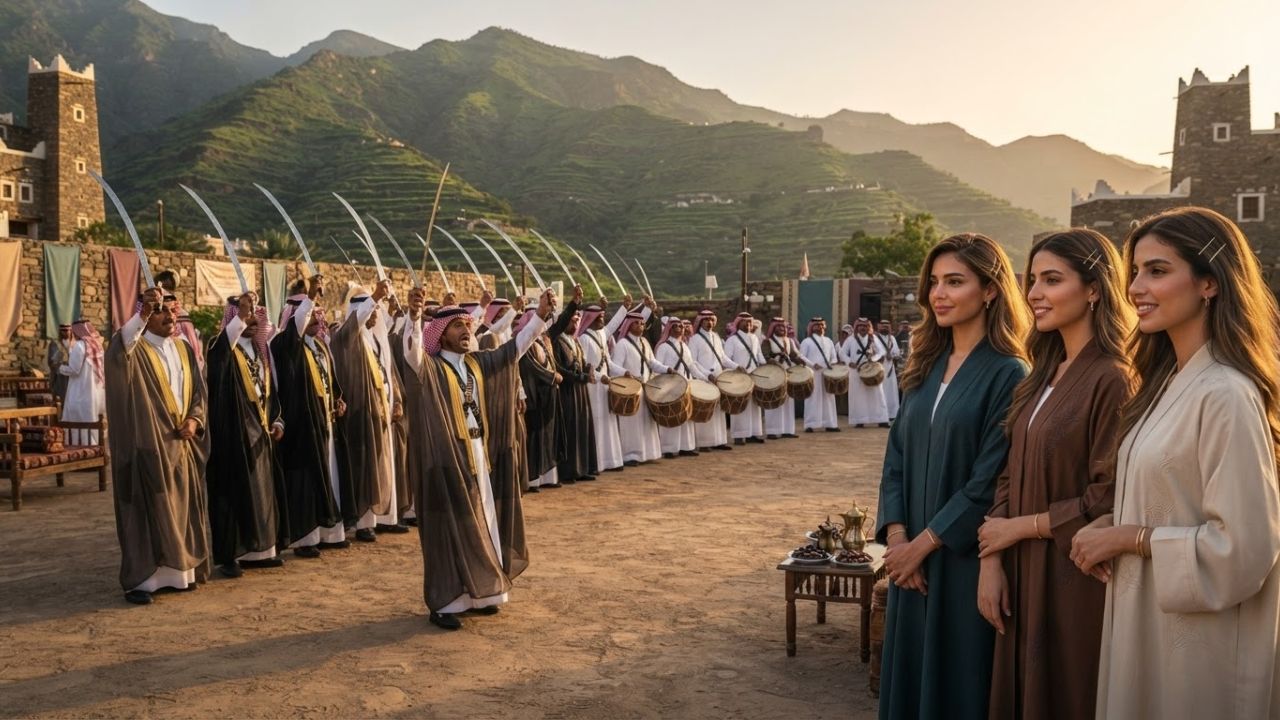
Image generated by AI
The Southern Ardah of Al-Baha is currently supported by 12 folk troupes comprising more than 350 active members across various governorates — making it one of the most institutionally organised living performance traditions in the Arabian Peninsula, and one of the least-known to international cultural travellers.
What the Southern Ardah Is — and Why Al-Baha Is Its Centre
Al-Baha, a mountainous province in southwestern Saudi Arabia between the Hejaz and Tihama regions, is the geographic and institutional home of the Southern Ardah — a centuries-old performance tradition built around synchronised sword movements, improvised poetry exchanges, and the rhythmic beating of the traditional Al-Zir drum.
The Southern Ardah is not a staged recreation for tourists. It is a living community practice that functions as a carrier of collective memory, folk narratives, and regional identity. The art form passes historical events, tribal stories, and social values from one generation to the next through a specific grammar of physical movement, poetic language, and percussion — a combination that, taken together, operates as an oral and kinetic archive of the Al-Baha region's social history.
Dr. Ali Al-Baydani, Director of the Saudi Arabian Society for Culture and Arts, Al-Baha branch, has described the Ardah as a centuries-old tradition through which the shared identity of the Al-Baha community is reflected. Over time, the form evolved from its tribal origins into a performance characterised by artistic grace, poetic eloquence, and structured communal participation.
The Structure of a Southern Ardah Performance
Understanding what actually happens during a performance gives the tradition its full significance. Faisal Waze', Head of the society's folk troupe, has explained the mechanics in detail:
Choreographic Formations: Participants are arranged in flexible rows — there is no fixed numerical limit on participants. Traditional weapons, which include swords, rifles, or daggers, are held during the display. Performers take synchronised steps in pairs, move into a circular formation, and return to a single row. The central field positions performers facing one another, and the movements of lead performers are followed and echoed in controlled sequence by the wider group.
Poetic Exchanges: The physical performance is periodically paused for an exchange of improvised verses between one or more featured poets. This is not incidental — the poetry is structurally integrated into the performance as the moment where the tradition's oral archive is most directly activated. The verses reference historical events, honour specific lineages, and record the community's memory in real time.
Rhythmic Guidance: The Al-Zir drum provides acoustic continuity throughout and governs the pacing and energy of the movement. The drum does not merely accompany — it regulates, functioning as the structural spine that holds the choreography and the poetry in alignment.
The Saudi Arabian Society for Culture and Arts, Al-Baha branch currently supports 12 folk troupes with more than 350 active members and participants across various governorates in the Al-Baha region. The Society also organises dedicated festivals and cultural events tied to national, social, and tourism occasions, and is actively working to document and revive related folk arts that had diminished — including Al-Mahshoush and Al-Samer — to ensure their ongoing transmission alongside the Ardah.
How the Southern Ardah Compares With Seven Regional Traditions
The Southern Ardah belongs to a broader network of Arabian Peninsula and Levantine performance arts that share structural DNA: poetry, percussion, collective movement, and traditional weaponry or symbolic objects. Understanding the distinctions is what makes each tradition meaningful.
Alardah Alnajdiyah — Najd, Saudi Arabia (UNESCO 2015)
The closest counterpart to the Southern Ardah is Alardah Alnajdiyah from the Najd region, inscribed on the UNESCO Representative List of the Intangible Cultural Heritage of Humanity in 2015. Both traditions rest on poetry recitation, group chanting, drum rhythms, coordinated physical movement, traditional clothing, symbolic weaponry, and collective participation during major celebrations. Alardah Alnajdiyah historically connected to tribal gatherings and pre-conflict demonstrations of collective strength and courage; it is now performed at weddings, national festivals, and official ceremonies. Two facing rows of men stand shoulder-to-shoulder, a central poet leads the verses, and sword movements are synchronised with drumbeats alongside a designated flag bearer.
Almezmar — Hijaz, Saudi Arabia (UNESCO 2016)
Almezmar, inscribed by UNESCO in 2016, is the Hijazi sword-stick tradition. It shares the Southern Ardah's structure of opposing lines and rhythmic chanting but replaces the sword with large wooden sticks rotated by two performers at the centre. Group responses are chanted by 15 to 100 participants. The practice represents community unity, collective memory, and social celebration during religious and national events.
Al-Ayyala — United Arab Emirates and Oman (UNESCO Intangible Cultural Heritage)
Al-Ayyala features two facing lines of men moving rhythmically while holding thin bamboo sticks or swords. Tempo is maintained by drummers while poetry is chanted to express solidarity and honour. Where the Southern Ardah emphasises complex sword movements and direct poetic exchanges between individual performers, Al-Ayyala relies more heavily on stick-based movement and structured group response chanting.
Al-Bar'ah — Dhofar, Oman (UNESCO Inscribed)
Al-Bar'ah is associated with the mountain communities of Dhofar and uses male group participation, traditional attire, and rhythmic movement during social and religious gatherings. Its distinctiveness lies in individual gestures — involving shoulders, head movements, and body postures — rather than the large military-style formations characteristic of the Southern Ardah.
Razha — Oman (Listed for UNESCO Consideration)
Razha incorporates sword displays, group formations, drumming, and competitive poetry exchanges — making it the most direct structural parallel to the Southern Ardah among the Omani traditions. Poetry functions as an oral archive to convey messages regarding honour, leadership, historical events, and tribal achievements, mirroring the Southern Ardah's poetic purpose almost precisely.
Palestinian Dabkeh — The Levant (UNESCO 2023)
Palestinian Dabkeh, inscribed by UNESCO in 2023, fulfils a comparable social function across Palestine, Lebanon, Jordan, and Syria as a tool for community gathering and heritage preservation. Performers form straight lines, semi-circles, or connected groups holding hands or shoulders, and the tradition is centred on intricate footwork and physical contact. Where Dabkeh grounds itself in the body's relationship to the earth, the Southern Ardah centres on weapon symbolism, poetic recitation, and percussion rhythm.
Samri — Saudi Arabia and Gulf Region
Samri focuses on group singing, hand clapping, rhythmic swaying, and poetic exchange. Unlike the Southern Ardah, Samri omits battlefield symbolism and weapons entirely, functioning primarily as an expression of social entertainment and poetic appreciation at community gatherings.
The Four Cultural Pillars These Traditions Share
Across all eight of these forms — from the mountain communities of Al-Baha to the coastal towns of the Levant — four structural principles recur:
Poetry as a living archive: Historical events, tribal memories, heroic deeds, and social values are recorded within recited verses rather than written texts, making the performance the primary means of cultural transmission.
Movement as collective identity: Individual dancers are integrated into a single unified body. The tradition does not valorise individual performance — it makes collective synchronisation the point.
Percussion as a communication system: The drum — whether the Al-Zir of Al-Baha, the instruments of Almezmar, or the drummers of Al-Ayyala — functions beyond musical accompaniment. It regulates timing, controls movement speed, and maintains structural order.
Continuity through performance: These traditions survive because they are performed continuously at weddings, national holidays, cultural festivals, and educational displays — not because they are archived in museums.
Visitor Insider Tips: Experiencing the Southern Ardah and Al-Baha
When Ardah performances happen: The Saudi Arabian Society for Culture and Arts, Al-Baha branch, organises performances at national occasions — including Saudi National Day (September 23) and major regional festivals. These are the most reliable windows for witnessing a full performance with multiple troupes. Check the Ministry of Culture calendar at culture.gov.sa for confirmed events.
Al-Baha's climate advantage: Al-Baha sits at approximately 2,500 metres above sea level in the Asir mountain range, giving it a significantly cooler climate than the Gulf lowlands or Riyadh. The region receives rainfall and is notably greener than most of Saudi Arabia. The best travel window is October to March, when temperatures are mild to cool and the high-altitude terraced farmland is at its most visually striking.
The Al-Baha region beyond the performances: The nearby Al-Qarah caves, the terraced villages of the Baha highlands, and the Raghadan Forest — one of the few green forested areas in Saudi Arabia — add significant day-activity value to any cultural visit. The Raghadan Forest is a short drive from the town of Al-Baha city and operates as a public recreation area.
Alardah Alnajdiyah in Riyadh: If you are based in Riyadh and cannot travel to Al-Baha, the Najd Ardah (inscribed UNESCO 2015) is performed at national events at Diriyah and during the Riyadh Season festival, which runs October through February. Both provide accessible introductions to the tradition's structure.
Photography etiquette: At formal performances, always ask permission before photographing individual performers, particularly during poetry exchanges. The performers are community members engaged in a live cultural act, not a produced show. The Saudi Commission for Tourism guidelines suggest observing from designated areas and following the lead of local attendees on camera use.
Almezmar in Jeddah: The Hijazi Almezmar tradition (inscribed UNESCO 2016) is most commonly seen in Jeddah at wedding celebrations and during the Jeddah Season festival. If your itinerary includes Jeddah, local heritage tour operators can arrange attendance at community performances through cultural associations.
Tourism Outlook: Saudi Arabia's Intangible Heritage as a Travel Proposition
Saudi Arabia's Vision 2030 tourism development framework has placed intangible cultural heritage — alongside archaeological sites, natural environments, and entertainment infrastructure — as a core component of the country's international visitor offer. The institutional investment in traditions like the Southern Ardah of Al-Baha reflects a deliberate policy: preserve the living traditions that make Saudi culture distinct from what any global resort destination can replicate.
The Saudi Arabian Society for Culture and Arts operates branches across multiple regions precisely because heritage transmission cannot be left to organic community continuity alone in a rapidly urbanising society. The 12 Al-Baha troupes and their 350-plus participants represent an infrastructure of active cultural custodianship that has few equivalents at this level of organisation in the region.
For international visitors, the Southern Ardah and its counterpart traditions offer something the kingdom's new resorts and entertainment developments cannot: a direct encounter with a performance culture that has been continuous for centuries, still enacted by the communities from which it originated, in the regions where it developed. That is what makes it a genuine cultural tourism proposition rather than a heritage display.
The Saudi Tourism Authority has been systematically integrating intangible heritage programming into its international marketing since 2022. As Saudi Arabia's international visitor numbers continue growing, performances like the Southern Ardah will move from local community events into dedicated cultural tourism circuits — which means the window to experience them in their current, uncommercialized form is genuinely finite.
FAQ: Southern Ardah and Arabian Folk Traditions
What is the Southern Ardah of Al-Baha? The Southern Ardah is a centuries-old Saudi performance tradition from the Al-Baha region, structured around synchronised sword movements, improvised poetic exchanges between featured poets, and the rhythmic guidance of the Al-Zir drum. It is currently supported by 12 folk troupes comprising more than 350 active participants across the region's governorates.
How does the Southern Ardah differ from the UNESCO-inscribed Alardah Alnajdiyah? Both traditions share poetry, group chanting, drum rhythms, coordinated movement, traditional clothing, and symbolic weaponry. Alardah Alnajdiyah (inscribed UNESCO 2015) originates from the Najd region and historically represented demonstrations of tribal collective strength. The Southern Ardah of Al-Baha carries the distinct regional identity and folk narrative traditions of southwestern Saudi Arabia, with a structured role for improvised poetry exchange between multiple featured poets.
Which of these Arabian folk traditions are UNESCO-recognised? Alardah Alnajdiyah was inscribed by UNESCO in 2015. Almezmar was inscribed by UNESCO in 2016. Al-Ayyala (UAE and Oman), Al-Bar'ah (Dhofar, Oman), and Palestinian Dabkeh (2023) are also UNESCO-recognised. Razha is listed for UNESCO consideration. The Southern Ardah of Al-Baha is maintained through institutional support from the Saudi Arabian Society for Culture and Arts.
Related Travel Guides
- Lord Mayor Rejects Council Travel Ban as Global Energy Crisis and Strait of Hormuz Tensions Inflate Municipal Costs: How Saudi Arabia and UAE Stability Anchors Local Governance Amid US-Iran Conflict
- Imagicaaworld Approves 100 Crore Investment in Gujarat Water Park Expansion
- Visiting the Qiantang River Tidal Bore in Zhejiang: 2026 Logistics and Viewing Guide
Disclaimer
This article is for informational and educational purposes only. It does not constitute legal, financial, or professional advice. While we strive to provide accurate and up-to-date information, travel policies, regulations, and conditions change rapidly. Always verify information with official sources before making travel decisions. Nomad Lawyer makes no representations about the accuracy, reliability, completeness, or suitability of the information provided. Readers should consult qualified professionals for advice specific to their circumstances. The views expressed in this article are those of the author and do not necessarily reflect the views of Nomad Lawyer.