
Indonesian Hero Honored Following Deadly South Korea Fire; Raises Fire Safety Awareness for Expatriates
Following a horrific fire in South Korea, the incredible bravery of an Indonesian migrant worker who saved seven elderly citizens has triggered global praise and an urgent travel safety alert regarding accommodation fire hazards.

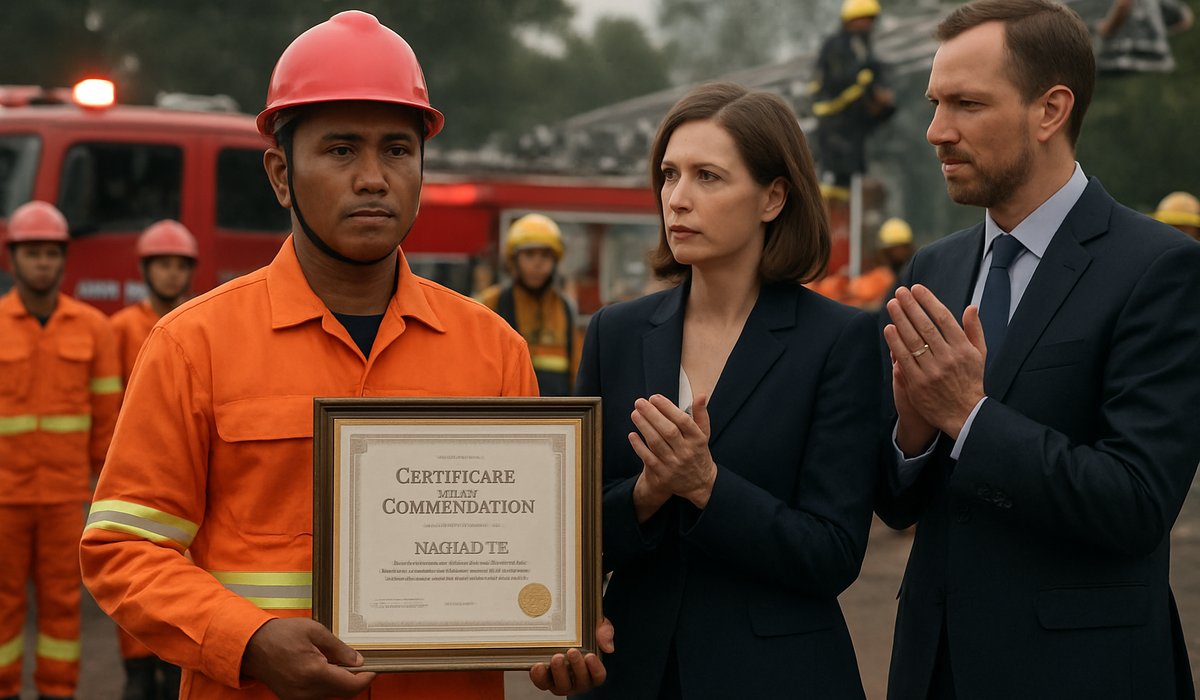
Image generated by AI
Diplomacy Meets Bravery As Tragedy Prompts Lodging Safety Review
In a powerful, heart-stopping event that has captured international diplomatic attention, Indonesian President Prabowo Subianto formally honored Sugianto, an Indonesian migrant worker whose extreme physical bravery directly saved the lives of seven elderly citizens during a catastrophic residential fire in South Korea. The deeply moving ceremony, taking place alongside senior Korean officials at the highest levels of government, has triggered massive global praise for the heroism of expatriate workers, while simultaneously issuing a blunt, terrifying reminder regarding urban fire safety for travelers and long-term expatriates residing in densely populated Asian cities.
While the diplomatic celebration highlights the profound human connection bridging two massive Asian economies, it starkly illuminates the lethal reality of high-density housing blocks. The swift, destructive nature of the South Korean blaze serves as a critical travel alert for millions navigating budget accommodations, hostels, and older residential properties entirely lacking modern, westernized fire suppression matrices.
The Reality of Accommodation Fire Threat
Sugianto’s actions—braving toxic smoke and extreme thermal assault to systematically drag out highly vulnerable individuals—were required primarily because the building's internal evacuation paths rapidly collapsed.
For budget backpackers, migrant workers, and long-term digital nomads traveling across Asia, older multi-story buildings frequently feature severely flawed electrical wiring, obstructed fire escapes, and an utter lack of centralized sprinkler systems. The reality is that if a fire detonates on a lower floor, the stairwells instantly convert into lethal chimneys of superheated, toxic gas, entirely trapping residents above the ignition line.
Core Travel Safety Takeaways from the Incident
| Safety Vector | Why it Matters | Actionable Steps |
|---|---|---|
| Egress Obstruction | Hallways in older Asian buildings often store extreme clutter | Always physically walk the fire stairs up to the roof upon check-in |
| Electrical Spikes | Faulty adapter plugs can initiate wall fires | Never leave large lithium power banks charging unattended overnight |
| Smoke Inhalation | 80% of fatalities occur from toxic smoke, not flames | Secure a wet towel immediately to breathe through during evacuation |
What Guests Get
- Vital emergency psychology — understanding that heroism aside, avoiding fatal residential fires depends heavily on hyper-awareness the moment you put down your luggage.
- Contextualizing diplomatic praise — realizing how the heroic actions of a single migrant worker fundamentally elevated the geopolitical respect for the millions of Indonesians supporting the South Korean economy.
- Sobering risk assessment — prioritizing personal safety over deep budget discounts when selecting international Airbnbs or deeply tucked urban hostels.
What This Means for Travelers
If you are checking into urban accommodations in East Asia: Perform an immediate "Five Second Fire Drill." The moment you open the door to your room, drop your bags, step back into the hallway, and physically count the number of doors between your room and the exit stairwell. If the hallway fills with thick, blinding smoke at 3:00 AM, you must be able to crawl on your hands and knees and navigate entirely by touch.
Verify Alternative Exits: Never rely exclusively on the main elevator lobby. Elevators are absolute death traps during a blaze. If your hotel or hostel features barred windows and locked rooftop accesses—highly common in densely packed urban zones to prevent burglary—recognize that your egress routes are severely compromised. Do not rent rooms higher than the third floor if you cannot verify a secondary, outdoor fire escape.
FAQ: International Hotel and Hostel Fire Safety
Are smoke detectors mandatory in South Korean hotels? In newly constructed or heavily renovated hotels, yes. However, South Korea, like many rapidly industrialized nations, possesses massive tracts of older residential "goshiwons" (micro-apartments) or traditional budget lodging where fire code compliance is heavily un-policed.
What is the diplomatic impact of Prabowo honoring Sugianto? It sends a massive message of national pride and defense of the workforce. Migrant workers frequently face marginalization; a Head of State formally honoring a laborer on foreign soil demands international respect for that community's deep societal contributions.
Should I buy a portable smoke detector for travel? It is highly recommended for extreme budget backpackers. A tiny, battery-operated travel smoke detector costs less than $20 and can be hooked over a hostel door, providing a blaring, life-saving alarm in buildings lacking centralized sensors.
Related Travel Guides
Disclaimer
This article is for informational and educational purposes only. It does not constitute legal, financial, or professional advice. While we strive to provide accurate and up-to-date information, travel policies, regulations, and conditions change rapidly. Always verify information with official sources before making travel decisions. Nomad Lawyer makes no representations about the accuracy, reliability, completeness, or suitability of the information provided. Readers should consult qualified professionals for advice specific to their circumstances. The views expressed in this article are those of the author and do not necessarily reflect the views of Nomad Lawyer.
Raushan Kumar
Founder & Lead Developer
Full-stack developer with 11+ years of experience and a passionate traveller. Raushan built Nomad Lawyer from the ground up with a vision to create the best travel and law experience on the web.
Learn more about our team →