
Fatal Six Flags Coaster Incident Triggers Precautionary Shutdown of Nine Rides Across Six Parks
Following a fatal roller coaster accident at Six Flags Over Georgia, operators suspend nine hypercoasters across six theme parks in the US and Canada amid a criminal and safety probe.

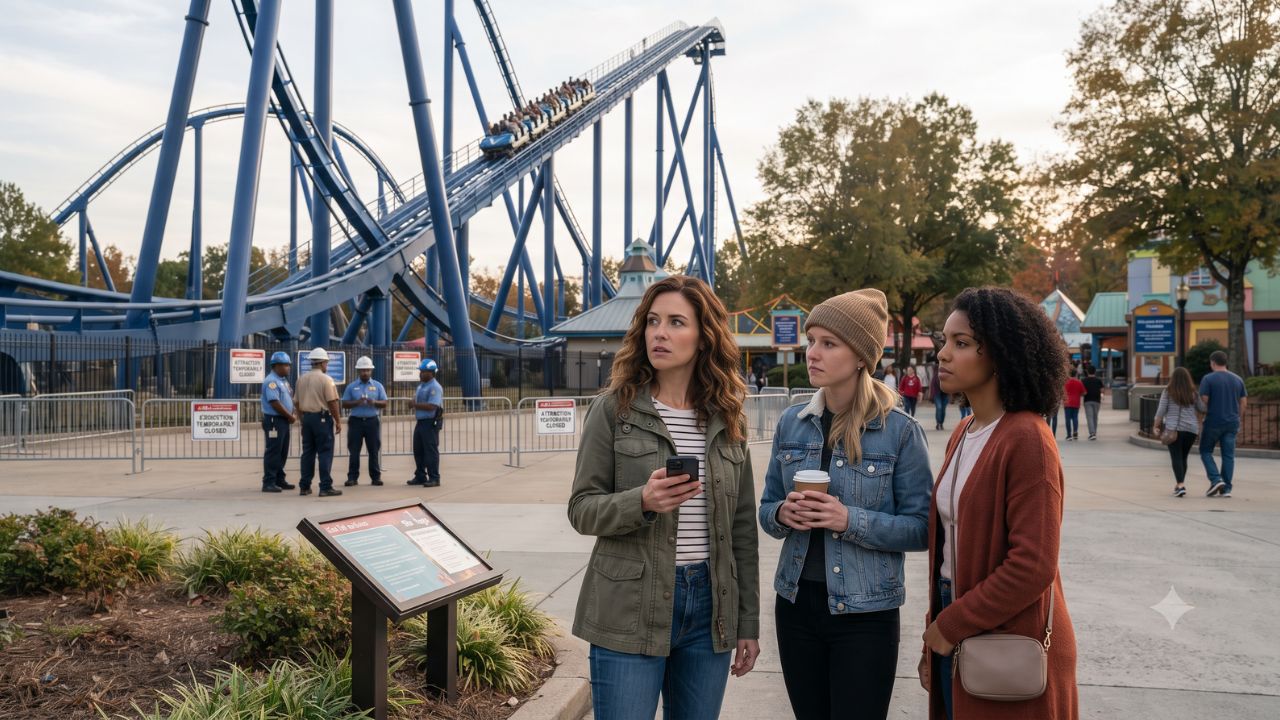
The precautionary shutdown of nine major roller coasters across six premier amusement parks in the United States and Canada follows a fatal incident on Monday, 12 October 2026, at Six Flags Over Georgia that left one person dead and several others injured. Occurring at the company's property in Austell, Georgia, just west of Atlanta, the tragedy has prompted an immediate multi-jurisdictional inquiry led by the Cobb County Police Department's Major Crimes Unit. In response, park operators suspended operations across comparable high-speed, large-scale attractions throughout their regional network, casting uncertainty over visitor schedules during the lucrative autumn travel season.
The multi-park operational stand-down highlights the acute sensitivity of global leisure attractions to catastrophic mechanical or procedural failures. While investigators work to establish whether the fatality stemmed from structural defects, sensor malfunctions, mechanical restraint failures, or rider medical emergencies, the fleet-wide suspension of similar hypercoasters demonstrates how safety protocols ripple across continental entertainment conglomerates. For traveling families and international tourists who plan multi-day destination itineraries around marquee thrill rides, the closures expose the complex intersection of theme park liability, fragmented safety oversight, and limited consumer refund protections.
Incident Circumstances and the Multi-Park Fleet Stand-Down
Initial emergency reports from Six Flags Over Georgia centered on Goliath, the park’s signature 200-foot-tall hypercoaster that reaches maximum advertised speeds of 70 miles per hour. Video footage circulating online showed park personnel evacuating passengers from the attraction's brake runs following the incident. While law enforcement authorities have not formally released the victim's identity or officially confirmed the specific mechanical sequence leading to the death and injuries, Six Flags leadership enacted immediate fleet-wide precautions across sister properties.
The precautionary closures span six major metropolitan leisure destinations in the United States and Canada, temporarily grounding nine high-capacity steel coasters with comparable ride geometry, restraint systems, or manufacturer heritage.
| Theme Park Property | Geographical Location | Affected Attraction / Operational Status | Engineering Scale & Operating Profile |
|---|---|---|---|
| Six Flags Over Georgia | Austell, Georgia (Metro Atlanta) | Goliath (Evacuated; focus of formal police inquiry) | 200-ft Hypercoaster; 70 mph maximum velocity; opened 2006 |
| Six Flags Great America | Gurnee, Illinois (Metro Chicago) | Raging Bull (Temporarily closed as precaution) | 202-ft Hypercoaster; 73 mph maximum velocity; opened 1999 |
| Six Flags Great Adventure | Jackson, New Jersey | Nitro (Suspended pending safety reviews) | 230-ft Hypercoaster; 80 mph maximum velocity; opened 2001 |
| Six Flags Magic Mountain | Valencia, California (Metro Los Angeles) | Goliath (Suspended pending technical clearance) | 235-ft Hypercoaster; 85 mph maximum velocity; opened 2000 |
| Kings Island | Mason, Ohio (Metro Cincinnati) | Similar high-speed coaster operations suspended | High-capacity steel thrill coaster infrastructure |
| Carowinds | Charlotte, North Carolina | Similar high-speed coaster operations suspended | Multi-inversion and high-speed steel coaster profile |
| Canada’s Wonderland | Vaughan, Ontario, Canada (Metro Toronto) | Similar high-speed coaster operations suspended | High-altitude mega/hypercoaster ride class |
The inclusion of Kings Island, Carowinds, and Canada’s Wonderland underscores the post-merger integration of the legacy Six Flags and Cedar Fair portfolios, creating an entertainment operator that applies centralized risk management protocols across North America. Rather than treating the Austell incident as an isolated facility occurrence, engineering directors have paused operations on mechanically comparable roller coasters until non-destructive testing (NDT), sensor logs, and restraint latch telemetry are fully reviewed.
Historical records note that Goliath experienced a separate medical emergency involving a rider shortly after its 2006 opening. However, forensic investigators stress that past medical events must not be conflated with the active criminal and mechanical inquiry into the 12 October tragedy.
The Federal Regulatory Void: The 1981 Roller Coaster Exemption
The investigation in Georgia brings renewed scrutiny to America's fragmented theme park safety regulatory framework. Under current federal statutes, fixed-site amusement park rides are exempt from federal consumer safety oversight. While the U.S. Consumer Product Safety Commission (CPSC) exercises regulatory authority over portable carnival rides transported across state lines, a 1981 congressional statutory amendment stripped the agency of oversight over permanent, fixed-site theme park attractions.
Consequently, inspection standards, incident reporting requirements, and operational certifications are decentralized across state and county agencies:
- State Labor and Insurance Inspections: In Georgia, fixed-site rides are governed under state labor and safety fire inspection codes, supplemented by third-party insurance audits and internal manufacturer guidelines.
- Disparate Reporting Mandates: Unlike the Federal Aviation Administration's mandatory public incident tracking for commercial aviation, amusement ride incident reporting varies dramatically between states. Some jurisdictions mandate immediate public disclosure of minor injuries, while others only require reports for fatalities or hospitalizations exceeding 24 hours.
- Industry Standards Self-Regulation: Theme park operators heavily rely on technical guidelines drafted by ASTM International’s F24 Committee on Amusement Rides and Devices alongside safety directives from the International Association of Amusement Parks and Attractions (IAAPA).
This lack of a unified national safety database complicates consumer risk assessment. When an incident occurs, municipal police departments like the Cobb County Major Crimes Unit must collaborate with private forensic engineering firms and state inspectors to reconstruct technical failures without a standardized federal investigation body analogous to the National Transportation Safety Board (NTSB).
Expert Analysis: Contractual Disclaimers, Ticket Refunds, and Travel Risk
For families and thrill-seekers planning autumn theme park trips, the direct consequence of the multi-park shutdown is significant disruption to vacation itineraries without guaranteed financial compensation. October represents one of the industry's most lucrative commercial windows, driven by evening Halloween and Fright Fest ticket sales. When signature attractions like Goliath, Nitro, or Raging Bull close indefinitely, the perceived value of multi-day gate passes drops sharply.
The legal and contractual friction this exposes highlights the restrictive terms embedded in theme park admission agreements:
- The "As-Is" Admission Clause: Standard ticket terms and conditions across major park operators explicitly state that admission grants access to the park as a whole, not to any specific ride, show, or attraction. Consequently, the unscheduled closure of a headline coaster does not legally obligate operators to issue cash refunds or credit vouchers.
- Travel Insurance Limitations: Standard comprehensive travel insurance policies rarely cover attraction closures unless an entire facility is shut down by civil authorities or catastrophic weather. Disappointment stemming from an inoperable roller coaster is universally categorized as a non-reimbursable change of mind or minor schedule alteration.
- Downstream Hospitality Commitments: For travelers flying into Atlanta, Chicago, or Toronto and booking non-refundable hotel stays adjacent to theme parks, shifting vacation plans is costly. Independent hotels and regional transit providers do not cancel reservations penalty-free simply because a nearby amusement ride is under inspection.
To mitigate trip disruption, travelers holding tickets for the six affected properties should actively monitor official park mobile applications for daily operating status. If visiting primarily for thrill rides, ticket holders should contact guest relations in advance to request date modifications or ticket validity extensions before passing through the turnstiles, as entry into the park universally voids refund requests.
Key Takeaways
- Fatal Roller Coaster Incident: One person died and several others were injured on Monday, 12 October 2026, at Six Flags Over Georgia in Austell, prompting a major police probe.
- Nine Roller Coasters Grounded: Precautionary ride suspensions affect nine similar hypercoasters across six parks, including Six Flags Great America, Six Flags Great Adventure, Six Flags Magic Mountain, Kings Island, Carowinds, and Canada's Wonderland.
- Goliath Under Investigation: The 200-foot-tall, 70-mph Goliath coaster at Six Flags Over Georgia was evacuated and remains the focal point of investigators.
- The Federal Oversight Gap: Fixed-site theme park rides remain exempt from U.S. Consumer Product Safety Commission jurisdiction under a 1981 federal law, leaving investigations to state and local authorities.
- No Automatic Ticket Refunds: Standard theme park admission contracts do not guarantee refunds for individual ride closures, requiring travelers to negotiate rain checks or date modifications directly with park guest services.
FAQ: Six Flags Ride Closures and Amusement Safety 2026
What caused the fatal accident at Six Flags Over Georgia?
The precise cause remains under active investigation by the Cobb County Police Department's Major Crimes Unit and state safety officials. The victim's identity and specific mechanical details have not yet been released.
Which Six Flags parks have closed roller coasters as a precaution?
Precautionary closures of similar roller coasters have been reported at Six Flags Over Georgia, Six Flags Great America (Illinois), Six Flags Great Adventure (New Jersey), Six Flags Magic Mountain (California), Kings Island (Ohio), Carowinds (North Carolina), and Canada’s Wonderland (Ontario).
Can travelers get a ticket refund if their favorite ride is closed?
Generally, no. Standard theme park tickets state that admission does not guarantee the availability of specific rides. However, guest services may offer ticket date changes or rain checks upon request prior to entering the park.
Does the federal government regulate roller coaster safety?
No. The U.S. Consumer Product Safety Commission regulates only portable carnival rides. Fixed-site rides at permanent amusement parks are governed entirely by state-level inspection agencies and municipal building codes.
As investigators examine the mechanics of high-speed thrills, travelers heading to North America's theme parks must prioritize verified safety updates over social media speculation.
Related Travel Guides
Disclaimer
This article is for informational and educational purposes only. It does not constitute legal, financial, or professional advice. While we strive to provide accurate and up-to-date information, travel policies, regulations, and conditions change rapidly. Always verify information with official sources before making travel decisions. Nomad Lawyer makes no representations about the accuracy, reliability, completeness, or suitability of the information provided. Readers should consult qualified professionals for advice specific to their circumstances. The views expressed in this article are those of the author and do not necessarily reflect the views of Nomad Lawyer.
Raushan Kumar
Founder & Lead Developer
Full-stack developer with 11+ years of experience and a passionate traveller. Raushan built Nomad Lawyer from the ground up with a vision to create the best travel and law experience on the web.
Learn more about our team →