
Singapore Sets Global Green Standard: Changi and Seletar Airports to Impose Mandatory Sustainable Aviation Fuel (SAF) Levy by 2026 Amid New Aviation Updates on Carbon Reduction
Singapore has announced a mandatory SAF levy for all flights departing Changi and Seletar starting 2027, introducing a fixed-price 'envelope' system for green travel.

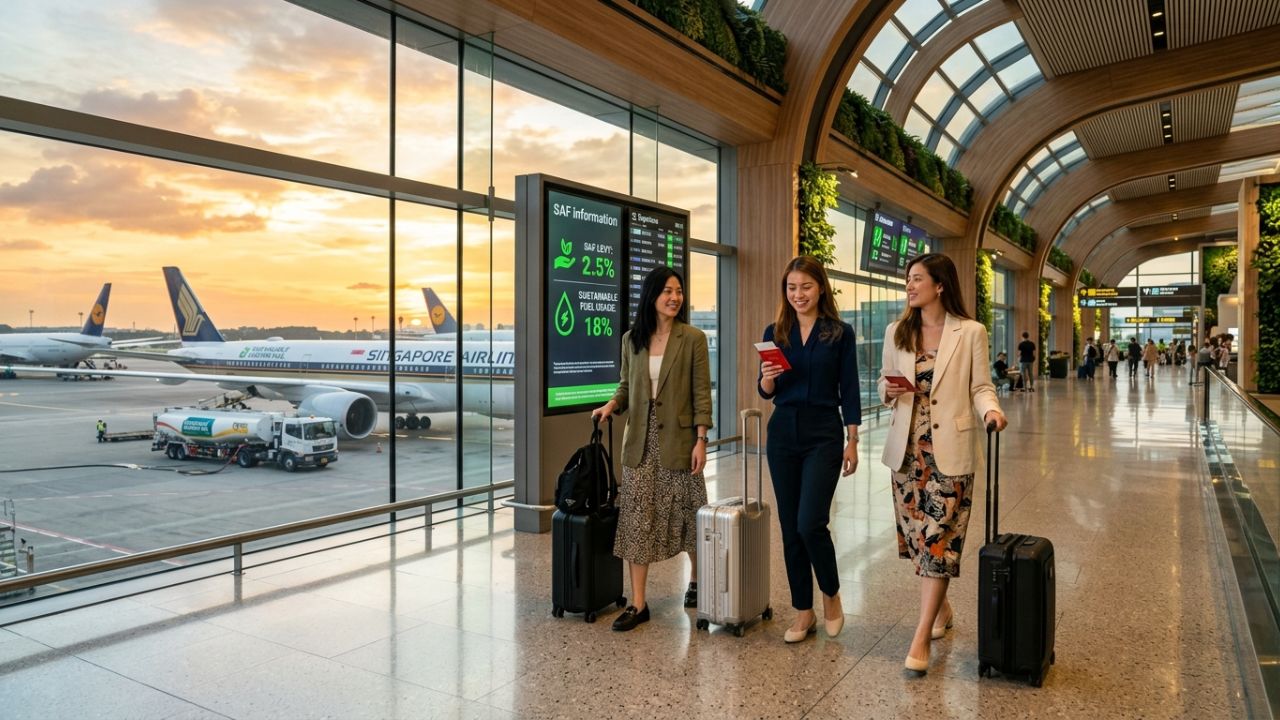
Image generated by AI
In a move that has established a new global blueprint for environmental responsibility, Singapore has officially confirmed the implementation of a mandatory Sustainable Aviation Fuel (SAF) Levy for all flights departing from Changi and Seletar Airports. This major airline news update, announced by the Civil Aviation Authority of Singapore (CAAS), introduces a sophisticated "envelope" funding system designed to shield the industry from the travel chaos and price volatility typically associated with green energy transitions. While the levy has been deferred to tickets sold from October 1, 2026, for flights departing in 2027, Singapore remains resolute in its goal to achieve a 1% SAF blend at its hubs, eventually scaling to 5% by 2030. For the global aviation community, this initiative serves as a critical aviation update on how hub airports can finance decarbonization without triggering the systemic airport disruptions seen in less regulated markets.
Breaking: The "Envelope" System and Singapore’s 2026 Green Mandate
The Singaporean model is a radical departure from the European Union’s ReFuelEU framework. While Europe imposes volume mandates on fuel suppliers, Singapore is shifting the cost certainty directly to the passenger. By centralizing a dedicated SAF Fund, the city-state can secure bulk-purchase agreements for sustainable fuel, which currently remains three to five times more expensive than traditional petroleum-based kerosene.
Aviation experts suggest that this "Green Ticket" approach is the most pragmatic way to avoid the cascading flight cancellations that often occur when airlines are hit with sudden, unmanageable operational costs. By providing a fixed-price surcharge based on travel distance and cabin class, Singapore ensures that both the carrier and the consumer have long-term financial predictability.
Expanded Overview: Navigating the Regional SAF Landscape
Singapore is not alone in its green push. The Asia-Pacific region is quickly becoming a "Regional Pioneer" bloc, with Thailand, Japan, South Korea, and Indonesia all implementing various SAF mandates by 2026. However, Singapore’s unique fixed-price levy positions it as the most transparent market for international travelers.
Initially, the mandate targets a 1% SAF blend at both Changi and Seletar. This phased rollout is a deliberate strategy to prevent the airport disruptions that can arise from supply chain bottlenecks. By leveraging a centralized procurement fund, CAAS can ensure that even as geopolitical tensions in the Middle East cause global fuel fluctuations, Singapore’s aviation hub remains competitively priced and environmentally compliant.
Section-Wise Breakdown: The Geography of the SAF Surcharge
Regional Hub Advantage (Band 1)
For short-haul travelers heading to destinations like Bangkok or Jakarta, the impact is minimal. Economy passengers will contribute just S$1, while Business and First Class travelers will pay S$4. This ensures that regional connectivity remains affordable, preventing the loss of low-yield routes that can lead to localized flight cancellations.
Medium-Haul Connectivity (Band 2)
Travelers bound for Japan, South Korea, or Australia will see a moderate adjustment. The levy is set at S$4 for Economy and S$16 for premium cabins. Cargo operators on these routes are also factored in, with a 5-cent-per-kilogram fee, ensuring that the entire logistics chain contributes to the national carbon goal.
Long-Haul Transcontinental Flights (Band 3)
The highest tier of the levy applies to ultra-long-haul services to the Americas and Europe. Surcharges of S$10.40 for Economy and S$41.60 for First Class are designed to reflect the higher carbon footprint of these journeys. By distributing costs across geographic bands, Singapore maintains a "trauma-informed" financial model that respects the economic realities of long-distance transit.
The Transit Exemption: Protecting the Hub
In a strategic masterstroke, transit and transfer passengers remain fully exempt from the levy. This ensures that Changi Airport maintains its competitive edge against rival hubs like Dubai or Doha, preventing the travel chaos that would occur if connecting passengers were forced to manage multiple regional tax regimes.
Flight Excellence: Global SAF Initiative Comparison
The following table providing a comparative look at how Singapore's approach stacks up against global and regional competitors.
Global and Regional SAF Mandate Comparison (2026)
| Region / Market | SAF Initiative / Mandate | Key Implementation Strategy |
|---|---|---|
| Singapore | 1% initial blend + Passenger Levy | Centralized SAF Fund; fixed-price per distance band |
| European Union | ReFuelEU Aviation Framework | Supplier-side volume mandates; no direct passenger levy |
| United Kingdom | UK SAF Mandate | Escalating blend requirements for all departing flights |
| Japan | 10% SAF Mandate (by 2030) | Targets all departing international flights |
| Thailand | 1% SAF Blending Mandate | Matches Singapore’s 2026 timeline and approach |
| South Korea | 1% SAF Mandate | Applies specifically to international departures |
Passenger Details: The SAF Levy Charge Matrix
For the 2026 traveler, understanding the specific cost of your "Green Ticket" is essential for itinerary planning.
Singapore SAF Levy Charges by Category (Tickets from Oct 2026)
| Flight Category / Geographic Band | Economy / Prem. Economy | Business / First Class | Cargo Fee (per kg) |
|---|---|---|---|
| Regional (Band 1 - e.g., Bangkok) | S$1.00 | S$4.00 | 1 Cent |
| Medium-Haul (Band 2 - e.g., Japan) | S$4.00 | S$16.00 | 5 Cents |
| Long-Haul (Band 3 - e.g., Americas) | S$10.40 | S$41.60 | 15 Cents |
| Transit / Transfer Passengers | Exempt | Exempt | N/A |
Passenger Impact: Transparency vs. Financial Friction
While any new tax can be met with resistance, the Singapore SAF levy is designed for "Human-Centric Transparency."
- Cost Predictability: Travelers can budget for the surcharge months in advance, avoiding the "hidden fees" often found in other markets.
- Mitigation of Travel Chaos: By securing fuel supply in bulk, Singapore prevents the aircraft groundings and flight cancellations that occur during localized fuel shortages.
- Green Accountability: Passengers are provided with clear communication on how their contribution is directly funding the purchase of sustainable fuel at Changi.
- Hub Advantage: Transit travelers enjoy a surcharge-free experience, ensuring that Changi remains a cost-effective node for the 2026 travel season.
Industry Analysis: The Shift Toward Centralized Green Funding
Aviation analysts suggest that Singapore’s "Envelope System" is a superior model for the Asia-Pacific region.
- Market Stability: Unlike supplier mandates, which can lead to localized "fuel droughts" and airport disruptions, the centralized fund ensures a steady supply of SAF for all carriers.
- LCC Resilience: Low-cost carriers (LCCs) benefit from the fixed-price nature of the levy, as it prevents the wild price swings that often lead to the cancellation of regional leisure routes.
- Regional Synergy: The alignment with Thailand and South Korea creates a "Green Air Corridor" in Southeast Asia, encouraging regional investment in SAF production facilities.
Conclusion: Bridging the Gap to Net-Zero Aviation
Singapore’s implementation of the mandatory SAF levy is a transformative moment that marks the beginning of the "Net-Zero Era" for Asian aviation. By balancing environmental stewardship with hub competitiveness, the city-state has created a model that is both pragmatic and scalable. As we move toward 2027, the success of the Changi and Seletar SAF mandate will likely serve as the benchmark for airports worldwide, proving that the path to green travel does not have to lead to travel chaos. For the 2026 traveler, the "Green Ticket" is no longer a luxury—it is a mandatory, transparent, and essential part of the modern journey.
Key Takeaways
- Timeline: Levy applies to tickets sold from Oct 1, 2026; flights departing from Jan 1, 2027.
- System: Fixed-price "envelope" levy based on distance and cabin class.
- Scope: All commercial and business flights departing Changi and Seletar.
- Exemption: Transit and transfer passengers are fully exempt.
- Target: 1% SAF blend initially, targeting 3-5% by 2030.
- Benefit: Centralized fund prevents airport disruptions and secures fuel supply during volatile periods.
Related Travel Guides
Disclaimer
This article is for informational and educational purposes only. It does not constitute legal, financial, or professional advice. While we strive to provide accurate and up-to-date information, travel policies, regulations, and conditions change rapidly. Always verify information with official sources before making travel decisions. Nomad Lawyer makes no representations about the accuracy, reliability, completeness, or suitability of the information provided. Readers should consult qualified professionals for advice specific to their circumstances. The views expressed in this article are those of the author and do not necessarily reflect the views of Nomad Lawyer.
Kunal K Choudhary
Co-Founder & Contributor
A passionate traveller and tech enthusiast. Kunal contributes to the vision and growth of Nomad Lawyer, bringing fresh perspectives and driving the community forward.
Learn more about our team →