
SFO Plunged into Chaos: FAA Permanently Restricts Parallel Landings, Triggering Massive Delays
A sweeping new mandate by the Federal Aviation Administration permanently prohibits parallel landings at San Francisco International Airport. Combining with aggressive runway construction, SFO faces a brutal season of flight delays.

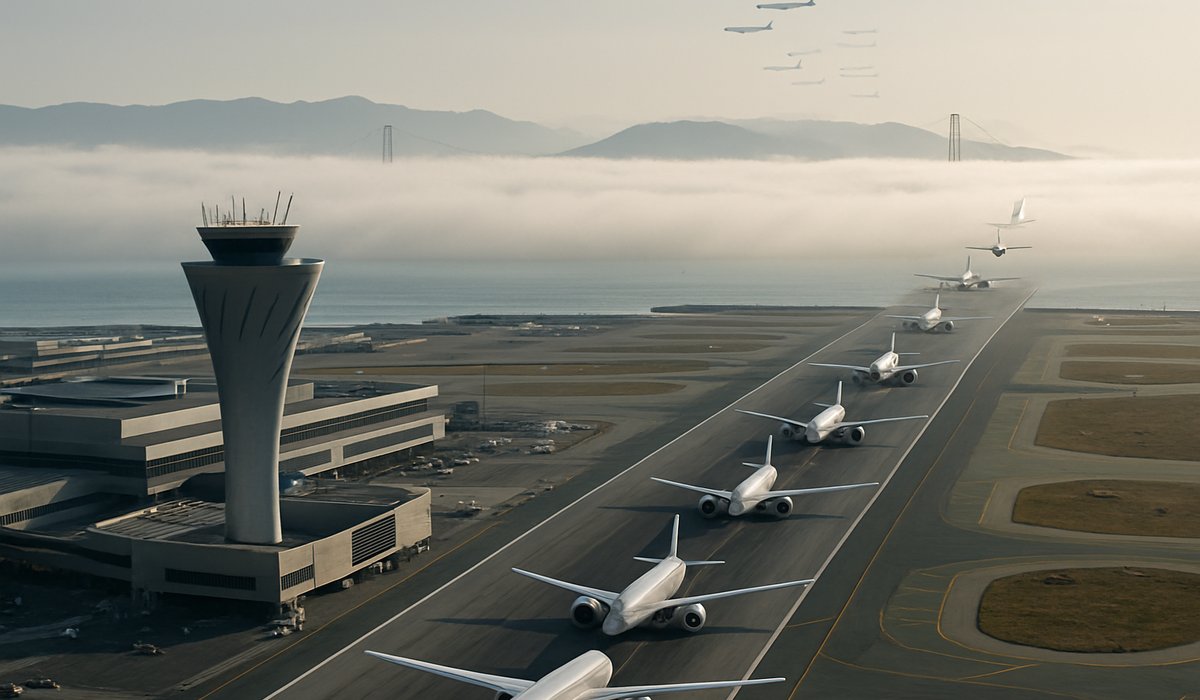
Image generated by AI
SFO Arrivals Throttle Due to Stringent New FAA Mandate
Travelers utilizing San Francisco International Airport (SFO)—deeply entrenched as one of the most critical aviation hubs traversing the American West Coast—are bracing for an extended season of severe arrival disruptions. A sweeping Federal Aviation Administration (FAA) mandate has effectively prohibited the deployment of parallel landings on the airport’s dual east-west runways due to acute, re-evaluated safety separation concerns.
Historically, SFO heavily relied on simultaneous, side-by-side aircraft landings to accommodate immensely dense trans-Pacific and domestic volume requirements. Decades of this operational "norm" have now been universally banned. Aircraft are newly mandated to execute strict single-file descent configurations. This immediate bottleneck triggers a catastrophic domino effect throughout SFO’s daily operational cadence, rapidly generating cascading logistical delays.
The Core Issue: Analyzing the Aircraft Separation Mandate
The controversial FAA directive fundamentally attacks SFO's tightly cramped architectural runway layout. The two primary parallel landing strips are separated physically by a mere 750 feet.
Historically, highly skilled air traffic controllers successfully managed side-by-side visual approaches, primarily switching to single-file staggered descents merely during SFO's infamous dense coastal fog windows. The FAA, leaning aggressively on newly rigid safety doctrines, officially decreed the 750-foot gap fundamentally unsafe for any simultaneous parallel landings, entirely irrespective of perfect weather positioning. Consequently, a policy once treated as a weather-contingency measure is now an unyielding, permanent operational reality.
A Perfect Storm: Compounding the Mega Runway Construction
What aggressively elevates this arrival crisis from merely "annoying" to "systemically disruptive" is the tragic synchronization with SFO's monumental active runway resurfacing initiative.
Currently locked in a sprawling six-month reconstruction project focused intensely on repaving and realigning a pivotal main artery (slated for completion entirely on October 2), the airfield was already predicting a painful 15% reduction in arrival throughput. Now, crippled by the sudden FAA parallel-landing ban, operational authorities rapidly upgraded arrival delay metrics to roughly 25%. The maximum arrival capability violently plummets from 54 descending aircraft per hour to a desperately low 36. SFO officials predict rolling 30-minute to 60-minute holding patterns for incoming intercontinental flights stacked above the Bay.
Airline Response Mechanisms: Mitigating the Damage
United Airlines, maintaining SFO as essentially its most critical hub connecting the Americas to Oceania and Asia, has initiated emergency schedule reviews in direct conjunction with the FAA.
United's network planners face the grueling task of 'smoothing' arrival banks—essentially attempting to spread out their tightly clustered arrivals so they do not overwhelm the newly mandated 36-plane-per-hour limit. However, the ripple effect ensures that a 40-minute arrival holding pattern circling SFO subsequently delays the aircraft's outbound turnaround capability, severely impacting departures and bleeding delays into secondary airports.
What Guests Get
- Immediate in-app push notifications alerting flyers to mandated airborne holding patterns over the Pacific
- Rebooked connecting flights via intelligent software if outbound SFO layovers are compromised by arrival congestion
- Waiver implementations allowing flyers to re-route via Oakland (OAK) or San Jose (SJC) without financial penalties
- Upgraded inflight Wi-Fi comping as compensation during extended Tarmac holds following delayed arrivals
- Proactive scheduling adjustments, smoothing heavy arrival banks into lighter traffic hours
SFO Operational Disruption Summary
| Disruption Factor | Implementation | Estimated Delay Impact | Affected Phase |
|---|---|---|---|
| FAA Parallel Landing Ban | Permanent, Unyielding | Immediate Throttle | Inbound Flight Path |
| Arrival Throughput Limit | Active | Gutted from 54 to 36/Hour | Network Capacity |
| Major Runway Resurfacing | Extending Through Oct 2 | Contributes 15% Baseline Delay | Ground Maneuvering |
| Weather Visibility Rules | Status Quo | Combines with Ban limits | Low-Fog Constraints |
| United Airlines Schedule | Actively Reviewing | Smoothing Arrival Timetables | Hub Transfer Efficiency |
What This Means for Travelers
If you booked a ticket terminating at or connecting heavily through SFO prior to October 2nd, aggressively expect scheduling delays. Travelers attempting critical connections must inject massive padding into their itineraries; booking a 45-minute layover through SFO in 2026 is virtually guaranteeing a missed connection. Opt strictly for layovers exceeding two hours manually.
Additionally, this mandate practically mandates utilizing alternative Bay Area gateways for purely domestic travel. Look proactively at Oakland International (OAK) or San Jose Mineta International (SJC) if you are merely visiting Silicon Valley or San Francisco proper. Both regional facilities remain entirely unaffected by SFO’s rigid 750-foot separation mandates and offer vastly superior on-time arrival reliability without the threat of exhausting holding patterns.
FAQ: SFO Parallel Landings Restrictions
Why did the FAA ban parallel landings at SFO now? The FAA tightened national airborne safety standards regarding minimum aircraft distance separation. Because SFO's parallel runways are squeezed only 750 feet apart (much closer together than most modern international airport designs), the FAA decided side-by-side approaches pose an unacceptable risk.
Can SFO just build new runways that are farther apart? No. SFO is built aggressively on a peninsula directly expanding into the San Francisco Bay. Historical proposals in the 2000s attempting to dump fill directly into the Bay to expand runway separation were utterly abandoned due to crushing environmental resistance.
Does this mandate affect all airports with two runways? No. The restriction is highly specific to SFO purely because of its unique, historically cramped architectural design profile. Massive hubs like Denver (DEN) or Atlanta (ATL) have safely distanced runways and are not impacted.
Related Travel Guides
SFO Layovers: How to Survive Delayed Connections in Terminal 3
Bay Area Airport Alternatives: Comparing OAK vs SJC for Direct Flights
Disclaimer
This article is for informational and educational purposes only. It does not constitute legal, financial, or professional advice. While we strive to provide accurate and up-to-date information, travel policies, regulations, and conditions change rapidly. Always verify information with official sources before making travel decisions. Nomad Lawyer makes no representations about the accuracy, reliability, completeness, or suitability of the information provided. Readers should consult qualified professionals for advice specific to their circumstances. The views expressed in this article are those of the author and do not necessarily reflect the views of Nomad Lawyer.
Raushan Kumar
Founder & Lead Developer
Full-stack developer with 11+ years of experience and a passionate traveller. Raushan built Nomad Lawyer from the ground up with a vision to create the best travel and law experience on the web.
Learn more about our team →