
Seattle and Los Angeles Welcome Stress-Free Travel as Korean Air and Delta Air Lines Unite with South Korea to Cure the Pain of Airport Layovers – All You Need To Know
Korean Air and Delta Air Lines expand Seamless Baggage Transfer to LAX and SEA airports, using IRBS technology to elimin

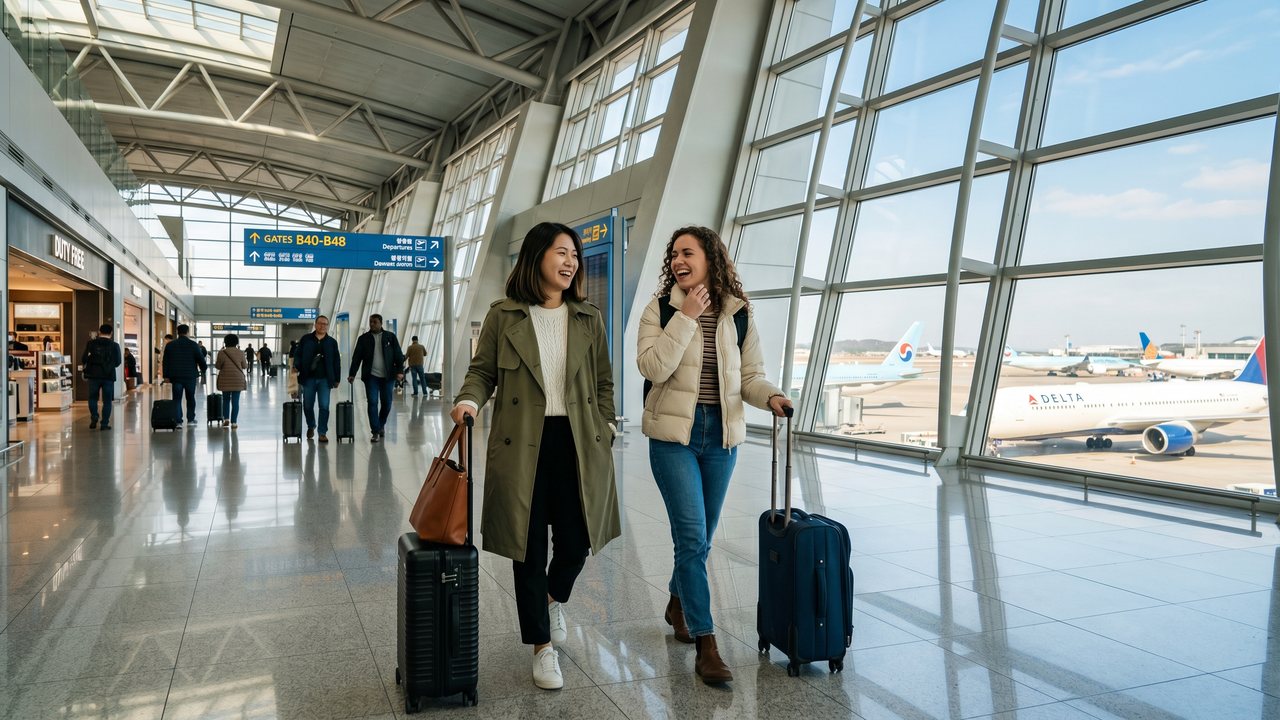
Image generated by AI
[Seoul, June 29, 2026] — Korean Air and Delta Air Lines have expanded their Seamless Baggage Transfer service to include Seattle-Tacoma International Airport (SEA) and Los Angeles International Airport (LAX), effectively eliminating the need for passengers to recheck luggage during connections. This initiative, supported by the South Korean Ministry of Land, Infrastructure and Transport and U.S. Customs and Border Protection (CBP), launched on June 23, 2026, to streamline transpacific travel.
Modernizing Transpacific Transit Infrastructure
The expansion of the Seamless Baggage Transfer program addresses one of the most significant pain points for international travelers: the tedious process of claiming and re-checking bags during tight flight connections. By integrating advanced logistics and government cooperation, the two airlines are reducing the physical and mental fatigue associated with long-haul journeys between Asia and North America.
The service is designed to remove the friction that often discourages global tourists from visiting distant destinations. By targeting high-traffic gateways like Los Angeles and Seattle, the partnership aims to make these cities more accessible to Asian travelers, potentially increasing tourism numbers for iconic landmarks such as the Space Needle and the Hollywood districts.
Implementation of International Remote Baggage Screening in Seoul
The core of this operational upgrade is the International Remote Baggage Screening (IRBS) system. This technology allows for the pre-clearance of luggage at Seoul-Incheon International Airport (ICN) before the aircraft even departs for the United States.
Under this system, checked bags undergo rigorous scanning using high-tech X-ray machinery at Incheon. While the flight is in transit over the Pacific, the digital data from these scans is transmitted securely to U.S. customs officials. Federal agents review the luggage data remotely, granting clearance before the plane lands on American soil.
Because the bags are pre-approved, passengers arriving at LAX or SEA can bypass the baggage carousels entirely. This allows travelers to move directly from their arrival gate to their next domestic connection, mirroring the simplicity of a domestic flight transfer. Industry reports indicate that this automated process saves passengers approximately 20 minutes of transit time.
Expansion of Stress-Free Routes Across Five U.S. Hubs
The addition of Seattle and Los Angeles marks a significant scaling of the program, which has already demonstrated measurable success in other markets. The service was first implemented for flights between Incheon and Atlanta in August 2025.
According to government data, the initial rollout in Atlanta resulted in a reduction of face-to-face customs interactions by more than 65 percent. This efficiency significantly improved the rate of successful connections, as passengers were no longer delayed by lengthy baggage recheck queues.
The network now encompasses five major American gateways:
| Eligible U.S. Gateway Airports | Service Status |
|---|---|
| Atlanta (ATL) | Active (since August 2025) |
| Minneapolis-St. Paul (MSP) | Active |
| Detroit (DTW) | Active |
| Seattle-Tacoma (SEA) | Active (as of June 23, 2026) |
| Los Angeles (LAX) | Active (as of June 23, 2026) |
This expansion coincides with the eighth anniversary of the transpacific joint venture between Korean Air and Delta Air Lines, which began in May 2018. Since its inception, the alliance has transported nearly 20 million passengers. At peak capacity, the carriers manage 20 daily departures between Seoul and the U.S., facilitating the movement of approximately 4,800 connecting passengers every day through the Incheon hub.
Executive Perspectives on Aviation Logistics
Aviation leaders have highlighted the emotional and operational benefits of removing transit barriers. Kwangho Ko, Senior Vice President at Korean Air, noted that the joint venture with Delta is focused on strengthening the connectivity between South Korea and the United States. He emphasized that the goal is to provide a more integrated global network via Incheon, offering passengers increased convenience and a higher standard of service.
Jeff Moomaw, Vice President for Asia Pacific at Delta Air Lines, stated that the expansion into the Los Angeles and Seattle hubs allows customers to navigate some of the busiest airports in the U.S. more efficiently. According to Moomaw, the primary benefit is granting travelers more time to relax and enjoy their journey rather than stressing over logistical hurdles.
Analysis of Industry Impact
The integration of IRBS technology represents a shift toward "invisible" border security, where the verification process happens in the background rather than as a physical barrier to the passenger. By shifting the customs burden from the arrival terminal to the departure hub, the airlines are effectively decongesting U.S. arrival halls.
This move is likely to trigger a competitive response from other transpacific carriers. As the "seamless" experience becomes a selling point, airlines that continue to require manual baggage rechecks may see a decline in preference among high-value connecting passengers. Furthermore, the 65% reduction in face-to-face customs interactions suggests a scalable model for reducing manpower requirements at U.S. ports of entry.
Why This Matters (Information Gain)
This development is not merely a convenience upgrade but a strategic realignment of international aviation logistics. The partnership between Korean Air and Delta demonstrates a successful "triple-threat" collaboration involving two private carriers and two national governments (South Korea and the U.S.).
The broader implication for the aviation industry is the transition toward a "hub-and-spoke" model where the hub (Incheon) acts as a comprehensive processing center for both passengers and cargo. By digitizing the customs process, the airlines are removing the "psychological barrier" of entry into the U.S., which has historically been a deterrent for short-term tourists. This sets a precedent for other international hubs—such as Singapore or Dubai—to seek similar remote-clearance agreements with the U.S. government to boost tourism and transit traffic.
Related Travel Guides
Disclaimer
This article is for informational and educational purposes only. It does not constitute legal, financial, or professional advice. While we strive to provide accurate and up-to-date information, travel policies, regulations, and conditions change rapidly. Always verify information with official sources before making travel decisions. Nomad Lawyer makes no representations about the accuracy, reliability, completeness, or suitability of the information provided. Readers should consult qualified professionals for advice specific to their circumstances. The views expressed in this article are those of the author and do not necessarily reflect the views of Nomad Lawyer.
Raushan Kumar
Founder & Lead Developer
Full-stack developer with 11+ years of experience and a passionate traveller. Raushan built Nomad Lawyer from the ground up with a vision to create the best travel and law experience on the web.
Learn more about our team →