
San Francisco Airport Gridlock: 337 Delays, 5 Cancellations Paralyze United, American, British Airways on June 5
San Francisco International Airport faces massive travel chaos with 337 flight delays and 5 cancellations affecting United, American, British Airways, and Emirates across 10 countries on June 5, 2026.

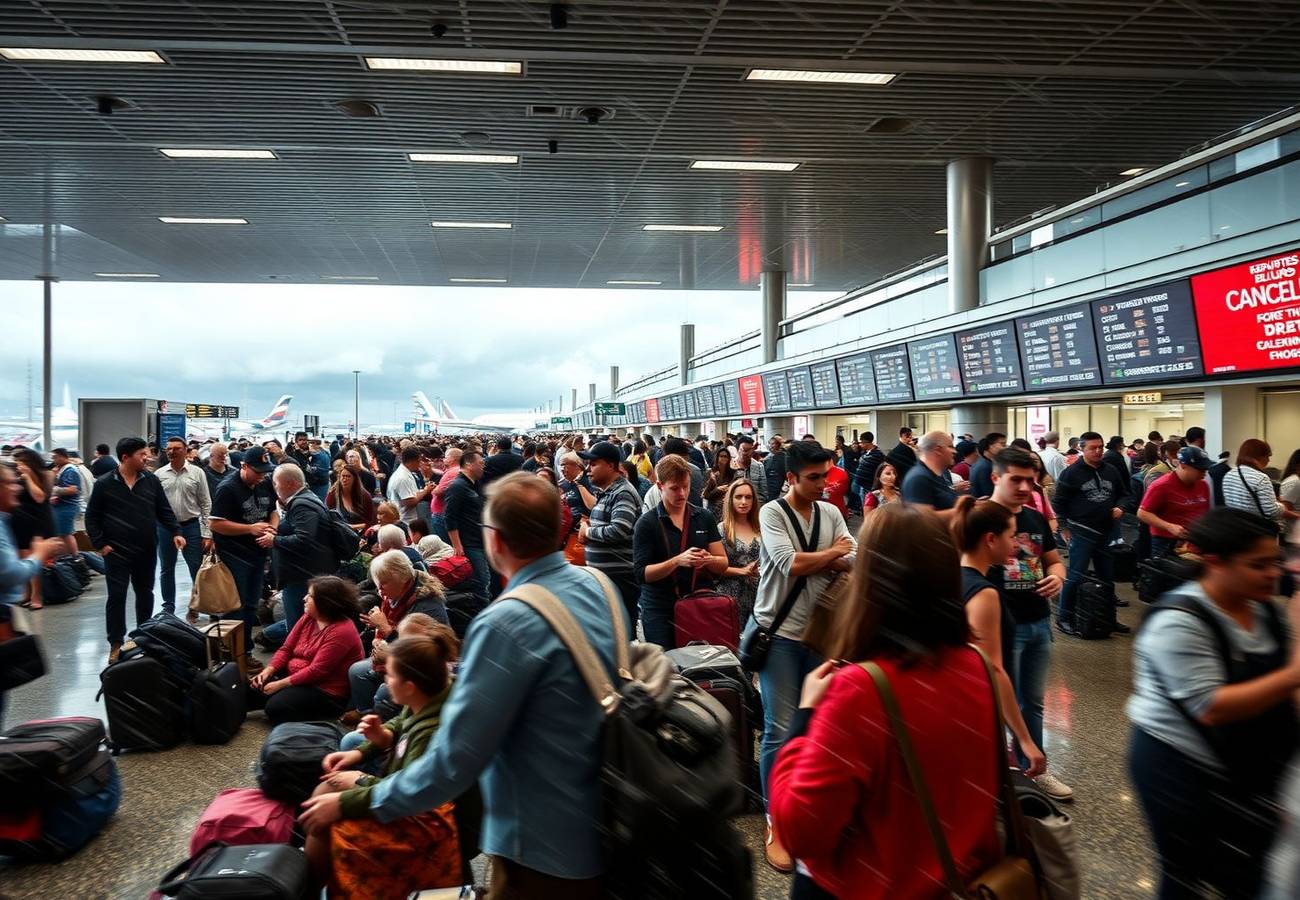
Image generated by AI
A Perfect Storm at America's Golden Gate
San Francisco International Airport (SFO) descended into operational chaos on June 5, 2026, as 337 flight delays and 5 cancellations cascaded through terminals packed with thousands of stranded passengers. The disruptions rippled across domestic and international networks, touching 10 countries and devastating travel plans for everyone from weekend leisure travelers to business executives racing to board long-haul flights.
The sheer scale of the disruption marks one of SFO's worst days in recent memory. Unlike isolated weather events that typically resolve within hours, today's chaos appeared systemic—affecting carriers, destinations, and airport operations in ways that suggest deeper operational challenges.
Reddit: "Just got the cancellation email. SFO is a nightmare right now. United is offering rebooking but everything is full." — r/travel
Which Airlines Took the Biggest Hit
United Airlines emerged as the hardest-hit carrier, with 126 delays and 5 cancellations—representing a staggering 25% of all United flights operating through SFO that day. For a carrier that dominates Bay Area operations, this level of disruption signaled serious operational breakdown.
But United wasn't alone in the pain. Southwest Airlines reported 45 delays affecting 62% of its flight schedule—an alarming operational failure rate that left passengers scrambling for alternatives. SkyWest, the regional carrier operating connections for major airlines, logged 57 delays representing 31% of operations. American Airlines (25 delays, 30% impact rate) and Delta Air Lines (17 delays, 20% rate) also faced significant headwinds.
The outlier? Breeze Airways, a budget carrier with limited SFO presence, reported 6 delays affecting an astonishing 85% of its flights—suggesting that whatever triggered the chaos affected smaller operations disproportionately.
International carriers bore particularly brutal consequences. British Airways, Emirates, Air Canada Rouge, and flights routed through Dublin International, Copenhagen Airport, Dubai International, and Kansai International all reported 100% delay rates, indicating that overseas routes faced near-total operational paralysis.
The Ripple Effect: Domestic Dominoes
SFO's chaos didn't stay contained at a single airport. The disruptions cascaded through America's busiest hub network:
Los Angeles International (LAX) saw 14 delays (33% of operations). Phoenix Sky Harbor (PHX) reported 10 delays affecting 76% of flights—a critical juncture for Southwest-heavy connections. Chicago O'Hare (ORD), a United Airlines fortress, logged 4 delays and 2 cancellations, impacting transcontinental service. San Diego International (SAN) experienced 12 delays (48%), while Seattle-Tacoma (SEA) recorded 5 delays (23%).
The cascade extended to smaller hubs. Houston Bush Intercontinental (IAH) posted 6 delays affecting 60% of operations. Regional airports in Aspen (ASE), Bozeman (BZN), and Glacier Park (GPI) reported 100% delays—airports with minimal daily flight volume were entirely paralyzed, suggesting staffing, weather, or system-wide technical failures at play.
International Meltdown: Asia-Pacific and Europe in Freefall
The true global scale of SFO's collapse became apparent when examining international consequences.
Asia-Pacific routes took the hardest punch. Singapore Changi (SIN) logged 3 delays (75% of operations). Manila (MNL) reported 2 cancellations and 4 delays (66% impact)—devastating for travelers connecting from Southeast Asia. Kansai International (KIX) in Osaka and Dubai International (DXB) both showed 100% delay rates, while Hong Kong (HKG) experienced 50% of flights delayed.
European gateways weren't spared. Dublin (DUB) and Copenhagen (CPH) recorded 100% delays, disrupting transatlantic service. London Heathrow (LHR) posted 42% delays, Frankfurt (FRA) showed 50% impact, and Paris Charles de Gaulle (CDG) reported 33%—all major European hubs dealing with cascading SFO-originated delays.
The geographic reach tells the story: disruptions originating at a single California airport created measurable chaos across three continents within hours.
What Triggered the Chaos?
While official causes remained under investigation, the data suggested potential contributing factors. Smaller regional airports experiencing 100% delays despite minimal flight volume pointed toward staffing shortages or system-wide technical failures. The near-universal impact across carriers suggested the problem wasn't isolated to a single airline's operations but rather facility-wide constraints—possibly runway capacity, air traffic control staffing, or ground handling delays.
The timing matters too. June 5 represents mid-summer travel season, when SFO operates near maximum capacity. Even minor disruptions amplify exponentially when airports are already stretched thin.
Actionable Steps for Affected Passengers
If you were caught in today's SFO disruptions, these steps can protect your rights and options:
Immediately verify your flight status through official airline channels—United, Southwest, American, and Delta all offer real-time tracking via mobile apps and websites. Don't rely on airport displays alone; they lag behind backend systems.
Proactively contact your airline if you're connecting through affected hubs like ORD, LAX, PHX, or IAH. Call rather than message; phone queues typically move faster during major disruptions. Request explicit rebooking confirmations in writing (email).
Document everything. Screenshot your original booking confirmation, the delay or cancellation notice, and any communications with airline representatives. These become crucial for filing compensation claims under U.S. Department of Transportation (DOT) regulations, which entitle passengers to compensation for cancellations and delays exceeding three hours caused by airline operations (not weather).
Review your travel insurance policy immediately. If you purchased coverage, most policies cover delays exceeding 12-24 hours, offering reimbursement for meals, hotels, and transportation. File claims within the insurer's specified window—typically 30-90 days from the incident.
Consider alternative routes. Less-impacted airports like Oakland (OAK) or San Jose (SJC) may offer escape hatches. Rental car costs might exceed flight rebooking fees, making drive-through options viable for Bay Area travelers.
The Bigger Picture: System Fragility
Today's SFO meltdown exposes a uncomfortable truth about modern aviation infrastructure. A single major airport's operational failure cascades globally within hours, affecting 10 countries and thousands of passengers with no simple recovery mechanism. Unlike airline-specific IT failures that can be isolated and rebooted, airport-wide challenges—whether staffing, runway capacity, or air traffic control—require system-level intervention that takes days to resolve.
The fact that regional airports with minimal traffic experienced complete operational shutdown suggests the problem ran deeper than typical summer congestion. Weather patterns, staffing absences, or technical system failures created a domino effect across North America's most critical aviation gateway.
Passengers learned harsh lessons: diversify your routing (avoid single-hub connections when possible), purchase travel insurance for summer trips, and maintain realistic expectations about airport resilience during peak season.
The only certainty in aviation disruptions is that they'll happen again—the question is whether travelers and infrastructure operators learn from today's chaos before the next catastrophe strikes.
Related Travel Guides
United Airlines Flight Diverted After Passenger Attempts Multiple Cockpit Breaches
Travel Delays Latest: San Diego Joins Major US Hubs in March 2026 Disruptions
Seven New Long-Haul Nonstop Routes Transform Global Aviation Connectivity This Week
Disclaimer
This article is for informational and educational purposes only. It does not constitute legal, financial, or professional advice. While we strive to provide accurate and up-to-date information, travel policies, regulations, and conditions change rapidly. Always verify information with official sources before making travel decisions. Nomad Lawyer makes no representations about the accuracy, reliability, completeness, or suitability of the information provided. Readers should consult qualified professionals for advice specific to their circumstances. The views expressed in this article are those of the author and do not necessarily reflect the views of Nomad Lawyer.
Preeti Gunjan
Contributor & Community Manager
A passionate traveller and community builder. Preeti helps grow the Nomad Lawyer community, fostering engagement and bringing the reader experience to life.
Learn more about our team →