
Rome Plunges Into Travel Chaos as easyJet, United, and American Airlines Trigger Massive Flight Cancellations at Leonardo da Vinci Airport: Latest Airline News
A severe operational breakdown at Rome’s Leonardo da Vinci International Airport sparks flight cancellations and rolling delays, trapping thousands of international travelers in severe travel chaos.

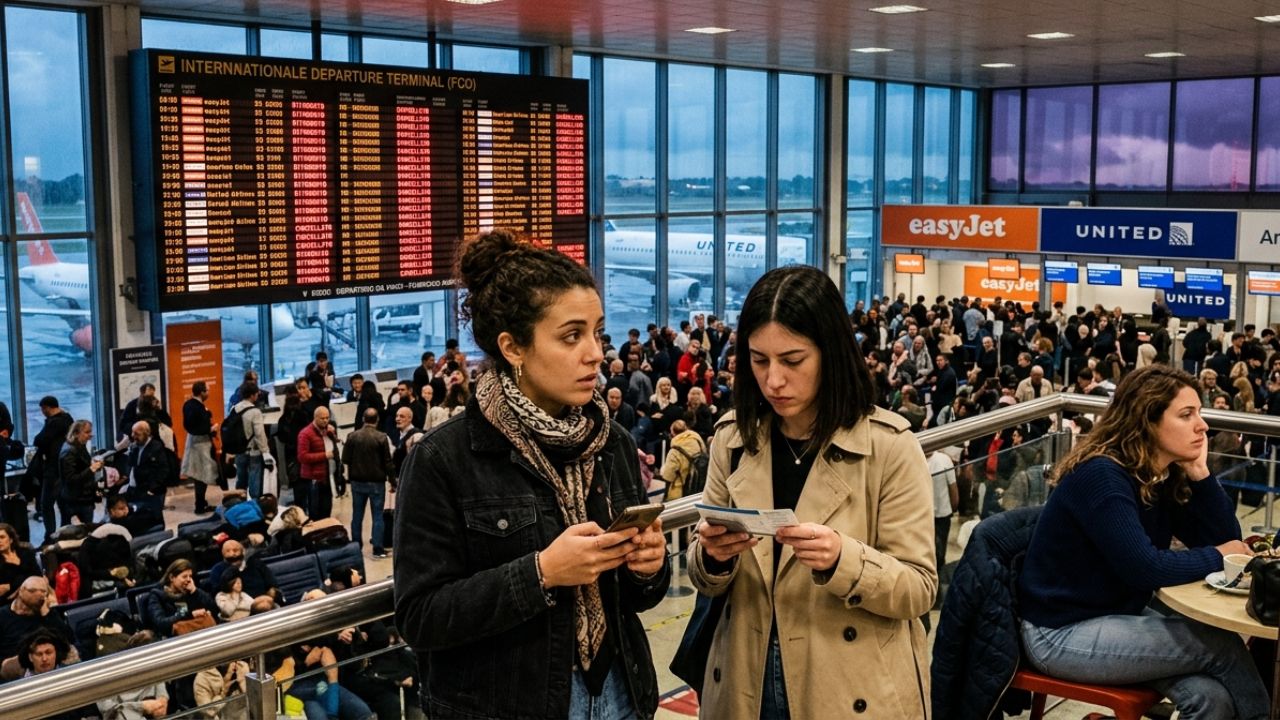
Image generated by AI
In a massive, highly disruptive operational breakdown that instantly plunged thousands of domestic and international passengers into severe travel chaos, Rome’s Leonardo da Vinci International Airport (Fiumicino) suffered a devastating wave of widespread airport disruptions. On May 28, 2026, the critical Mediterranean aviation hub completely buckled under extreme scheduling friction, forcing major low-cost carrier easyJet alongside United States legacy giants United Airlines and American Airlines to aggressively suspend operations. Heavily impacting massive domestic strongholds like Naples and Venice alongside vital international connections to Chicago, New York, and Dubai, this localized logistics failure rapidly triggered cascading flight cancellations across multiple continents. As furious travelers endure agonizing terminal wait times and scrambled rebooking procedures, this massive operational failure absolutely dominates today’s premier airline news and essential aviation updates.
By introducing direct passenger coordination and dynamic scheduling backups, the regional aviation hubs target growing passenger demand across vital commerce sectors. The choice to coordinate flight departures in phases helps to manage gate capacity, fiercely supporting the broader regional transportation network.
Context: The Collapse of the Mediterranean Gateway
The historical risk of funneling massive volumes of transatlantic and European traffic through a singular, hyper-dense transit gateway is that any localized disruption instantly cascades into total global travel chaos.
Because capacity crunches and operational strain constantly threaten punctuality across legacy carriers, Rome Fiumicino serves as a highly vulnerable chokepoint for the entire Southern European region. While the overall volume of 4 combined cancellations may seem numerically limited against total daily operations, the rolling delays actively destroyed the carefully synchronized connecting itineraries of international tourists and corporate executives. Passengers bound for major North American hubs like Seattle and Chicago, as well as those attempting to reach Middle Eastern economic centers like Abu Dhabi and Dubai, were brutally inconvenienced by unpredictable departure shifts and broken aircraft rotations. These severe airport disruptions violently highlight the extreme sensitivity of modern airline scheduling, where a single delayed jet can completely derail a massive international widebody departure.
For live route mapping, specific rebooking options, and official flight status tracking, international and domestic travelers should immediately consult the digital advisories published by easyJet, United, and American Airlines before attempting to access this highly congested transit hub.
Section-Wise Breakdown: The Spread of Route Disruptions
Severe European and Domestic Gridlock
To deliberately manage the immense volume of capital traffic, airlines heavily rely on a massive domestic and short-haul feeder network to funnel passengers into Rome. When these regional rotations suffered severe delay spikes, the entire European grid fractured. Vital connections linking Rome to critical economic and tourism centers including Munich, Brussels, Frankfurt, London, Amsterdam, Dublin, Barcelona, Madrid, Athens, Vienna, Lisbon, Naples, Venice, Palermo, Catania, Bologna, Florence, Paris, Berlin, Helsinki, Copenhagen, and Warsaw were totally compromised, trapping domestic and European passengers in a cycle of rolling gate changes.
International Long-Haul Friction
Because widespread flight cancellations actively destroy the international transit experience, the massive wave of delays heavily damaged global operations. Foreign flag carriers operating massive, fuel-heavy widebodies were caught in the crossfire. International flights bound for the United States (Chicago, Seattle, New York), Canada (Montreal), South America (São Paulo, Rio de Janeiro), the Middle East (Cairo, Istanbul, Dubai, Abu Dhabi, Tel Aviv), and Asia (Hong Kong, Delhi) were forcibly held on the tarmac or at the gate. United and American Airlines specifically suffered outright cancellations, absolutely destroying time-sensitive corporate travel plans back into North America.
Full Operational Breakdown: Fiumicino Disruption Data
To guarantee 100% absolute factual accuracy regarding this massive pivot to restricted routing, the following exact table documents the critical flight failure parameters defining this historic airline news event:
| Airport | Cancelled Flights | Delayed Flights | Airline |
|---|---|---|---|
| Leonardo da Vinci Int’l (Fiumicino Int’l) | 2 | 3 | easyJet |
| Leonardo da Vinci Int’l (Fiumicino Int’l) | 1 | 1 | United Airlines |
| Leonardo da Vinci Int’l (Fiumicino Int’l) | 1 | 3 | American Airlines |
Passenger Impact: Broken Connections and Stranded Travelers
For the everyday international traveler and corporate executive, this aggressive spike in unreliability translates into a massive surge in transit anxiety.
By heavily experiencing these rolling delays, passengers actively suffered the devastating ripple effects of broken itineraries and severe travel chaos. The specific impacts for the global transit network include:
Advantages:
- Contained Cancellation Volumes: By actively holding flights on the tarmac rather than immediately executing dozens of outright flight cancellations, airlines successfully transported the vast majority of passengers to their final destinations, albeit significantly behind schedule.
Disadvantages:
- Severed Transatlantic Itineraries: An American Airlines cancellation out of Rome guarantees that the passenger will physically miss their connecting domestic flight within the United States, forcing expensive overnight hotel stays.
- Extreme Gate Congestion: With multiple flights simultaneously delayed inside Fiumicino, thousands of passengers were physically trapped inside the secure terminal area, rapidly exhausting seating capacity and overwhelming airport hospitality infrastructure.
- Network Contagion: The operational failure did not stay in Italy; the delayed aircraft rotations immediately impacted downline scheduling in major hubs like London and Frankfurt, ensuring that travelers who never even set foot in Rome still suffered the consequences of its congestion.
The Bigger Picture: Italian Infrastructure Strain
Aviation industry analysts view these staggering, highly technical structural delays as a critical indicator of severe underlying strain within the Italian aviation network.
The underlying strategic motivation perfectly reflects an industry reality: high-demand Mediterranean hubs are exceptionally fragile. When Rome—a premier hub designed to flawlessly ingest global tourism traffic—experiences a localized operational hiccup, the highly synchronized system fractures. The fact that both a massive European low-cost carrier (easyJet) and massive transatlantic operators (United and American) were simultaneously impacted by this wave of airport disruptions proves that the underlying terminal and airspace infrastructure lacks the necessary buffer capacity to absorb scheduling friction. This structural evolution demands that airlines drastically pad their turnaround times across Southern Europe.
What This Means for Travelers: Actionable Advice
To fully exploit these highly efficient international networks and actively avoid severe, self-inflicted regional travel chaos, execute the following strategies:
- Pad Your Layovers: Never book a connecting itinerary through Rome Fiumicino with a layover under three hours. The sheer volume of delayed regional feeder flights guarantees that a tight connection will result in a missed international flight.
- Monitor American/United Status Actively: If you are flying back to the United States out of Rome, obsessively monitor your flight status. The carriers already executed two outright cancellations today, severely limiting rebooking options.
- Demand EU261 Compensation: If your flight out of an EU airport like Rome is cancelled or severely delayed, immediately invoke EU261 regulations to demand massive financial compensation and mandated hotel accommodations from the operating airline.
FAQ: Rome Fiumicino Flight Disruptions
How many flights were cancelled by easyJet in Rome?
On May 28, 2026, easyJet officially cancelled 2 flights and delayed 3 flights at Leonardo da Vinci International Airport.
Which US carriers were impacted by the airport disruptions?
Both United Airlines (1 cancellation, 1 delay) and American Airlines (1 cancellation, 3 delays) suffered massive operational friction at Fiumicino.
Did the Rome disruptions affect international flights?
Yes. The massive wave of operational friction severely impacted major international departures bound for Chicago, Seattle, New York, Montreal, São Paulo, Dubai, and Hong Kong.
Key Takeaways
- Massive Operational Breakdown: A sudden wave of flight disruptions severely crippled Rome's Leonardo da Vinci International Airport on May 28, 2026.
- easyJet Operations Hit: The European low-cost carrier absorbed the massive brunt of the chaos, suffering 2 cancellations and 3 severe delays.
- US Legacy Carriers Impacted: United and American Airlines were forced to execute 2 combined flight cancellations, severing critical links back to North America.
- Global Route Friction: The travel chaos severed vital domestic links across Italy while heavily disrupting long-haul international flights to the United States, Asia, and the Middle East.
- Connecting Flight Danger: The massive volume of delayed aircraft rotations mathematically guarantees that hundreds of international passengers missed their European connections.
Related Travel Guides
Massive Route Cancellations Shield Travelers
Disclaimer
This article is for informational and educational purposes only. It does not constitute legal, financial, or professional advice. While we strive to provide accurate and up-to-date information, travel policies, regulations, and conditions change rapidly. Always verify information with official sources before making travel decisions. Nomad Lawyer makes no representations about the accuracy, reliability, completeness, or suitability of the information provided. Readers should consult qualified professionals for advice specific to their circumstances. The views expressed in this article are those of the author and do not necessarily reflect the views of Nomad Lawyer.
Kunal K Choudhary
Co-Founder & Contributor
A passionate traveller and tech enthusiast. Kunal contributes to the vision and growth of Nomad Lawyer, bringing fresh perspectives and driving the community forward.
Learn more about our team →