
Portugal Spain Italy Greece Belgium Brace EES Airport Queues Summer 2026 US UK India UAE Travelers
Europe's busiest airports face extended queues as the EU's Entry-Exit System reshapes Schengen border procedures for millions of non-EU travelers heading into peak summer 2026.

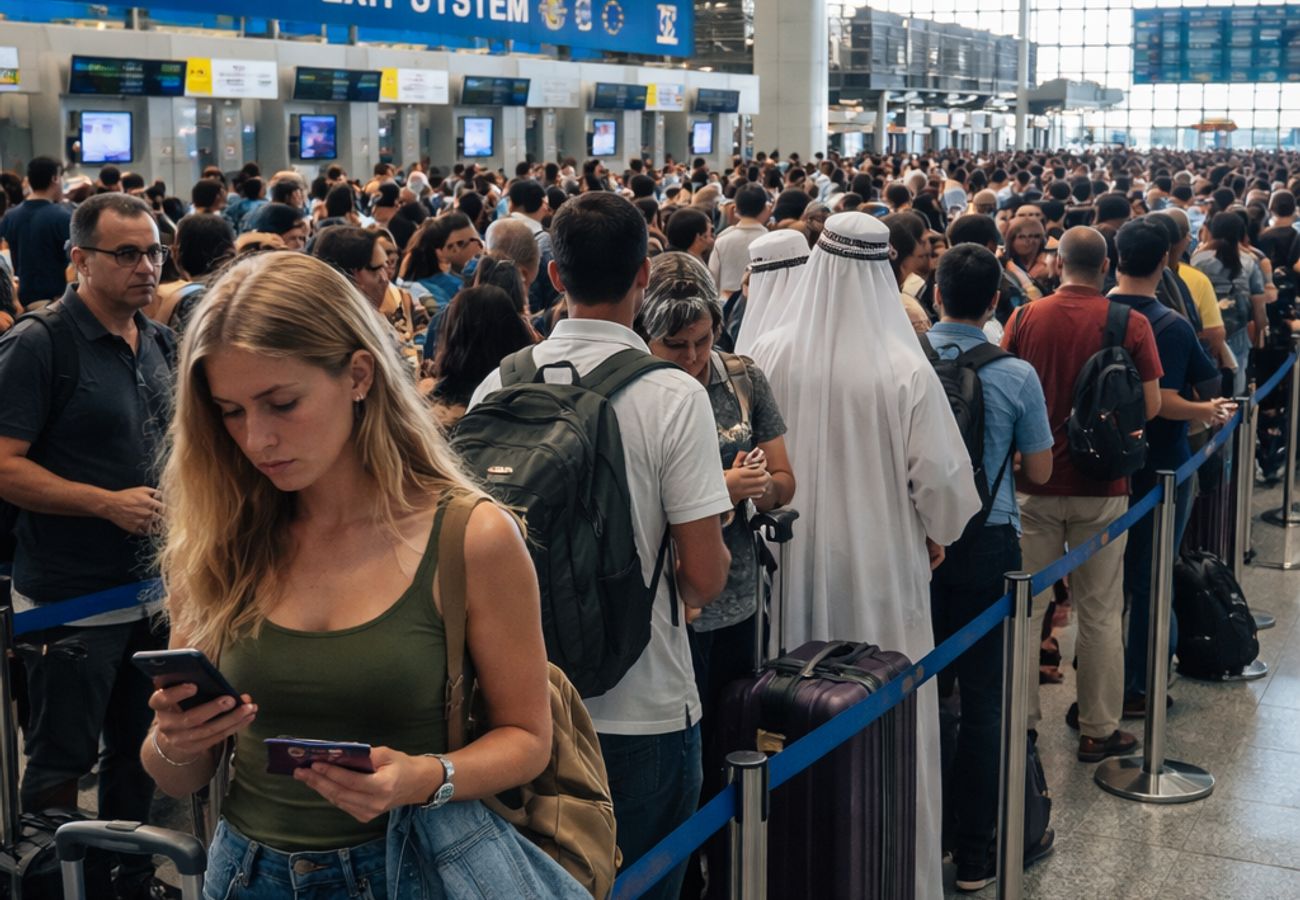
Image generated by AI
Europe's Summer Gateway Airports Face Digital Border Reality Check
Portugal, Spain, Italy, Greece, and Belgium are bracing for an operational reckoning as Europe's peak summer travel season collides head-on with the European Union's newly implemented Entry/Exit System (EES). The digital border framework, designed to modernize Schengen Area immigration procedures, is already triggering congestion at some of the continent's busiest tourism hubs—and airport leaders warn the worst may be yet to come.
For travelers arriving from the United States, United Kingdom, India, UAE, and other non-EU countries, the implications are immediate: longer queues, extended processing times, and the potential for missed connections during one of the busiest travel periods on the global calendar. What was supposed to be a security modernization initiative has become an operational bottleneck just as Europe prepares to welcome record numbers of summer visitors in 2026.
Reddit: "Just landed in Barcelona and spent 45 minutes in the EES line. Nobody told me I'd need biometric registration." — r/travel
The Math Behind the Delays: Why EES Processing Takes Three Times Longer
The Entry/Exit System replaces traditional passport stamping with electronic biometric registration, capturing fingerprints and facial data when non-EU travelers cross Schengen borders. On paper, digitization sounds efficient. The operational reality tells a different story.
Traditional passport checks averaged 20-25 seconds per traveler. EES biometric registration now requires approximately 90 seconds—a threefold increase in processing time. Scale that across thousands of daily passengers at major hubs, and the mathematics become brutal.
A single immigration officer working an eight-hour shift can historically process roughly 1,000 passengers. Under EES procedures, that capacity drops to approximately 320 passengers. Even with flawless technology, throughput collapses when each traveler requires digital fingerprint capture, facial recognition verification, and electronic database confirmation.
Why The Timing Is Catastrophic for European Tourism
Europe attracts more than 50% of all international tourist arrivals globally, according to UN Tourism. Countries like Spain, Italy, Greece, and Portugal generate substantial economic revenue during summer months, with airports handling millions of leisure travelers between June and September alone.
The rollout timing compounds the challenge. Historically, southern European airports experience peak passenger volumes between late June and August. Yet EES-related disruptions are already surfacing in early June—before the busiest travel weeks even arrive. This suggests that July and August could see significantly worse congestion.
Airports serving Mediterranean holiday destinations, cruise embarkation hubs, and major international gateways face the steepest operational demands. A single delayed flight at a connecting airport creates cascading effects across the entire network.
Who Bears the Greatest Burden: The EES Impact Matrix
Non-EU travelers face disproportionate exposure to EES procedures. Citizens from the US, UK, India, and UAE must undergo biometric registration. By contrast, EU citizens pass through expedited lanes with minimal additional processing.
This creates an uncomfortable operational reality: the visitors generating the most tourism revenue for southern European destinations are precisely those facing the longest waits.
Tour operators report that cruise passengers arriving from the United States and departing within hours face particular risk of missing embarkations. Hotel check-ins delay by hours. Scheduled shore excursions get disrupted. What began as a border control procedure cascades into lost vacation time and disappointed customers.
The Convergence of Multiple Aviation Pressures
EES implementation occurs during an already turbulent period for European aviation. Airlines continue managing:
- Rising fuel costs driven by geopolitical uncertainty and route diversions, with fuel accounting for approximately 25% of airline operating expenses
- Persistent staffing shortages extending from the post-pandemic recovery period
- Airspace restrictions forcing longer flight routings across central Europe
- Airport capacity constraints particularly acute at major southern European hubs
The result: airlines are simultaneously navigating profitability, network expansion, and operational resilience. Border delays represent yet another uncontrollable variable in an already fragile equation.
Industry analysts note that some carriers have increased flights specifically to build schedule buffer time—a costly workaround that ultimately transfers to passenger ticket prices.
What Technology Integration Actually Requires
The EES framework demands seamless interaction between multiple systems: national immigration databases, airport infrastructure, airline reservation systems, and border agency platforms across numerous jurisdictions. A weakness in any single segment cascades throughout the entire process.
Airport IT departments report that system integration testing has revealed compatibility issues with legacy immigration databases in some countries. When border control systems encounter unexpected data formatting or validation errors, manual intervention becomes necessary—precisely what creates queues.
Staffing presents an equally intractable challenge. Additional border procedures require proportionally more trained personnel. Yet many European airports continue recruitment struggles from the 2022-2023 pandemic recovery period. Hiring and training immigration officers cannot happen overnight.
Practical Strategies for Summer 2026 Travelers
Preparation has become essential for anyone planning European travel. Rather than focusing solely on flight schedules, passengers should account for substantially extended airport processing time.
Smart adjustments:
Allow additional arrival time at the departing airport—90 minutes minimum for non-EU travelers, not the traditional 60 minutes. Choose longer connection windows when transiting through Spain, Portugal, Italy, Greece, or Belgium. For cruise passengers, consider arriving a day earlier to eliminate embarkation stress.
Monitor airport-specific updates before departure. Major hubs publish real-time queue information. Arriving at off-peak times (early morning, late evening) can meaningfully reduce wait duration.
Review travel insurance closely. Ensure missed connection coverage is included, given that EES delays—not airline operational failures—may now trigger cascading disruptions.
The Broader Question: Digital Border Control at Scale
Despite current operational friction, the long-term case for EES remains valid. Digital border systems are increasingly viewed as essential for balancing security requirements with growing international passenger volumes. The question is not whether biometric border controls should exist, but whether they can be implemented efficiently during record-breaking travel periods.
If Europe's aviation stakeholders resolve staffing bottlenecks, stabilize technology integration, and expand pre-registration solutions, EES could eventually deliver faster and more secure border crossings. However, the coming summer season will serve as the first major test of that proposition.
For airports, airlines, tourism boards, and the millions of travelers heading to Europe this summer, the months ahead may determine whether EES becomes a model for future border modernization or a cautionary tale about implementing major infrastructure changes during peak demand periods.
The Schengen Area's digital transformation is about to meet reality—and neither one may like what happens next.
Related Travel Guides
United States Canada Flight Disruption: Air Canada CRJ-900 Incident at LaGuardia
Disclaimer
This article is for informational and educational purposes only. It does not constitute legal, financial, or professional advice. While we strive to provide accurate and up-to-date information, travel policies, regulations, and conditions change rapidly. Always verify information with official sources before making travel decisions. Nomad Lawyer makes no representations about the accuracy, reliability, completeness, or suitability of the information provided. Readers should consult qualified professionals for advice specific to their circumstances. The views expressed in this article are those of the author and do not necessarily reflect the views of Nomad Lawyer.
Kunal K Choudhary
Co-Founder & Contributor
A passionate traveller and tech enthusiast. Kunal contributes to the vision and growth of Nomad Lawyer, bringing fresh perspectives and driving the community forward.
Learn more about our team →