
Pope Leo XIV Stranded in Tenerife: Engine Failure Forces Papal Iberia A320 Evacuation, Spanish King Offers Private Jet Rescue
Pope Leo XIV was forced to evacuate an Iberia A320 at Tenerife Norte Airport when engine startup failure prevented departure. Spanish King Felipe VI stepped in with his private Dassault Falcon 900, marking the first papal flight emergency requiring aircraft change in nearly four decades.

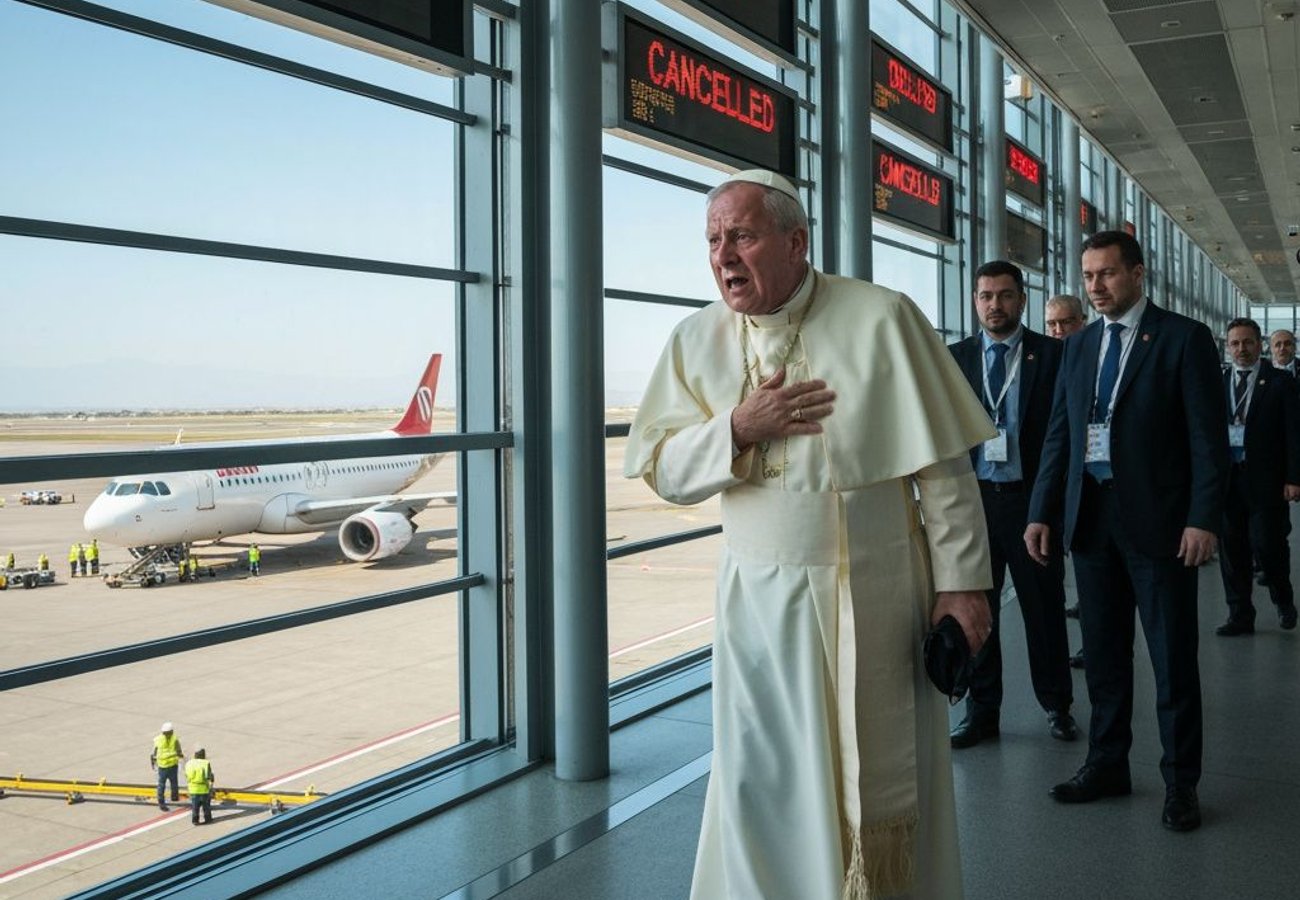
Image generated by AI
A Rare Vatican Crisis Unfolds at Tenerife Norte
Pope Leo XIV's carefully orchestrated seven-day apostolic visit to Spain took an unexpected turn on Friday afternoon when a routine flight home became an aviation crisis. The pontiff had successfully visited Madrid, Barcelona, Las Palmas de Gran Canaria, and Tenerife between June 6–12, with every leg proceeding without incident. But as he and his delegation of approximately 80 journalists, Vatican officials, and Church members boarded an Iberia Airbus A320 for the return journey to Rome, mechanical failure would force an extraordinary intervention from one of Europe's most powerful figures.
The aircraft pushed back from Tenerife Norte Airport (TFN) at approximately 4:00 PM local time—already delayed by an earlier technical issue. As the flight crew initiated departure procedures, disaster struck: one of the aircraft's engines refused to start.
Engine Won't Turn Over: Strong Winds Complicate Rescue Efforts
Over the public address system, the captain delivered the grim announcement. According to reports from ABC News, he cited a "startup failure of the engine" exacerbated by the powerful wind conditions battering the airport. This wasn't a random malfunction—Tenerife Norte is notorious for its changeable, ferocious winds, making it one of the most operationally challenging airports in the world.
The flight crew attempted the standard protocol. A maintenance team rushed to the aircraft and repositioned it into the wind direction for a second engine start attempt. The fix failed. A third option remained: cancel the flight entirely and order all 200-plus occupants to disembark. There would be no departure to Rome that evening aboard the A320.
Reddit: "Never thought I'd see the Pope stranded at an airport like a regular traveler. That's some next-level bad luck." — r/travel
Spanish Royalty Steps In: King Felipe VI's Gracious Gesture
What could have become a diplomatic and logistical nightmare transformed into an extraordinary display of continental solidarity. King Felipe VI had arrived at Tenerife Norte moments earlier to personally bid farewell to the Pope—a gesture of respect customary between heads of state. When word of the engine failure reached the monarch, he made a spontaneous but consequential decision: he would surrender his personal aircraft to the papal delegation.
The Dassault Falcon 900, a ultra-luxury executive jet configured in VIP specifications, would transport Pope Leo XIV and his innermost circle back to Rome. The Vatican released an official statement confirming the arrangement:
"Pope Leo XIV will return to Rome aboard an aircraft graciously made available by His Majesty the King of Spain. The flight is scheduled to depart at around 6:00 p.m. local time and is expected to arrive in Rome at approximately 11:00 p.m. Rome time. The Holy See staff and the journalists traveling on the papal flight will return in the coming hours on a separate aircraft provided by Iberia."
The papal entourage departed Tenerife just before 7:00 PM aboard the Dassault Falcon 900, reaching Rome by late evening. However, the smaller jet's VIP configuration carried only approximately 12 passengers—a stark contrast to the A320's capacity. This meant roughly 70 members of the wider papal delegation remained stranded.
The Fallback Plan: Iberia Mobilizes Replacement Aircraft
The situation demanded swift damage control. Iberia, clearly motivated by the gravity of transporting the Pope and maintaining diplomatic relations with Spain's monarchy, dispatched a replacement A320 from Madrid to Tenerife later that evening. This aircraft eventually transported the journalists, lower-ranking Vatican officials, and remaining delegation members back to Rome in the hours following the papal departure.
The entire episode reflected organizational chaos mitigated by extraordinary resources. For most commercial airlines, an engine start failure at a wind-prone airport would simply result in a rebooking. For the Catholic Church's supreme pontiff, it triggered royal intervention and parallel aircraft deployments.
A Historical Anomaly: First Papal Flight Emergency Since 1988
This incident carries genuine historical weight. According to Associated Press reporting, this marks the first time in nearly four decades that a papal flight required an emergency aircraft change. The last documented occurrence happened in 1988, when Pope John Paul II's plane diverted to South Africa during poor weather conditions, forcing the pontiff to complete his journey to Lesotho by automobile.
Engine start failures triggered by strong winds represent a known aeronautical phenomenon. The standard corrective procedure—repositioning the aircraft into the wind—works in most scenarios. Yet Tenerife Norte's legendary wind patterns proved insurmountable that Friday afternoon, leaving the A320's maintenance crew without options.
The Bigger Picture: Iberia's Role as Papal Carrier
ITA Airways (formerly Alitalia) serves as the official papal airline for Rome-based flights. However, a longstanding Vatican tradition holds that the pontiff will utilize the host nation's flag carrier for return journeys. During his Spanish visit, Pope Leo XIV relied exclusively on Iberia for regional flights connecting Madrid, Barcelona, Las Palmas de Gran Canaria, and Tenerife.
The engine failure that disrupted this itinerary exposed the vulnerability of even carefully planned episcopal travel. A single mechanical anomaly, compounded by local weather conditions, forced the Pope and his security apparatus to improvise on a continental scale.
Friday's incident will likely prompt reviews of backup procedures for high-profile papal flights, particularly those departing from meteorologically challenging airports. For King Felipe VI, the decision to surrender his private aircraft secured Spain's standing as a steadfast ally of the Vatican. For Pope Leo XIV, an inconvenient afternoon became an unexpected reminder that even religious authority cannot override physics and weather.
The winds of Tenerife taught the Vatican that sometimes the best contingency plan wears a crown.
Related Travel Guides
Disclaimer
This article is for informational and educational purposes only. It does not constitute legal, financial, or professional advice. While we strive to provide accurate and up-to-date information, travel policies, regulations, and conditions change rapidly. Always verify information with official sources before making travel decisions. Nomad Lawyer makes no representations about the accuracy, reliability, completeness, or suitability of the information provided. Readers should consult qualified professionals for advice specific to their circumstances. The views expressed in this article are those of the author and do not necessarily reflect the views of Nomad Lawyer.
Kunal K Choudhary
Co-Founder & Contributor
A passionate traveller and tech enthusiast. Kunal contributes to the vision and growth of Nomad Lawyer, bringing fresh perspectives and driving the community forward.
Learn more about our team →