
Philippine Airlines Expands Qatar Airways Codeshare: Manila, Cebu, Clark, Davao Now Connected to Middle East Hub
Philippine Airlines and Qatar Airways expand their codeshare network across four Philippine gateways, creating seamless connectivity to the Middle East, Europe, and Africa starting June 1, 2026.

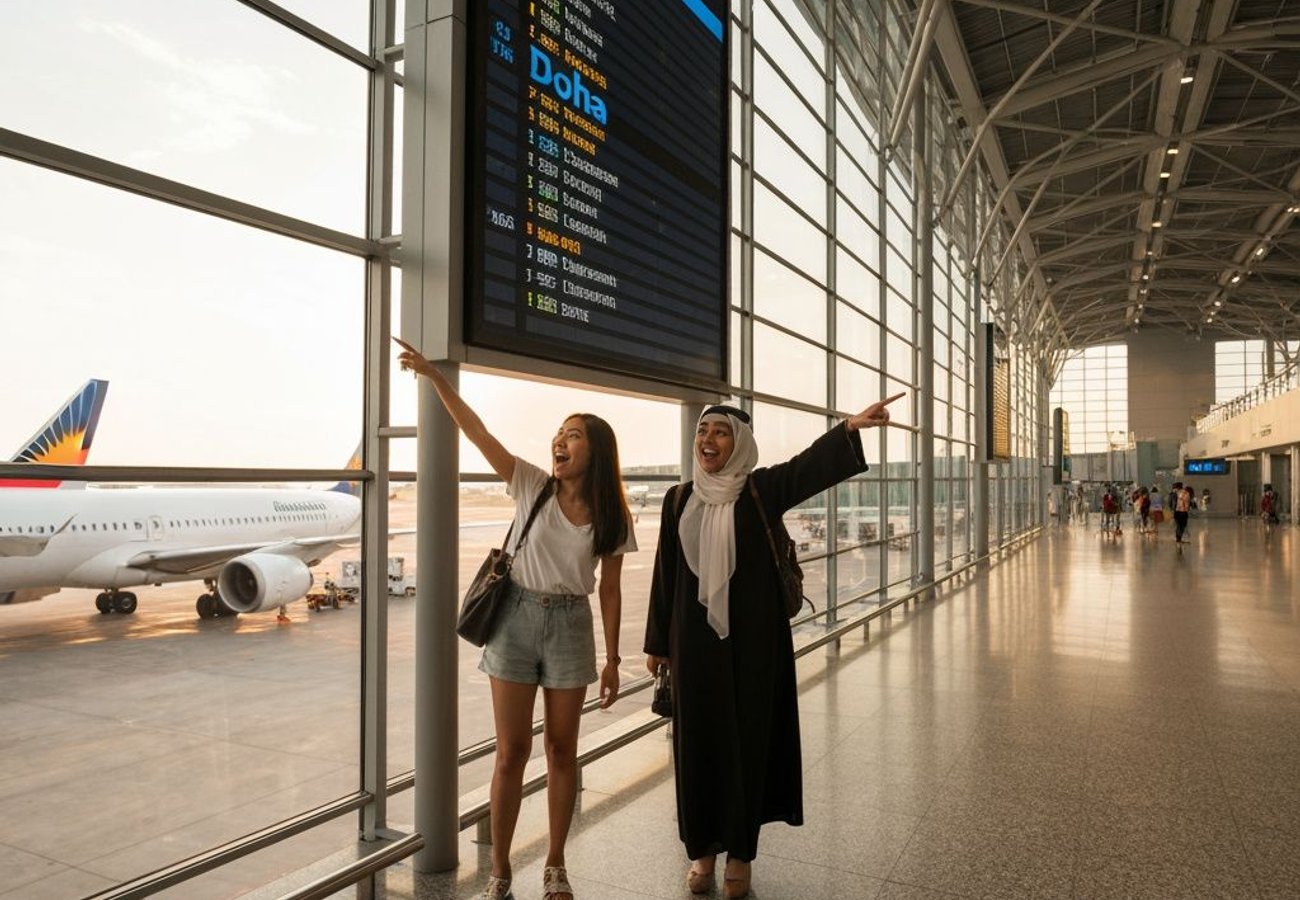
Image generated by AI
A Major Aviation Partnership Takes Shape in Southeast Asia
Philippine Airlines (PAL) and Qatar Airways just made a major move that's reshaping air travel between the Philippines and the world. Starting June 1, 2026, the two carriers expanded their codeshare agreement far beyond the original Manila–Doha daily service—and the implications are massive for travelers, tourism, and regional connectivity.
The expansion is straightforward but transformative: PAL will now place its PR code on Qatar Airways flights departing from four Philippine gateways—Manila, Cebu, Clark, and Davao—all connecting to Hamad International Airport (DOH) in Doha. In return, Qatar Airways places its QR code on selected PAL domestic services from Manila and Cebu.
Reddit: "This is huge for anyone trying to reach Europe or the Middle East from the provinces. No more flying to Manila first." — r/travel
What does this actually mean? Travelers from Cebu, Clark, and Davao can now book international connections through Qatar Airways' sprawling network without the traditional detour through Manila. That's a game-changer for a country shaped like an archipelago.
How the Expanded Partnership Works
The mechanics are elegant in their simplicity.
PAL's PR code now appears on Qatar Airways flights from:
- Manila (MNL)
- Cebu (CEB)
- Clark (CRK)
- Davao (DVO)
All roads lead to Doha, one of the world's most strategic aviation hubs. From there, Qatar Airways passengers access routes spanning Europe, the Middle East, Africa, Asia, and North America—meaning a traveler from Davao can now reach London, Rome, or Johannesburg with coordinated bookings and seamless baggage handling.
Qatar Airways' QR code appears on PAL domestic flights from:
- Manila
- Cebu
This dual arrangement creates bidirectional benefits. International passengers arriving in the Philippines can connect to regional destinations within PAL's domestic network without rebooking or collecting luggage. For a business traveler heading from Doha to Mindanao or a tourist island-hopping from Luzon to the Visayas, this eliminates friction.
The result? A more integrated travel ecosystem where geography stops being an obstacle.
Doha's Hub Status Just Got Stronger
Hamad International Airport already ranks among the world's premier aviation hubs. This partnership deepens that dominance.
For the Philippines, positioned as a crucial entry point to Southeast Asia, Qatar Airways' hub in Doha now functions as a direct gateway to:
- European capitals and secondary cities
- Gulf business centers (Dubai, Abu Dhabi, Riyadh)
- African markets
- Asian connectivity beyond Southeast Asia
Passengers transiting through Doha face shorter connection times and better schedule coordination than before. For airlines, partnerships like this often generate benefits comparable to launching entirely new routes, according to aviation industry data.
The strategic geography matters here: Qatar Airways operates one of aviation's most extensive networks, with flights to 180+ destinations across 90+ countries. That network is now accessible to Philippine travelers through multiple entry points.
Why This Matters for Philippine Tourism
The Philippines attracts millions of international visitors annually, but historically, tourism infrastructure relied heavily on Manila as the primary gateway.
Tourism dispersal—spreading visitor arrivals across multiple regions—has long been a goal for Philippine stakeholders. Why? Because concentrated arrivals in the capital drain resources and limit economic benefits to provincial communities.
The expanded codeshare directly addresses this.
International travelers now access regional Philippines more naturally:
- Cebu: Gateway to the Visayas, island tourism, beach destinations, and heritage sites
- Clark: Portal to Central Luzon, heritage attractions, and emerging leisure markets
- Davao: Access point for Mindanao's nature tourism, agricultural regions, and southern business communities
A tourist from Frankfurt can now book a single ticket connecting Frankfurt → Doha → Cebu, dramatically simplifying what was previously a two-ticket journey. This encourages longer, multi-destination stays and spreads tourism revenue beyond Manila.
Reddit: "Game changer for visiting Palawan or Boracay without spending 3 hours driving from Manila." — r/Philippines
Business Travel Gets a Major Upgrade
The Philippines maintains robust economic links with Gulf markets, particularly in energy, trade, and professional services sectors.
Corporate travelers now benefit from:
- Reduced layover time and connection complexity
- Access to multiple Philippine gateways for regional meetings
- Simplified rebooking if schedules change mid-trip
- Broader destination access for multi-city business itineraries
For Philippine companies operating internationally, the agreement similarly expands their executives' access to global markets through Qatar Airways' extensive network. A CFO based in Cebu can now connect to investment meetings in London or Frankfurt without routing through Manila first.
This supports corporate mobility, trade missions, investment activity, conference participation, and government travel across both directions.
The Regional Gateway Strategy
By incorporating Cebu, Clark, and Davao into the codeshare framework, PAL and Qatar Airways deliberately reduced dependence on a single-city bottleneck.
Cebu operates as one of the Philippines' leading tourism and business centers, serving islands and international markets beyond its immediate geography.
Clark continues its evolution as an alternative aviation hub for Central Luzon, with capacity and infrastructure expanding steadily.
Davao provides access to Mindanao, supporting agriculture, business, and tourism activity in the Philippines' southern regions—areas historically underserved by international aviation connectivity.
The partnership recognizes a simple reality: strong regional hubs reduce airline congestion, improve passenger experience, and support economic growth beyond capital cities.
The Bigger Picture in Global Aviation
This expansion reflects a broader industry trend: rather than launching point-to-point routes (expensive, risky, capacity-intensive), airlines increasingly deploy strategic partnerships to extend network reach and improve customer convenience.
For PAL and Qatar Airways, the codeshare is more efficient than adding entirely new aircraft and crew bases. For passengers, it means broader choice without waiting for new routes to launch.
The agreement strengthens Southeast Asia's connectivity to the Middle East—a corridor handling enormous volumes of business travelers, tourists, migrant workers, and trade. As international travel demand continues evolving, these integrated partnerships will increasingly define how people move across continents.
Tourism organizations, airport operators, and regional governments benefit too. Improved connectivity attracts new visitor segments, encourages longer stays, and drives visitation to secondary destinations.
What Travelers Should Know Right Now
If you're planning a trip from the Philippines to Europe, the Middle East, or Africa, starting June 1, 2026, you now have more options:
- Book directly from Cebu, Clark, or Davao to international destinations via Doha—no Manila stopover required
- Use PAL domestic services to connect regional Philippine cities with international arrivals
- Enjoy coordinated baggage handling and simplified rebooking through the codeshare agreement
For frequent travelers, this simplifies complicated multi-city itineraries. For occasional tourists, it dramatically reduces travel friction.
The agreement also signals PAL's confidence in regional growth and Qatar Airways' commitment to Southeast Asian markets. Both airlines are betting that direct regional connectivity drives higher passenger volumes and customer loyalty.
One codeshare agreement. Four gateways. Hundreds of new destination combinations. Southeast Asian travel just got dramatically simpler.
Related Travel Guides
Disclaimer
This article is for informational and educational purposes only. It does not constitute legal, financial, or professional advice. While we strive to provide accurate and up-to-date information, travel policies, regulations, and conditions change rapidly. Always verify information with official sources before making travel decisions. Nomad Lawyer makes no representations about the accuracy, reliability, completeness, or suitability of the information provided. Readers should consult qualified professionals for advice specific to their circumstances. The views expressed in this article are those of the author and do not necessarily reflect the views of Nomad Lawyer.
Raushan Kumar
Founder & Lead Developer
Full-stack developer with 11+ years of experience and a passionate traveller. Raushan built Nomad Lawyer from the ground up with a vision to create the best travel and law experience on the web.
Learn more about our team →