
Pacific Coast Passenger Rail 2026: California and Washington Synchronize Real-Time Station Departure Alerts
California and Washington state transit authorities coordinate with Amtrak to introduce visual, walk-time-calibrated boarding countdowns across Pacific rail hubs.

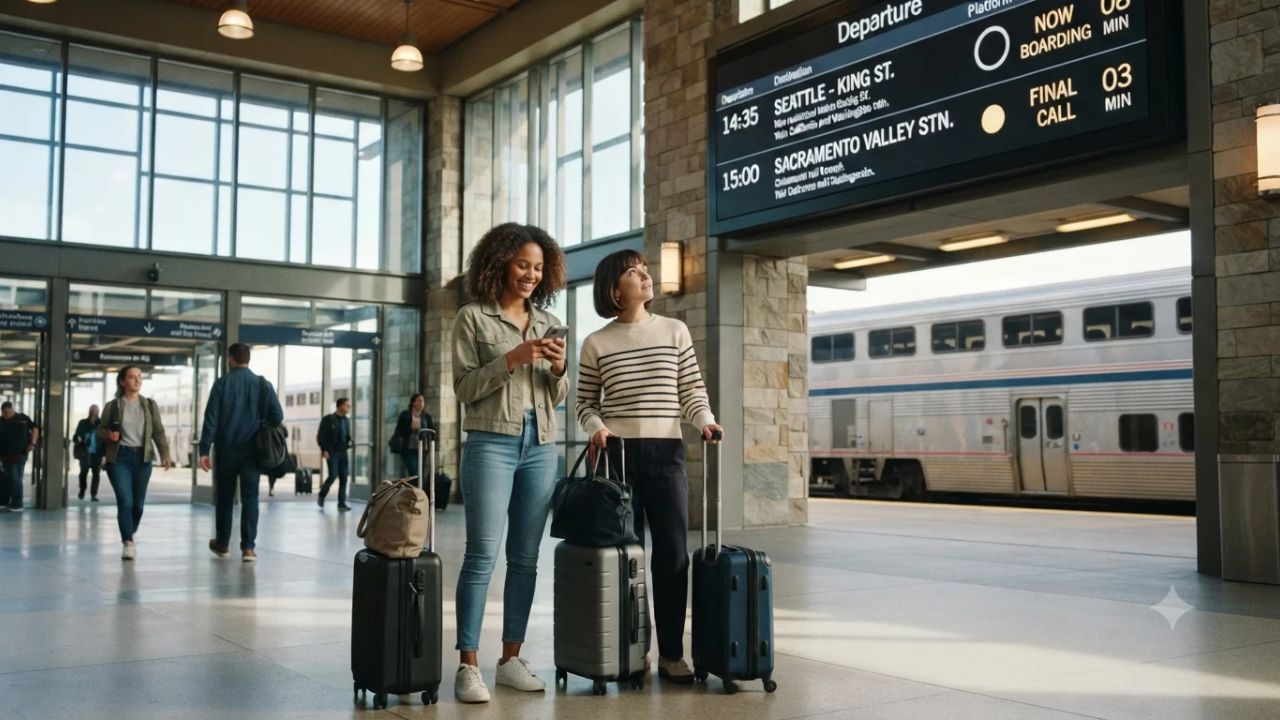
While passengers navigating massive American rail terminals have long relied on garbled loudspeaker announcements, a joint interstate transit initiative between California and Washington has introduced walk-time-calibrated digital countdowns that cut platform stairwell congestion by over 20%. Operating across major transit hubs connecting Seattle King Street, Portland Union Station, Sacramento Valley Station, and Los Angeles Union Station, the joint project standardizes visual departure indicators. Working in coordination with Amtrak, regional transport authorities are replacing static timetable text with dynamic geometric symbols that reflect real walking distances between concourse waiting lounges and subterranean tracks.
By aligning dispatch telemetry with passenger-facing digital architecture, the system provides riders with micro-timed boarding alerts, eliminating last-minute boarding dashes and curbing dwell-time creep along Western passenger corridors.
The Pacific Coast Transit Initiative: Synchronized Boarding Architecture
For decades, passenger rail facilities across the Western United States operated under disconnected visual signage. Travelers transferring between regional commuter lines and long-distance trains frequently congregated near track gates prematurely, causing platform overcrowding and safety hazards.
To resolve these bottlenecks, the California Department of Transportation (Caltrans) and the Washington State Department of Transportation (WSDOT) deployed a unified digital display standard inspired by high-density European rail systems. Station departure monitors now utilize four distinct geometric status tiers that communicate exact passenger directives.
| Visual Indicator State | Active Time Threshold | Passenger Operational Directive | Concourse & Platform Status |
|---|---|---|---|
| Standard Timetable Text | > 7 minutes to departure | Relax in main concourse lounges or retail areas | Train positioning, safety inspections, or cleaning underway |
| Steady Open Circle | ~ 5 minutes to departure | Proceed directly to designated platform stairways/escalators | Active passenger boarding initiated at platform gates |
| Pulsing Solid Dot | ~ 3 minutes to departure | Immediate platform arrival and train boarding required | Vestibule door closure preparation sequence active |
| Flashing Gate Closed | Departure imminent | Boarding concluded; check monitors for subsequent service | Platform security barriers and train vestibules locked |
Unlike static schedules, the system's underlying algorithm automatically measures the physical walking distance to each specific track. If boarding Gate 14 requires a four-minute walk through subterranean tunnels and fare gates, the system advances the steady circle warning to nine minutes, ensuring passengers reach train vestibules in an orderly flow.
What Makes the Pacific Corridor System Different
The synchronized departure framework unites distinct regional routes into an interconnected passenger network spanning the West Coast:
1. Unified Intercity and Commuter Interfaces
Whether boarding the Amtrak Cascades in the Pacific Northwest, the Capitol Corridor and San Joaquins in Northern California, or the Pacific Surfliner along the Southern California coastline, travelers encounter identical visual iconography. This common design language eliminates navigation friction for multi-city business travelers and international tourists unfamiliar with local regional operators.
2. Multi-Modal Concourse Distribution
By keeping passengers informed of the exact boarding window, stations transform concourse waiting halls into active, relaxed spaces. Rather than crowding track doorways, travelers can utilize station cafes, artisan bakeries, and workstation lounges until the digital indicator triggers movement.
3. Smartphone and Dispatch Integration
The standardized software interface feeds directly into regional transit mobile applications. Passengers receive synchronized push notifications and countdown timers on their mobile devices that match terminal displays precisely, providing seamless journey tracking from transit concourses to train seats.
| Rail Corridor Network | Primary Metropolitan Hubs Connected | Rolling Stock & Route Highlights | Digital Departure Implementation |
|---|---|---|---|
| Amtrak Cascades | Vancouver BC, Seattle, Portland, Eugene | European-style articulated trainsets; Puget Sound views | Full concourse rollout across King Street & Portland Union |
| Capitol Corridor | San Jose, Oakland, Sacramento, Auburn | Bi-level California cars; San Francisco Bay coastal tracks | Deployed at Sacramento Valley & Oakland Jack London |
| Pacific Surfliner | San Luis Obispo, Santa Barbara, Los Angeles, San Diego | Ocean-view bi-level coaches; Southern California beaches | Live across LA Union Station, Anaheim, & San Diego Santa Fe |
| Coast Starlight | Seattle to Los Angeles (Long-Distance) | Superliner sleeper coaches and Sightseer Lounge | Coordinated boarding across all shared Pacific terminals |
Visitor Insider Tips
- Rely on the Five-Minute Open Circle: When resting in station lounges at Los Angeles Union Station or Seattle King Street, do not rush the gate while the board displays standard timetable text. Move toward the platforms only when the indicator changes to the steady open circle.
- Book Ocean-Side Seating on the Pacific Surfliner: On southbound services from Santa Barbara to San Diego, select seats on the right side of the train for uninterrupted Pacific Ocean views; on northbound services, sit on the left side.
- Utilize Direct Transit Connections: Major Pacific hubs feature seamless transfers without leaving the station footprint—such as the Sounder commuter rail and Link Light Rail at Seattle King Street, and the Metro Rail network at Los Angeles Union Station.
- Track Mobile Alerts During Shoulder Hours: Keep mobile push notifications enabled on the Amtrak application when riding late-evening regional services to receive automated track reassignment notifications instantly.
Cultural and Environmental Context
The modernization of passenger rail signage represents a broader regional shift toward sustainable, low-carbon transportation along the Pacific Rim. California and Washington state continue to invest billions of dollars in rail electrification, grade-separation projects, and fleet renewal to position passenger trains as competitive alternatives to interstate highways (such as Interstate 5) and high-emission short-haul regional flights.
Reducing platform crowding and train dwell times directly improves operational energy efficiency. By keeping passenger loading cycles predictable down to the second, trains maintain tighter schedules, avoid idling delays on shared freight tracks, and optimize power consumption across electrified and clean-diesel corridors.
FAQ: Riding Pacific Coast Passenger Rail 2026
How does the new departure alert system help passengers?
It provides clear visual countdown symbols on station monitors that show exactly when to start walking to the platform, factoring in physical walking distances to prevent overcrowding.
What should I do when I see a pulsing dot on the departure board?
A pulsing dot indicates that only three minutes remain before train doors close. You must proceed immediately to your assigned platform and board the train.
Are these visual alerts available on mobile phones?
Yes. The standardized software API synchronizes directly with the Amtrak mobile app and regional transit applications, delivering real-time countdown alerts to smartphones.
Which train lines use this synchronized alert system?
The system is operational across major Western passenger corridors, including Amtrak Cascades, the Pacific Surfliner, Capitol Corridor, San Joaquins, and the long-distance Coast Starlight.
Related Travel Guides
- European Aviation 2026: Summer Airport Passenger Traffic and Regional Growth
- North Wales Film Tourism 2026: Six-Day Screen Adventure Route
- Baa Atoll Maldives 2026: Landaa Giraavaru Manta Safaris and Reef Restoration
- Eastern Europe Travel 2027: Bieszczady Trails and Slow Rail Expeditions
With micro-timed visual countdowns and walk-calibrated alerts, Western passenger rail makes sustainable Pacific travel predictable, calm, and effortlessly efficient.
Disclaimer
This article is for informational and educational purposes only. It does not constitute legal, financial, or professional advice. While we strive to provide accurate and up-to-date information, travel policies, regulations, and conditions change rapidly. Always verify information with official sources before making travel decisions. Nomad Lawyer makes no representations about the accuracy, reliability, completeness, or suitability of the information provided. Readers should consult qualified professionals for advice specific to their circumstances. The views expressed in this article are those of the author and do not necessarily reflect the views of Nomad Lawyer.
Raushan Kumar
Founder & Lead Developer
Full-stack developer with 11+ years of experience and a passionate traveller. Raushan built Nomad Lawyer from the ground up with a vision to create the best travel and law experience on the web.
Learn more about our team →