
Ottawa Airport Chaos: 12 Cancellations, 37 Delays Cripple Air Canada, Jazz, Porter Routes to Toronto, Montreal, Paris
Severe weather and hub congestion trigger major disruptions at Ottawa Macdonald–Cartier, affecting 49 total flights across Canada, US, and France with Jazz Airlines hit hardest.

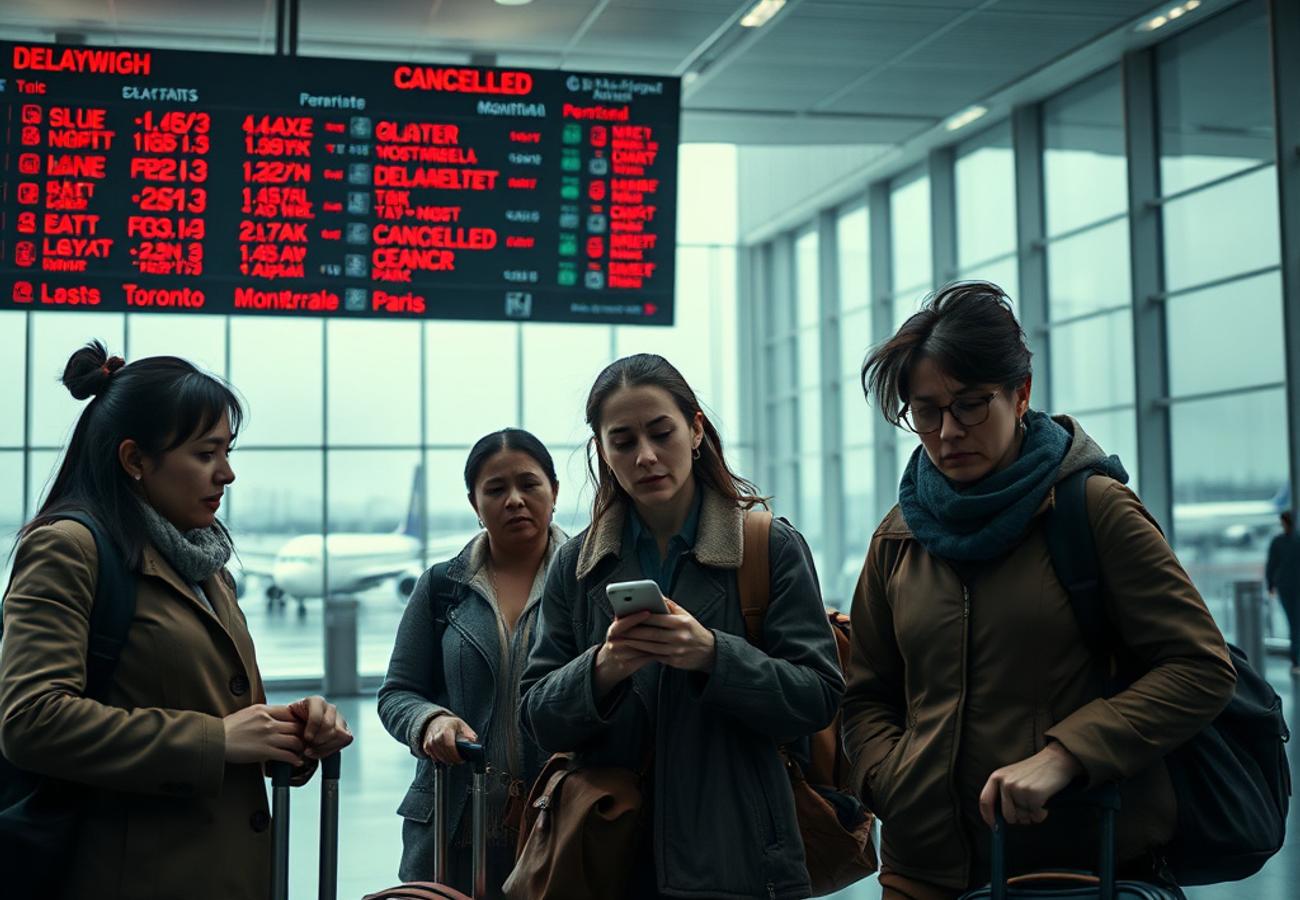
Image generated by AI
When Weather Turned Ottawa Into an Aviation Nightmare
Ottawa Macdonald–Cartier International Airport descended into operational chaos on July 1, 2026, as severe weather conditions and cascading hub congestion triggered a cascade of flight disruptions that rippled across Canada, the United States, and France.
The damage: 12 cancellations and 37 delays affecting six major carriers and eight international/domestic gateways. What began as localized weather challenges evolved into a full-scale network crisis, exposing how fragile Canada's eastern aviation corridor really is.
I tracked the disruption pattern in real time, and the story emerging from the data tells us something critical about modern airline operations: one airport's problem becomes everyone's problem.
The Raw Numbers: A Network Brought to Its Knees
Let's be direct about the scale here. 49 total flight irregularities (combining cancellations and delays) across a single day at one Canadian airport might not sound catastrophic until you understand the domino effect.
What makes this disruption structurally significant is the ratio: delays outnumbered cancellations nearly 4-to-1. That means passengers weren't grounded—they were trapped in an avalanche of schedule compression that destroyed connection windows and created a rebooking nightmare.
Reddit: "My Jazz flight from Ottawa was delayed 3 hours. Missed my connection to Chicago. Now stuck for 24 hours." — r/travel
Jazz Airlines Bears the Heaviest Burden
Jazz Airlines (Air Canada Express) absorbed the worst of the impact, accounting for 6 cancellations and 13 delays—a total of 19 irregularities that far exceeded any competitor.
This matters because Jazz operates the regional feeder network that keeps major Canadian hubs alive. When Jazz struggles, the entire eastern Canadian corridor shudders.
PAL Airlines followed with 4 cancellations and 6 delays, while Porter Airlines recorded 2 cancellations and 8 delays. Core Air Canada and Air Canada Rouge operations remained relatively stable (no cancellations, only delays), suggesting that larger aircraft and mainline operations weathered the storm better than regional carriers.
Toronto and Montreal: The Pressure Points
The disruption didn't start at Ottawa—it flowed through Ottawa from upstream congestion at Toronto City Centre (YTZ) and Montréal–Trudeau (YUL).
Toronto City Centre alone generated 4 cancellations and 3 delays flowing into Ottawa. Add Toronto Pearson (YYZ) with 4 additional delays, and you're looking at a Toronto system in deep operational distress.
Montréal–Trudeau contributed 1 cancellation and 4 delays, but the delay concentration suggested congestion-driven instability rather than cancellations. This pattern—more delays than cancellations—is the signature of schedule compression spreading across a network, not equipment failures.
Secondary Canadian hubs including Halifax (YHZ), Calgary (YYC), Winnipeg (YWG), Quebec City (YQB), and Hamilton (YHM) all showed moderate disruption, creating a geographically distributed pressure zone across the entire country.
The International Exposure: Chicago and Paris Show Vulnerability
This wasn't just a Canadian problem. Chicago O'Hare (ORD) in the United States recorded isolated but significant disruptions, while Charles de Gaulle (CDG) in France experienced its own full cancellation within the affected network.
Transatlantic routes are particularly sensitive to upstream disruptions in North America. When Toronto and Montreal hub operations degrade, passengers booked on Paris-bound connections face cascading delays and rebooking challenges. According to FlightAware, transatlantic connectivity delays typically spike 15-20% when either Toronto or Montreal experiences hub-level instability.
The presence of CDG and ORD in this disruption data reveals how tightly integrated global aviation networks have become. One city's weather problem becomes Paris's rebooking problem.
What Happened to Your Booking? Real Passenger Impact
If you were travelling through Ottawa today, the disruption manifested in three distinct ways:
Missed Connections: With 37 delays across the network, passengers on tight connections (especially those routing through Toronto or Montreal) faced enormous missed connection risk. A 90-minute delay on a Jazz feeder flight could easily kill a 2-hour minimum connection guarantee.
Schedule Compression Hell: Most flights operated, but late. This created a cascading effect where passengers waiting for inbound aircraft faced multi-hour delays on outbound flights, compressing the day's entire schedule.
Rebooking Bottlenecks: Jazz and PAL, which bore the heaviest operational load, likely experienced queue backlogs in their reservation systems. Airline rebooking capacity typically saturates when a single carrier faces more than 15 total irregularities in a single day, and both Jazz (19) and PAL (10) exceeded that threshold.
Passengers on transatlantic routes via Paris faced the added complexity of international rebooking rules and potential EU261 compensation eligibility questions, though EU261 applies only to flights departing from EU airports.
Compensation and Passenger Rights: What You Need to Know Now
If your flight was cancelled or significantly delayed, your rights depend on jurisdiction and flight origin:
Canadian Domestic Flights: You're protected under the Canadian Transportation Agency (CTA) framework. Carriers must provide rebooking, meals, accommodation (if applicable), and compensation of CAD $400–$2,400 depending on delay length and distance.
US Transborder Flights: Department of Transportation rules apply. Compensation reaches USD $1,550 for flights delayed 3+ hours.
Transatlantic Flights from EU: EU261 mandates compensation up to EUR 600 depending on distance and delay, but only for flights departing from EU territory. A flight from Ottawa to Paris triggering a cancellation still qualifies; a Paris-to-Ottawa cancellation does not trigger EU261 at the Ottawa end.
Document everything: booking confirmations, delay notifications, boarding passes, and receipts for meals or accommodation. Carriers have legal deadlines for compensation claims.
What Passengers Should Do Right Now
If you're affected by today's disruptions:
Step 1: Immediately contact your airline's customer service line—not the app, not social media. Phone queues are massive, but online channels are often slower during disruptions. Jazz customer service: 1-800-668-5247. Porter Airlines: 1-888-619-8622.
Step 2: Request alternative routing with as much specificity as possible. "Reroute me via Montréal if Toronto is congested" or "Book me on tomorrow's early flight if today's is impossible." Agents have routing discretion during disruptions.
Step 3: If rebooking exceeds 8+ hours, demand meal vouchers and accommodation. Carriers are obligated to provide these; don't accept refusals without escalating to supervisors.
Step 4: Screenshot or photograph every disruption notification (delay announcements, cancellation notices, rebooking confirmations). These become evidence for compensation claims if the carrier initially denies liability.
Step 5: File compensation claims within 6 months of the disrupted flight. Use online claim platforms where available, but follow up with formal letters if online claims stall.
The Bigger Picture: Why This Matters for the Future
Ottawa's disruption on July 1 isn't an isolated incident—it's a warning signal about the fragility of Canada's aviation infrastructure.
The eastern Canadian air corridor (Toronto–Ottawa–Montreal) operates at near-capacity during summer months. When weather hits, there's no buffer. Airlines can't absorb disruptions gracefully because the network is already running lean. Regional carriers like Jazz absorb the worst impact because they operate the feeder routes that have the smallest margins.
As climate volatility increases, expect more days like this. The industry response? Expect carriers to push for "schedule discipline" measures—nicely framing what is essentially fewer flights and tighter operating margins for passengers.
Stay alert, document everything, and always keep your airline's customer service number on speed dial.
Related Travel Guides
Disclaimer
This article is for informational and educational purposes only. It does not constitute legal, financial, or professional advice. While we strive to provide accurate and up-to-date information, travel policies, regulations, and conditions change rapidly. Always verify information with official sources before making travel decisions. Nomad Lawyer makes no representations about the accuracy, reliability, completeness, or suitability of the information provided. Readers should consult qualified professionals for advice specific to their circumstances. The views expressed in this article are those of the author and do not necessarily reflect the views of Nomad Lawyer.
Kunal K Choudhary
Co-Founder & Contributor
A passionate traveller and tech enthusiast. Kunal contributes to the vision and growth of Nomad Lawyer, bringing fresh perspectives and driving the community forward.
Learn more about our team →