
Orlando International Airport Plunged into Travel Chaos: 74 Delays and 6 Cancellations Hit Southwest, United, and Bahamasair as Equipment Shortages Paralyze MCO Hub
Orlando International Airport (MCO) faces significant travel chaos as 74 delays and 6 cancellations hit Bahamasair, Southwest, and international corridors.

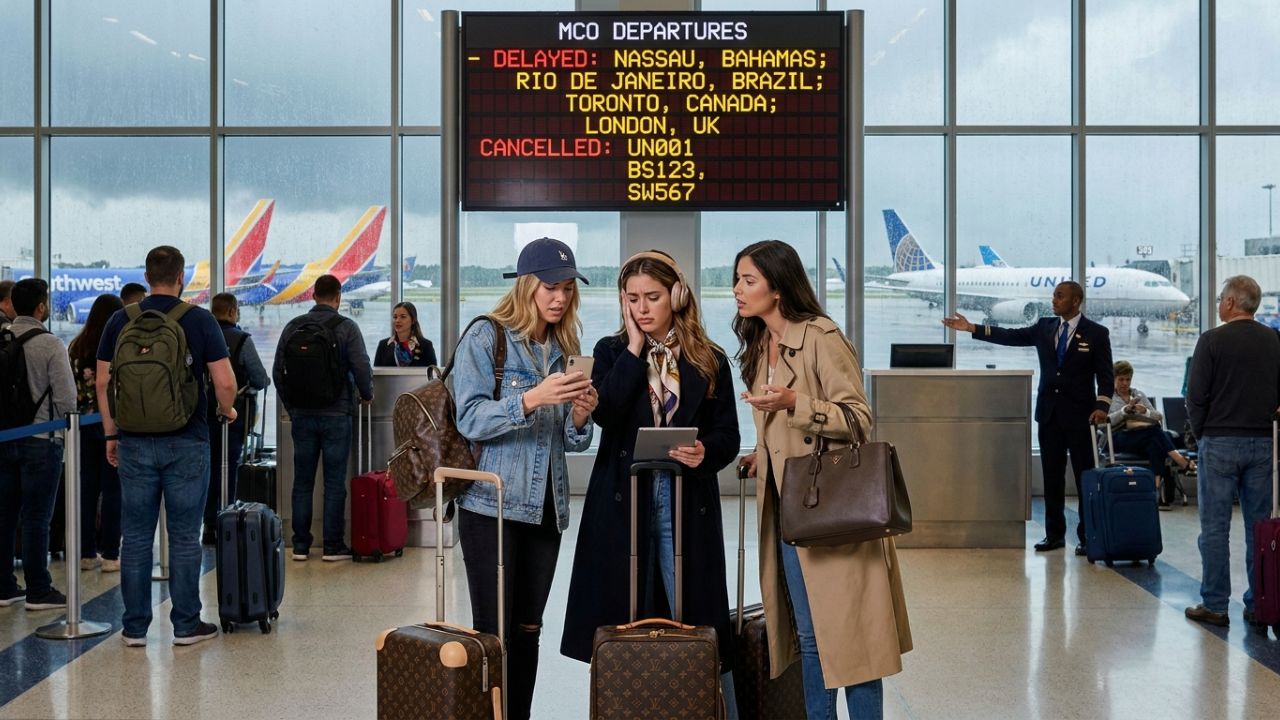
Image generated by AI
In a day defined by mounting operational friction in the Florida aviation corridor, Orlando International Airport (MCO) has been plunged into a state of severe travel chaos. On May 16, 2026, a sudden wave of logistical hurdles—ranging from acute equipment shortages to shifting weather patterns—triggered 74 flight delays and 6 total cancellations. This systemic failure has left hundreds of passengers effectively "isolated" within the terminal, with disruptions heavily impacting critical international corridors to The Bahamas, Brazil, Canada, and the United Kingdom. This major airline news update highlights the mounting pressure on primary carriers like Southwest, United, and Bahamasair, as they struggle to maintain schedule integrity amidst a day of localized airport disruptions.
Breaking: Logistical Standoff Strands Long-Haul Travelers at MCO
The disruption at MCO, one of the busiest hubs in the United States, was characterized by a sharp contrast between high-volume delays and total schedule volatility. While the overall "heartbeat" of the airport remains operational, a closer look at the data reveals significant pockets of frustration for passengers heading to specific domestic hubs and international gateways. Technical issues at smaller carriers and gate congestion for the majors remain the primary drivers of the current standoff.
Aviation experts suggest that while 6 cancellations may seem manageable, the concentration of these groundings on high-impact routes to Seattle (SEA), St. Louis (STL), and Chicago (ORD) has created a "bottleneck" effect for domestic transit. For international travelers heading to London or São Paulo, the day was defined by the frustration of seeing 100% delay rates, threatening the viability of complex multi-city itineraries and long-haul connections.
Expanded Overview: Southwest Volume vs. Bahamasair Volatility
The statistical deep dive into today’s aviation updates paints a picture of "quantity versus impact." Southwest Airlines leads the disruption board in raw volume with 22 delays, representing 6% of its MCO operations. However, Southwest has maintained a 0% cancellation rate, demonstrating a commitment to moving its passengers, albeit behind schedule.
In stark contrast, Bahamasair has emerged as today’s most volatile carrier. With a catastrophic 50% cancellation rate and a 50% delay rate, the airline has essentially seen its entire daily schedule split down the middle. For travelers heading to Nassau, the departure has become a literal coin-flip, a situation that has taxed the airport’s customer service infrastructure.
Section-Wise Breakdown: Geographic Disruption Narratives
The Caribbean and International Crisis
The most severe "total schedule failure" was recorded at Bahamasair, but the pain rippled across the Atlantic and South America as well. LATAM Brasil recorded a 100% delay rate on its operations to São Paulo (GRU), while British Airways struggled with a 40% delay rate to the UK. Canadian travelers were not spared, with Toronto Pearson (YYZ) experiencing a 25% delay rate and origins like Calgary reporting 100% delay figures.
The Northeast Corridor Bottleneck
Boston Logan (BOS) emerged as a major bottleneck for passengers departing from Orlando, with a 36% delay rate. Significant "drag" was also recorded for Philadelphia (PHL), which saw a 31% delay rate. This suggests that the high-volume Northeast corridor is facing its own set of localized airport disruptions that are flowing back into MCO.
The Pacific Northwest and Midwest Sensitivity
Seattle-Tacoma (SEA) saw a critical 20% cancellation rate for flights connected to Orlando. Similarly, St. Louis (STL) and Chicago O’Hare (ORD) both documented cancellations, making the North-South corridor particularly sensitive to today's equipment shortages.
Flight Details and Comprehensive Operational Matrices
The following tables provide the exact metrics for the carriers and routes most affected at Orlando International Airport (MCO) on May 16, 2026.
MCO Airline Performance Matrix
| Airline | Delays | Delay Rate (%) | Cancellations | Cancellation Rate (%) |
|---|---|---|---|---|
| Southwest Airlines | 22 | 6% | 0 | 0% |
| Bahamasair | N/A | 50% | N/A | 50% |
| LATAM Brasil | N/A | 100% | 0 | 0% |
| Breeze Airways | N/A | 14% | 0 | 0% |
| British Airways | N/A | 40% | 0 | 0% |
High-Impact Route Disruption Summary
| Destination / Origin | Delay Rate (%) | Cancellation Rate (%) | Impact Level |
|---|---|---|---|
| Boston Logan (BOS) | 36% | 0% | High Delay |
| Philadelphia (PHL) | 31% | 0% | Reactionary Delay |
| San Juan (SJU) | 31% | 0% | Reactionary Delay |
| Toronto Pearson (YYZ) | 25% | 0% | Moderate Delay |
| Seattle-Tacoma (SEA) | N/A | 20% | High Cancellation |
| São Paulo (GRU) | 100% | 0% | Severe Standoff |
Passenger Impact: Isolation and Rebooking Realities
For the hundreds of passengers affected at MCO, the travel chaos has translated into significant "terminal isolation."
- Reactionary Lag: High delay percentages from origin points like San Juan and Philadelphia (both at 31%) suggest that aircraft are arriving late into Orlando, causing a "cascade" effect that pushes back evening departures.
- High-Intent Rebooking: For those on the 6 cancelled flights to Seattle or Nassau, the race for seats is critical. Since these are high-impact routes, alternative flights fill within minutes, leaving many to seek overnight accommodations.
- Economic Strain: Travelers from 100% delayed origins like Calgary or Portland are facing increased out-of-pocket costs for meals and communication, taxing the "Trip Delay Reimbursement" protections of high-end travel cards.
Industry Analysis: The Reactionary Delay Phenomenon
Aviation analysts note that the 74 delays at MCO are likely due to "localized equipment issues" rather than a national airspace failure. The fact that hubs like Atlanta (ATL) and Newark (EWR) are maintaining delay rates as low as 4% and 5% suggests that the problem is concentrated within specific airline fleets and gate handling teams at MCO.
- Equipment Shortages: The sudden logistical hurdles mentioned by major carriers suggest a shortage of spare aircraft or flight crew at the Orlando hub, making them vulnerable to any minor weather shift.
- Inbound Pressure: The 31% delay rates from SJU and PHL highlight the "Reactionary" nature of modern aviation. If the inbound aircraft is late, the departure schedule at MCO is essentially doomed.
- Regional Volatility: The total collapse of the Bahamasair schedule demonstrates how smaller, regional players can be completely overwhelmed by operational disruptions that larger carriers might absorb.
Conclusion: A Fragile Recovery for the Orlando Hub
As Orlando International Airport works to clear the midday backlog, residual delays are expected to persist well into the evening. While the lack of massive flight cancellations is a positive indicator for Southwest and United, the situation for Bahamasair and LATAM Brasil remains critical. Travelers are strongly encouraged to monitor the "inbound" status of their aircraft via mobile apps and to maintain a high degree of flexibility as airlines modify itineraries to prioritize safety and operational recovery.
Key Takeaways
- Total Disruption: 74 delays and 6 cancellations recorded at MCO on May 16, 2026.
- Carrier Crisis: Bahamasair faces a 50% schedule failure; LATAM Brasil reports 100% delay rate.
- Route Bottlenecks: Boston (36%) and Philadelphia (31%) are the primary delay drivers.
- Cancellations: Specifically hitting Seattle (20% rate), St. Louis, and Chicago.
- Cause: Equipment shortages and reactionary inbound delays from the Northeast and Caribbean.
- Passenger Advice: Track the "incoming" aircraft on airline apps and confirm rebooking rights early for cancelled flights.
Related Travel Guides
Disclaimer
This article is for informational and educational purposes only. It does not constitute legal, financial, or professional advice. While we strive to provide accurate and up-to-date information, travel policies, regulations, and conditions change rapidly. Always verify information with official sources before making travel decisions. Nomad Lawyer makes no representations about the accuracy, reliability, completeness, or suitability of the information provided. Readers should consult qualified professionals for advice specific to their circumstances. The views expressed in this article are those of the author and do not necessarily reflect the views of Nomad Lawyer.
Kunal K Choudhary
Co-Founder & Contributor
A passionate traveller and tech enthusiast. Kunal contributes to the vision and growth of Nomad Lawyer, bringing fresh perspectives and driving the community forward.
Learn more about our team →