
Qantas Sacrifices Capacity for Range: Project Sunrise A350 Configured With Just 238 Seats on 350-Seat Airframe
Breaking airline news and aviation industry updates for 2026.

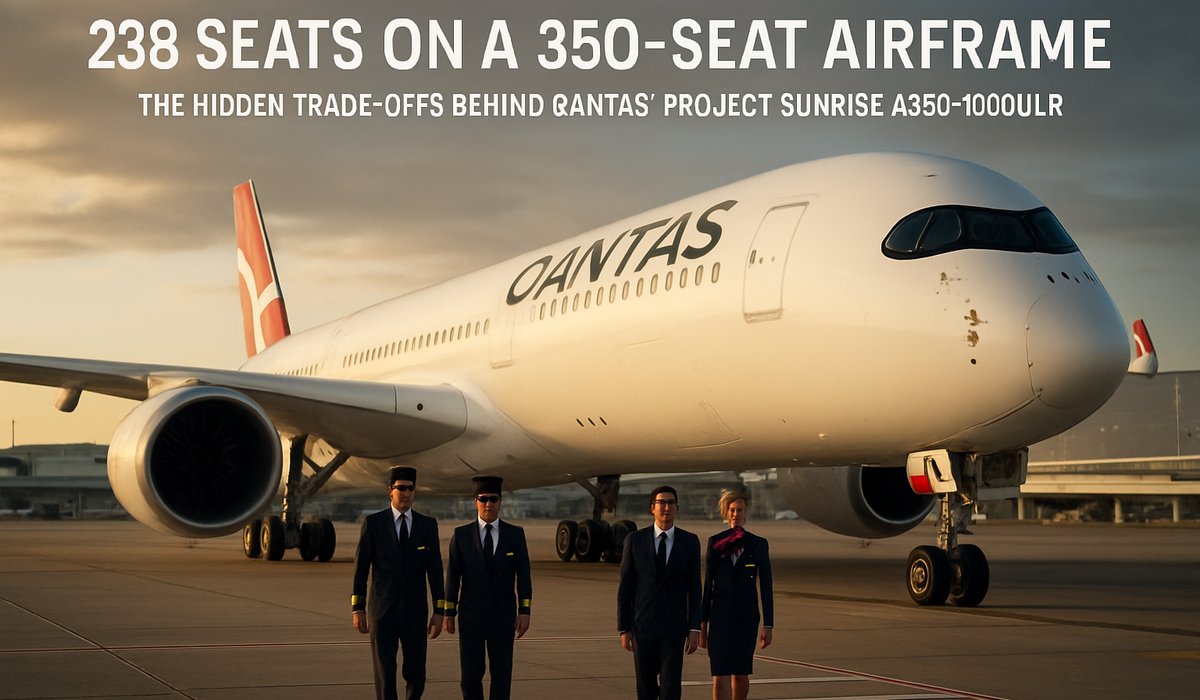
Image generated by AI
Qantas Sacrifices Capacity for Range: Project Sunrise A350 Configured With Just 238 Seats on 350-Seat Airframe
Ultra-long-range ambitions reveal aviation's latest cost-benefit crisis as carrier prioritizes fuel efficiency over passenger volume
The Range-Capacity Trade-Off Reshaping Long-Haul Aviation
Qantas' pursuit of non-stop service connecting Sydney to London and New York has resulted in a starkly revealing configuration: its second Airbus A350-1000ULR will carry merely 238 passengers despite the airframe's standard capacity of 350 seats. The aircraft entered final assembly in Toulouse during February 2026, marking a watershed moment in how carriers navigate the competing demands of extreme range and operational economics.
The decision underscores a fundamental tension dominating modern aviation strategy. To sustain nearly 22 consecutive hours of flight across the world's most challenging routing, Qantas has stripped the cabin to essentials—prioritizing fuel capacity and weight reduction over passenger density. This represents one of aviation's most dramatic capacity reductions, illustrating the unforgiving physics governing ultra-long-range operations.
Engineering Reality Behind Project Sunrise
The mathematics behind this configuration are uncompromising. Each additional passenger adds weight, requiring additional fuel, which in turn demands more weight to carry that fuel. This exponential penalty becomes catastrophic on routes exceeding 20 hours, where every kilogram directly impacts feasibility.
Project Sunrise demands operational specifications that conventional aircraft simply cannot meet. The A350-1000ULR—Airbus' purpose-built ultra-long-range variant—represents the technological ceiling for non-stop Sydney-London service. Yet even this specialized platform forces severe compromises on the carrier's revenue model.
Qantas has configured the aircraft with expanded first-class and premium cabin offerings, transforming apparent limitations into a luxury positioning strategy. The reduced overall capacity allows enhanced amenities, wider seats, and improved passenger comfort during marathon flights—features that command premium pricing and justify the lower seat count.
Industry-Wide Implications for Ultra-Long-Range Routes
This development signals broader challenges facing the aviation sector as carriers pursue increasingly ambitious routing. Fuel costs remain volatile, with jet fuel prices directly influencing the feasibility of ultra-long-range operations. The tighter configurations increase per-seat operating costs, requiring airlines to achieve higher yields through premium cabin premium pricing rather than volume.
Other carriers monitoring Project Sunrise's progress face similar decisions. The A350-1000ULR represents aviation's current technological frontier, yet its limitations reveal hard truths about the economics of point-to-point ultra-long-range service. Airlines pursuing comparable routes must accept comparable trade-offs between capacity and capability.
Qantas has framed the configuration as a deliberate strategy rather than an engineering constraint, positioning Project Sunrise flights as ultra-premium experiences rather than mass-market offerings. This positioning may prove essential given the substantial operating costs inherent in such extended routes.
FAQ: Understanding Ultra-Long-Range Aviation Trade-Offs
Q: Why does Qantas configure the A350-1000ULR with only 238 seats instead of maximum capacity? A: Extreme fuel requirements for 22+ hour flights demand significant weight reduction. Additional passengers require additional fuel, creating exponential penalties on ultra-long-range routes. Qantas prioritizes fuel efficiency and range capability over passenger volume.
Q: How do jet fuel prices impact the viability of ultra-long-range routes? A: Elevated fuel costs amplify the economics of carrying extra weight. Higher jet fuel prices make aggressive capacity reductions even more necessary, as fuel expense becomes the dominant operating cost on marathon routes.
Q: What other airlines are considering ultra-long-range A350 operations? A: Several carriers have expressed interest in A350-1000ULR variants, but few have committed to similarly extreme configurations. Most remain cautious about the revenue implications of dramatically reduced seating.
Q: How does the reduced seat count affect airline baggage fees and ancillary revenue? A: Premium cabin positioning allows carriers to bundle baggage policies into higher-tier fares. The luxury positioning strategy compensates for lower passenger volume through enhanced per-seat revenue from premium amenities and services.
Q: Will Project Sunrise routes remain profitable despite low capacity? A: Success depends on achieving substantial premium cabin yields. Qantas' strategy assumes sufficient demand for ultra-premium long-haul service to offset the reduced passenger count and elevated per-seat operating costs.
Related Travel Guides
Flight Delay Compensation Guide 2026
Understanding Airline Route Changes
Airport Security Process Updated (2026)
External Resources
Disclaimer
This article is for informational and educational purposes only. It does not constitute legal, financial, or professional advice. While we strive to provide accurate and up-to-date information, travel policies, regulations, and conditions change rapidly. Always verify information with official sources before making travel decisions. Nomad Lawyer makes no representations about the accuracy, reliability, completeness, or suitability of the information provided. Readers should consult qualified professionals for advice specific to their circumstances. The views expressed in this article are those of the author and do not necessarily reflect the views of Nomad Lawyer.
Kunal K Choudhary
Co-Founder & Contributor
A passionate traveller and tech enthusiast. Kunal contributes to the vision and growth of Nomad Lawyer, bringing fresh perspectives and driving the community forward.
Learn more about our team →