
Oman Air and Finnair Expand Codeshare Network Across Eight European Gateways and Bangkok to Link Helsinki with Melbourne
Oman Air and Finnair broaden bilateral codeshares, linking Helsinki across eight European gateways and connecting Melbourne via Bangkok to boost transcontinental transit.

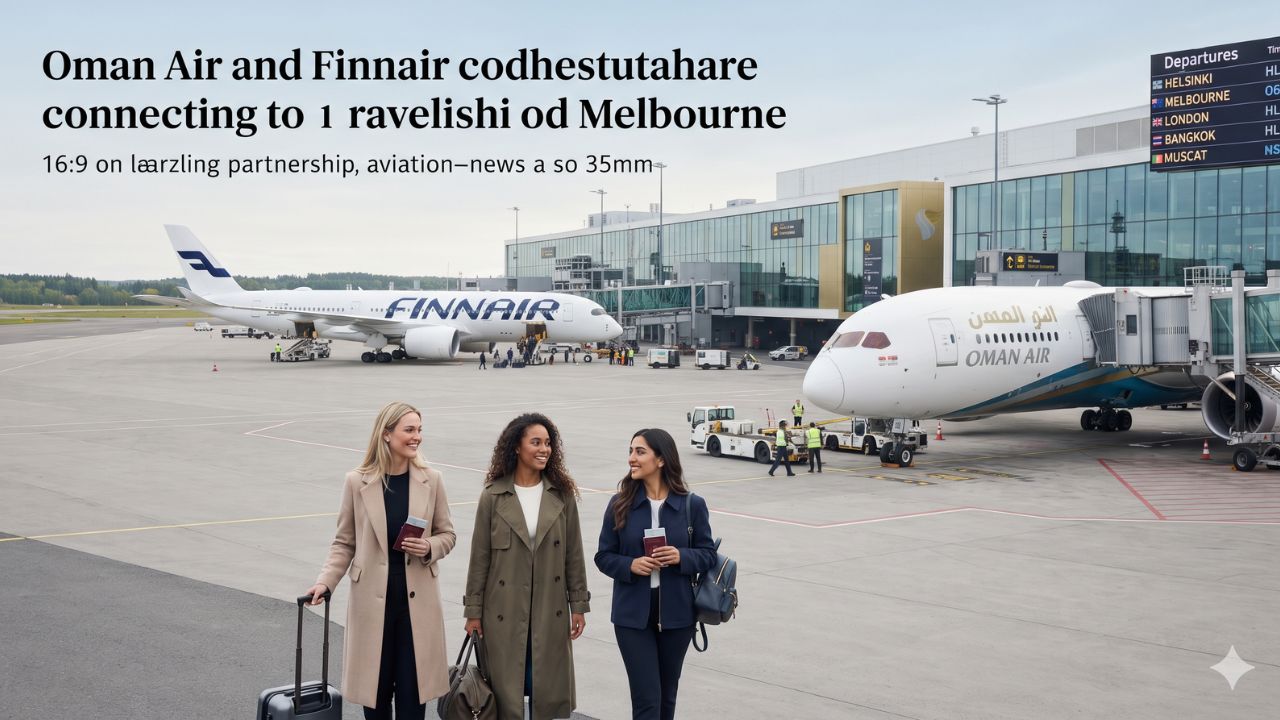
Long-haul passenger aircraft operating transcontinental connecting routes across global hub gateways
Connecting eight primary European capital gateways with Southeast Asia, a bilateral codeshare expansion between Oman Air and Finnair has linked Helsinki with Melbourne via dual transit nodes in Muscat and Bangkok. Announced on 22 October 2026, the interline accord allows both carriers to place marketing codes on partner-operated services, unlocking single-ticket itineraries through London Heathrow alongside seven mainland European hubs: Paris, Amsterdam, Frankfurt, Munich, Zurich, Milan, and Rome. By bridging Nordic route networks with the Arabian Gulf and Australasia, the partnership provides an alternative transit routing that circumvents congested megahubs in Doha and Dubai while strengthening Muscat International Airport’s commercial footprint.
The strategic coordination reflects a broader realignment in long-haul network economics. Following airspace closures over parts of Eastern Europe and Russia that forced Finnair to re-engineer its traditional Eurasian geographic advantage, European network carriers are increasingly relying on Gulf airline partnerships to access Asia-Pacific leisure and corporate traffic without deploying capital-intensive widebody aircraft on thin secondary routes.
Routing Architecture: Mapping the Eight European Gateways and Bangkok Corridors
Under the expanded codeshare framework, travelers departing the Middle East or connecting through Muscat gain seamless access to Finland via multiple European transfer points. Rather than relying solely on high-density transfer corridors through London Heathrow (LHR), Finnair and Oman Air have activated mutual codes across seven major continental hubs.
Simultaneously, the carrier accord extends eastward toward Australasia. Rather than channeling Australian passengers through standard Gulf megahubs, the agreement routes Melbourne (MEL) traffic through Bangkok’s Suvarnabhumi Airport (BKK). This dual-hub strategy allows Oman Air to funnel passengers from the Middle East and East Africa into Bangkok, where Finnair or interline partner flights complete the long-haul leg down to Victoria, Australia.
| Transfer Node & Hub Corridor | Connecting Carrier Alignment | Geographic Routing Flow | Key Transit Dynamics & Passenger Considerations |
|---|---|---|---|
| London Heathrow (LHR) | Finnair / Oman Air dual codes | Western Europe to Nordic & Gulf | High frequency; competitive corporate capacity across business cabins |
| Paris Charles de Gaulle (CDG) | Finnair / Oman Air interline | Western Europe – Helsinki / Muscat | Alternative to UK transit; avoids UK Air Passenger Duty departure levies |
| Frankfurt (FRA) & Munich (MUC) | Finnair / Oman Air mutual codes | Central Europe – Nordic / Arabian Sea | Key industrial and corporate export links for German business travel |
| Amsterdam (AMS) & Zurich (ZRH) | Finnair codes on regional links | Northern / Alpine Europe – Helsinki | Streamlined transfers; baggage through-checked to final destinations |
| Milan (MXP) & Rome (FCO) | Southern European gateways | Mediterranean to Baltic & Gulf | Captures Italian cultural tourism, seasonal leisure, and diaspora flows |
| Bangkok Suvarnabhumi (BKK) | Southeast Asian junction point | Middle East to Melbourne (MEL) | Intermediary transit bridge connecting Oman Air arrivals to Australian sectors |
| Muscat International (MCT) | Primary Gulf anchor facility | Global network crossroads | Promotes stopover tourism, cultural excursions, and regional Gulf dispersal |
Stopover Tourism and Omani National Strategy
For the Sultanate of Oman, the expanded airline partnership serves an important domestic economic objective. While long-haul passengers frequently treat Gulf airports purely as sterile airside transfer lounges, Oman’s national tourism strategy seeks to convert transit throughput into domestic foreign exchange earnings.
Muscat International Airport offers modern immigration and baggage facilities designed to support extended layovers. Travelers booking multi-leg itineraries can structure 24- to 72-hour stopovers to explore the Sultanate’s traditional souks, mountain forts, coastal fjords, and cultural landmarks before continuing onward to Scandinavia or Southeast Asia.
Simultaneously, Finland’s promotional authority, Visit Finland, is positioning Helsinki as more than a regional transit point. Beyond its role as an efficient transfer airport connecting Europe and East Asia, the Finnish capital offers distinct seasonal attractions, including Nordic maritime architecture, vibrant design districts, world-renowned museum networks, and historic sauna culture. The codeshare structure makes it straightforward for international travelers originating in the Gulf to combine Nordic urban breaks with wider European itineraries.
Ticketing Mechanics, Passenger Rights, and Visa Compliance
While codeshare agreements significantly expand available flight combinations, booking across multiple operating carriers requires careful adherence to international aviation rules monitored by the International Air Transport Association (IATA):
Single-Ticket Protections vs. Separate Itineraries
Passengers must verify that their entire multi-carrier journey—encompassing Oman Air and Finnair flight sectors—is issued under a single validated e-ticket number. Under international carriage conventions, a single ticket legally binds both airlines to rebook and accommodate passengers without additional charges if an inbound flight delay causes a missed connection in Bangkok, London, or continental Europe.
Operating Carrier Disclosure and Baggage Allowances
Aviation regulations require airlines to disclose the actual operating carrier for each flight segment during the booking process. While a ticket may carry an Oman Air "WY" flight prefix, the physical aircraft and cabin crew operating between Frankfurt and Helsinki may be Finnair. Baggage allowances, carry-on weight limits, and cabin seat selection policies follow the Marketing Carrier or the Most Significant Carrier (MSC) rule established under IATA Resolution 302.
Visas and Electronic Travel Authorities
Transcontinental journeys traversing Europe, the Gulf, and Australia cross distinct legal jurisdictions:
- Australia Entry: Australia’s Department of Home Affairs mandates that all foreign visitors hold a valid visa or Electronic Travel Authority (ETA) prior to boarding flights into Melbourne. Travelers transiting Bangkok must ensure their layover adheres to Thai transit visa regulations if changing terminals or rechecking luggage.
- Schengen Border Rules: Travelers entering Finland must comply with Schengen Area entry requirements, including passport validity of at least three months beyond the planned departure date and compliance with the 90-day visit ceiling within any rolling 180-day window.
Expert Analysis: Network Realignment in the Post-Siberian Airspace Era
The deepening partnership between Finnair and Oman Air demonstrates how mid-sized flag carriers are forging targeted alliances to counter the market dominance of global aviation giants. For travelers booking this route, the direct consequence is that competitive one-stop and two-stop pricing will become increasingly available on secondary international routes that bypass mega-carriers like Emirates or Qatar Airways.
The pricing pressure this creates means travelers flying between Northern Europe and Australia gain significant bargaining leverage, particularly during peak holiday periods when direct London–Singapore–Sydney Kangaroo routes command extreme rate premiums. By funneling passengers through European gateways into Muscat and onward via Bangkok to Melbourne, the alliance introduces valuable seat capacity into congested long-haul corridors.
Furthermore, this codeshare deepens Oman Air’s integration with global airline groupings ahead of its accession into the Oneworld alliance, of which Finnair is a founding member. By establishing joint commercial sales across eight European cities and Bangkok, both airlines pool corporate sales accounts, streamline frequent flyer reciprocity, and optimize aircraft utilization without committing scarce capital to speculative long-haul point-to-point routes.
Key Takeaways
- Multi-Hub Codeshare Expansion: Oman Air and Finnair expanded commercial codeshare operations on 22 October 2026, linking Helsinki and Melbourne through strategic partnerships.
- Eight European Gateways: The agreement channels traffic to Helsinki through London Heathrow alongside Paris, Amsterdam, Frankfurt, Munich, Zurich, Milan, and Rome.
- Australasian Transit via Bangkok: Melbourne connections operate via Bangkok Suvarnabhumi, giving Australian travelers an alternative corridor through Southeast Asia and the Gulf.
- Muscat Stopover Opportunities: The partnership supports Oman’s national tourism strategy by facilitating multi-day cultural layovers for transcontinental passengers.
- Passenger Protection Verification: Travelers must ensure multi-carrier flights are booked under a single ticket to protect through-checked baggage and ensure rerouting rights under IATA guidelines.
FAQ: Oman Air and Finnair Codeshare Expansion 2026
What destinations are covered under the Oman Air and Finnair codeshare?
The agreement connects Helsinki with Muscat and Melbourne, routing passengers through eight European gateways (London, Paris, Frankfurt, Munich, Amsterdam, Zurich, Milan, Rome) and Bangkok.
Does Oman Air fly directly from Muscat to Melbourne?
No. Travel between Muscat and Melbourne under this agreement operates via connecting flights through Bangkok Suvarnabhumi Airport, combining partner airline flight networks.
What are the visa rules for passengers transiting to Melbourne?
Travelers entering Australia must hold an approved Australian visa or Electronic Travel Authority (ETA) issued by the Department of Home Affairs before boarding their initial departure flight.
How does a single-ticket booking protect connecting passengers?
Booking multi-carrier codeshare flights on a single e-ticket guarantees that the airlines are legally obligated to provide free rebooking, meals, and hotel accommodation if an operational delay causes a missed connection.
By uniting Nordic efficiency with Arabian hospitality across eight European hubs, Oman Air and Finnair prove that flexible airline alliances can bridge the farthest corners of the globe.
Related Travel Guides
Condor and Etihad Transcontinental Abu Dhabi Network Expansion
Qatar Airways Western Sydney Long-Haul Schedule and Aircraft Allocations
10 Best Transit and Stopover Tips for Muscat and Bangkok, According To Reddit
Disclaimer
This article is for informational and educational purposes only. It does not constitute legal, financial, or professional advice. While we strive to provide accurate and up-to-date information, travel policies, regulations, and conditions change rapidly. Always verify information with official sources before making travel decisions. Nomad Lawyer makes no representations about the accuracy, reliability, completeness, or suitability of the information provided. Readers should consult qualified professionals for advice specific to their circumstances. The views expressed in this article are those of the author and do not necessarily reflect the views of Nomad Lawyer.
Raushan Kumar
Founder & Lead Developer
Full-stack developer with 11+ years of experience and a passionate traveller. Raushan built Nomad Lawyer from the ground up with a vision to create the best travel and law experience on the web.
Learn more about our team →