
Bordeaux Airport Completes €6.5M Ground Electrification Across 29 Aircraft Stands to Cut 4,100 Tonnes of CO2 Under EU AFIR Mandate
Bordeaux Airport completes a €6.5M ground electrification across 29 stands, replacing jet-fuel APUs with 400 Hz power and PCA units to cut 4,100 tonnes of CO2 by 2027.

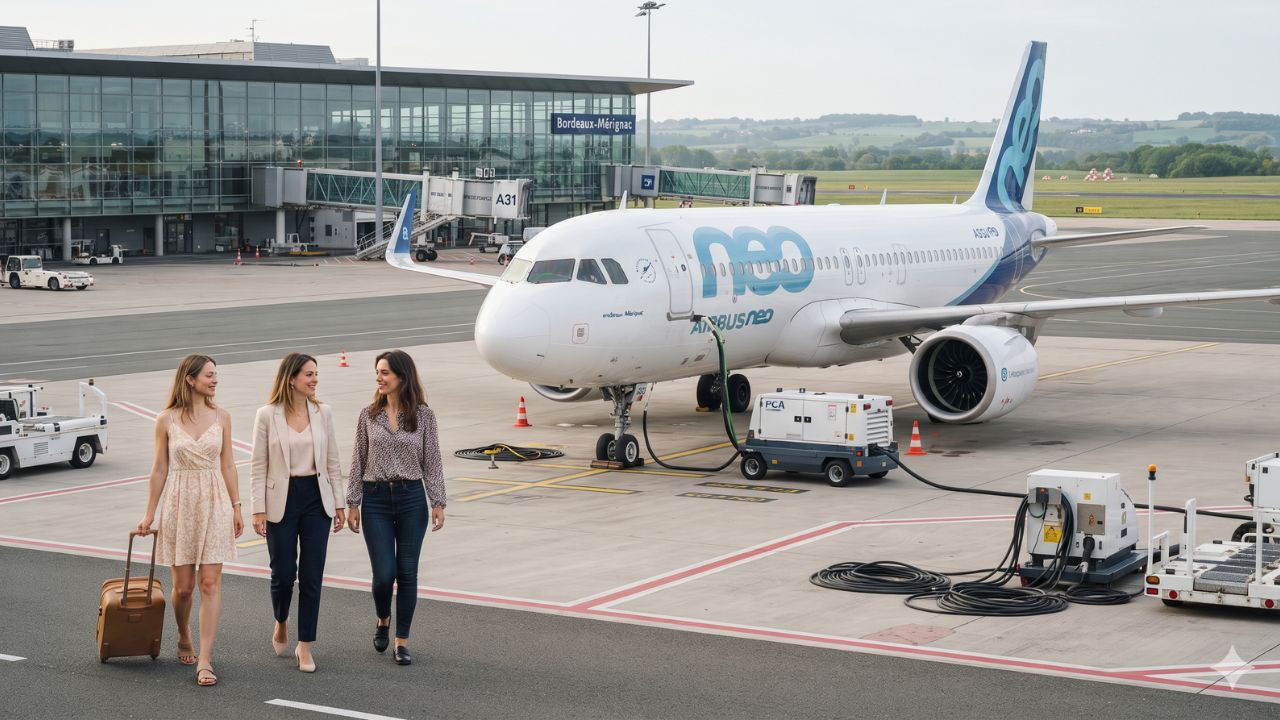
Zero-emission electric ground power and pre-conditioned air units servicing passenger aircraft on airport aprons
Eliminating the combustion of kerosene on airport aprons across all 29 commercial parking stands, Bordeaux-Mérignac Airport has completed a €6.5 million infrastructure electrification upgrade designed to reduce Scope 3 aviation emissions by 4,100 tonnes of carbon dioxide annually by 2027. The technical deployment, announced on 22 October 2026, equips every passenger gate with fixed 400 Hz electrical power outlets delivering 100% renewable electricity alongside 20 mobile Pre-Conditioned Air (PCA) units. By enabling arriving airliners to immediately power down their auxiliary power units (APUs), the southwestern French aviation gateway complies ahead of schedule with mandatory statutory deadlines set under the European Union's Alternative Fuels Infrastructure Regulation (AFIR).
The engineering overhaul marks a critical transition in how regional European airports manage indirect airline emissions. While airlines face long-term technological hurdles surrounding sustainable aviation fuels and fleet renewal, airports can directly eliminate fossil fuel consumption during the 35-to-50-minute ground turnaround window. By combining European grant capital with institutional mezzanine financing, the facility establishes an operational template for mid-sized hubs preparing for strict carbon compliance penalties across the continent.
Technical Execution: 400 Hz Ground Power and Pre-Conditioned Air Systems
The completed project at Bordeaux-Mérignac (BOD) addresses the two primary mechanical requirements of an aircraft parked at a terminal gate: electrical power for onboard avionics and thermal climate control for passenger cabins. Under conventional turnaround procedures, flight crews run an onboard gas-turbine engine located in the aircraft tail—the Auxiliary Power Unit (APU)—which burns between 100 and 300 kilograms of jet fuel per hour simply to keep cockpit instruments active and air conditioning circulating.
To replace this fossil-fuel cycle, the airport re-engineered its apron electrical distribution:
- Fixed 400 Hz Power Installations: All 29 passenger parking positions now supply high-frequency 400 Hz alternating current. This includes 20 newly electrified stands wired directly into the regional renewable electrical grid.
- Mobile Pre-Conditioned Air (PCA) Units: A fleet of 20 mobile PCA units connect directly to aircraft ventilation ducts via insulated flexible hoses, pumping filtered, chilled, or heated air into the cabin without requiring the aircraft’s air conditioning packs to run.
Approved under airside safety standards monitored by the European Union Aviation Safety Agency (EASA), the infrastructure eliminates apron engine noise and noxious exhaust fumes, providing ground crews with a safer working perimeter and passengers with stable boarding temperatures.
| Engineering & Environmental Indicator | Operational Specification / Reported Metric | Institutional Partner & Funding Mechanism | Strategic Impact on Airline Operations |
|---|---|---|---|
| Total Capital Investment | €6.5 million completed project budget | Mixed grant and mezzanine debt structure | Modernizes apron infrastructure ahead of EU AFIR compliance deadlines |
| Electrified Aircraft Stands | 29 commercial passenger positions (100%) | 20 newly electrified stands wired | Guarantees zero-emission turnarounds across all scheduled airline gates |
| Electrical Power Output | 400 Hz fixed ground power connections | 100% certified renewable energy grid | Replaces kerosene-burning APUs for avionics, galleys, and cabin systems |
| Cabin Climate Units | 20 mobile Pre-Conditioned Air (PCA) units | Certified under EASA ground safety rules | Maintains stable cabin temperatures during extreme summer heatwaves |
| Annual CO2 Emissions Reduction | 4,100 tonnes of CO2 per year by 2027 | Projected by regional environmental agencies | Slashes Scope 3 emissions generated by commercial airline partners |
| Mezzanine Debt Financing | €2.2 million subordinated loan | Banque des Territoires | Provides long-term patient capital for regional transport decarbonization |
| European Grant Support | Alternative Fuels Infrastructure Facility (AFIF) | Managed by CINEA | EU Green Deal backing under the statutory Fit for 55 regulatory framework |
Institutional Financing: The AFIF Grant Structure and Banque des Territoires
Executing the €6.5 million project required combining non-repayable European Union grants with long-term regional debt. The project secured primary financial backing through the Alternative Fuels Infrastructure Facility (AFIF), a funding instrument established under the European Green Deal’s Connecting Europe Facility. Operational management and grant disbursement were coordinated through the European Climate, Infrastructure and Environment Agency (CINEA).
To bridge the capital expenditure requirements, French public financial institution Banque des Territoires contributed a €2.2 million mezzanine loan. This hybrid financing model proves instrumental for regional airports whose commercial revenues cannot independently absorb capital-intensive airside civil works. Spreading risk between European climate agencies and domestic public lenders allows regional authorities to upgrade critical transport infrastructure without imposing prohibitive landing fee surcharges onto operating carriers.
The European Context: Schiphol, Paris CDG, and Venice
Bordeaux's apron electrification operates within a pan-European regulatory push toward zero-emission ground operations:
Amsterdam Airport Schiphol
Operating as a pioneer in ground decarbonization, Amsterdam Airport Schiphol has outfitted 73 aircraft stands with fixed 400 Hz electrical power and stationary PCA equipment. At Pier D, Schiphol deployed zero-emission electric Ground Power Units (e-GPUs) to replace diesel-powered generator carts, advancing toward a legally binding municipal target of net-zero airside operations by 2030.
Paris Charles de Gaulle
France’s primary international hub is currently executing the multi-year CLEARCDG28 initiative. Co-funded by European grants and supervised by the French Directorate General for Civil Aviation (DGAC), the project targets full electrification of stationary heavy long-haul aircraft gates across Paris CDG by 2028, handling complex dual-bridge widebody airframes.
Venice Marco Polo Airport
In northern Italy, Venice Airport secured European Union AFIR grants for its Electrification and Mobility Enhancement program. Supervised by the Italian Civil Aviation Authority (ENAC), the initiative focuses on halting airborne soot emissions to protect the vulnerable architecture of the adjacent UNESCO-listed Venetian Lagoon.
Expert Analysis: The Economics of Airport Scope 3 Compliance
Bordeaux’s ground electrification illustrates the subtle shift in aviation cost structures under Europe's "Fit for 55" regulatory regime. For travelers booking this route, the direct consequence is that summer tarmac delays will become significantly less physically stressful, with cabin temperatures reliably controlled by external ground air rather than struggling onboard mechanical systems.
The pricing pressure this creates means low-cost carriers operating tight 25-to-35-minute turnarounds at Bordeaux—including easyJet, Ryanair, and Volotea—can lower their direct fuel burn, saving dozens of gallons of expensive jet fuel on every turnaround. However, airports must eventually recover their capital outlays through adjusted ground handling tariffs. While fixed electric power is cheaper per kilowatt-hour than burning aviation kerosene, airlines that fail to connect to ground power face rising statutory airport penalties, establishing a strict operational mandate that favors modern, technically compliant aircraft fleets.
Furthermore, early AFIR compliance insulates Bordeaux from future regulatory flight caps. Under French Ministry of Transport guidelines, airports that violate European environmental mandates risk statutory restrictions on night operations and future slot growth. By converting all 29 stands to clean electricity, Bordeaux guarantees that international airlines can continue expanding direct flight routes into Aquitaine's wine and leisure corridors without running afoul of Brussels' escalating environmental enforcement mechanisms.
Key Takeaways
- Complete Apron Electrification: Bordeaux Airport installed 400 Hz electric power across all 29 commercial stands, including 20 newly electrified positions.
- 4,100-Tonne CO2 Reduction: Switching off aircraft APU engines during turnarounds will eliminate 4,100 tonnes of annual carbon emissions by 2027.
- Cabin Climate Guarantee: Deployed 20 mobile Pre-Conditioned Air (PCA) units to supply thermal comfort without burning aviation jet fuel.
- €6.5M Hybrid Financing: Funded through European Union AFIF grants managed by CINEA alongside a €2.2 million mezzanine loan from Banque des Territoires.
- Proactive AFIR Compliance: Meets mandatory EU Alternative Fuels Infrastructure Regulation standards years ahead of continental deadlines.
FAQ: Bordeaux Airport Ground Electrification 2026
What is the purpose of the €6.5 million Bordeaux Airport upgrade?
The project electrifies all 29 commercial aircraft parking stands, allowing planes to turn off their fuel-burning auxiliary engines (APUs) during gate turnarounds to cut carbon emissions and noise.
How much carbon dioxide will the project eliminate?
The airport projects an annual reduction of 4,100 tonnes of CO2 emissions by 2027, significantly slashing indirect Scope 3 emissions generated by airline partners.
What are PCA units and how do they benefit passengers?
Pre-Conditioned Air (PCA) units are mobile ground devices that pump filtered, cooled, or heated air directly into an aircraft cabin, keeping travelers comfortable during boarding without engine pollution.
What European regulation mandates these airport upgrades?
The upgrades fulfill the European Union’s Alternative Fuels Infrastructure Regulation (AFIR), part of the "Fit for 55" legislative package requiring stationary aircraft electrification at major transport nodes.
By replacing roaring auxiliary jet engines with clean renewable ground power, Bordeaux Airport proves that regional aviation decarbonization begins on the tarmac.
Related Travel Guides
France and Austria Green Aviation Initiatives: ReFuelEU Mandates and Sustainable Fuel Policies
Air France Transatlantic Network Expansion: Fleet Deployments and Modern Hub Routes
10 Best Travel Tips for Exploring the Bordeaux Wine Region by Air and Rail, According To Reddit
Disclaimer
This article is for informational and educational purposes only. It does not constitute legal, financial, or professional advice. While we strive to provide accurate and up-to-date information, travel policies, regulations, and conditions change rapidly. Always verify information with official sources before making travel decisions. Nomad Lawyer makes no representations about the accuracy, reliability, completeness, or suitability of the information provided. Readers should consult qualified professionals for advice specific to their circumstances. The views expressed in this article are those of the author and do not necessarily reflect the views of Nomad Lawyer.
Raushan Kumar
Founder & Lead Developer
Full-stack developer with 11+ years of experience and a passionate traveller. Raushan built Nomad Lawyer from the ground up with a vision to create the best travel and law experience on the web.
Learn more about our team →