
Aviation Updates: Severe Travel Chaos at Newark Liberty Airport as United, Delta, and Lufthansa Suffer 84 Flight Delays
Newark Liberty International Airport experiences major airport disruptions, recording 84 flight delays and 2 cancellations that impact major transatlantic routes.

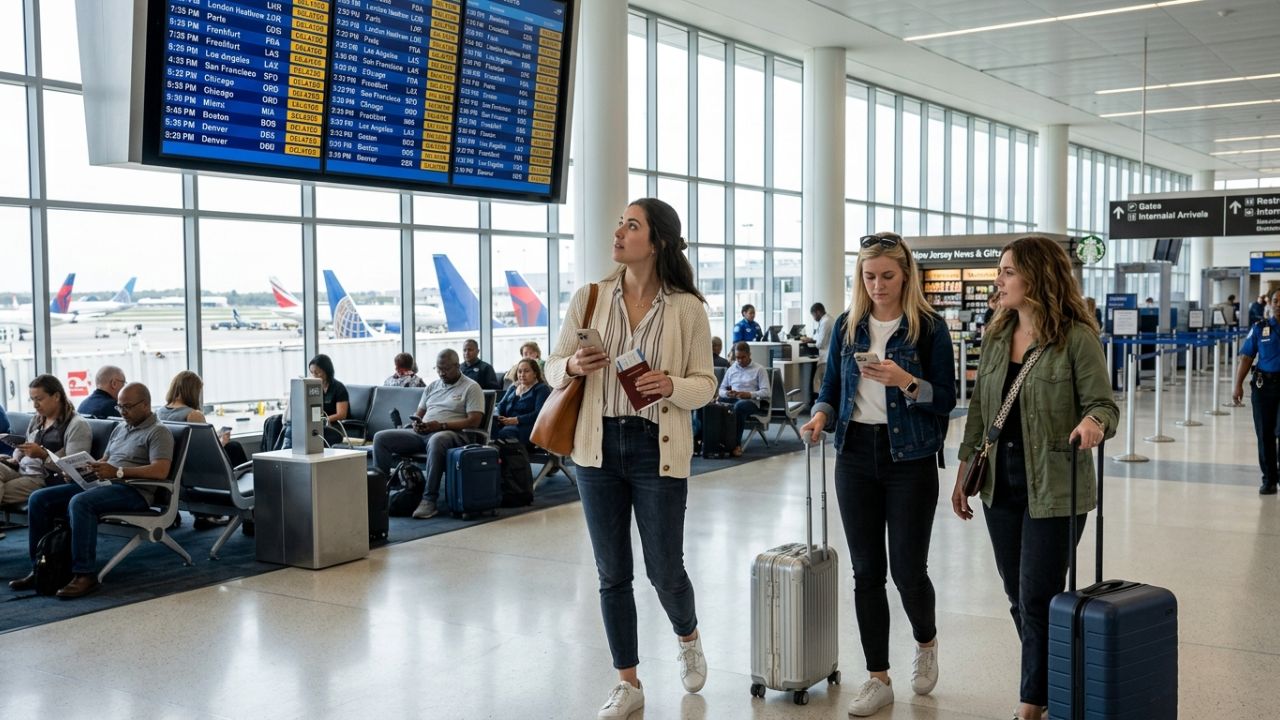
Image generated by AI
Aviation Updates: Severe Travel Chaos at Newark Liberty Airport as United, Delta, and Lufthansa Suffer 84 Flight Delays
Massive congestion in the New York airspace paralyzes transatlantic and domestic connectivity, leaving hundreds of business and leisure passengers stranded.
Image generated by AI
A massive wave of airport disruptions has severely crippled flight operations at Newark Liberty International Airport, plunging one of the busiest aviation gateways in the New York City area into absolute travel chaos. According to the latest aviation updates and verified flight tracking telemetry, the major transatlantic hub suffered 84 brutal flight delays and 2 outright flight cancellations in a single operational cycle. While the absolute number of cancelled flights remains relatively low, the sheer volume of severe delays has fractured domestic and international schedules, paralyzing operations for major operators including United Airlines, Delta Air Lines, JetBlue, and Lufthansa. This massive operational imbalance is currently cascading across global networks, completely devastating high-frequency routes connecting New York to London, Paris, Frankfurt, and numerous major US cities.
Expanded Overview: Congestion in the NYC Airspace
When a high-density, slot-restricted hub like Newark Liberty approaches maximum operational capacity, the entire facility becomes incredibly vulnerable. The current delays are highly correlated with intense air traffic congestion pressures plaguing the broader New York airspace.
This regional airspace restriction immediately amplified scheduling instability, creating massive secondary pressure on gate availability and complex runway sequencing. Because Newark operates as a critical intercontinental bridge, this localized friction generated immediate, global secondary effects. Long-haul and regional flights bound for Europe, Canada, and the Caribbean were forced into holding patterns or delayed at the gate, proving that the modern aviation system completely lacks the necessary buffer capacity to absorb even minor scheduling shocks during peak seasonal travel cycles.
Section-Wise Breakdown: The Domestic Network Collapse
As the dominant carrier at Newark Liberty, United Airlines absorbed the absolute brunt of the domestic network collapse. Operating the majority of the disrupted services, United recorded 43 delayed flights—the highest single-airline impact of the day.
This heavy concentration perfectly highlights the extreme risk associated with mega-hub operations. When United's mainline operations stalled, the pain immediately trickled down to its regional feeder network, with GoJet (operating for United) suffering 5 delayed flights and Republic Airways recording 2. Competing domestic carriers were also caught in the crossfire; JetBlue recorded 6 delays, Delta Air Lines took 3, American Airlines logged 2, and Frontier Airlines suffered 1. This widespread domestic gridlock shattered high-frequency business routes across the United States, leaving premium passengers with virtually zero rebooking flexibility due to tight aircraft turnaround schedules.
Section-Wise Breakdown: Transatlantic Routes Paralyzed
While the domestic impact was severe, the disruption to international long-haul operations carries massive implications for global tourism and connectivity. Transatlantic routes are incredibly sensitive to congestion because they operate on highly strict slot coordination and rigid air traffic sequencing.
The delays at Newark successfully fractured inbound tourism flows originating from major European hubs like Zurich, Copenhagen, London, Paris, and Frankfurt. Air France, Swiss International Air Lines, SAS, and French Bee each recorded 2 agonizing delays. Lufthansa, Austrian Airlines, and Icelandair each suffered 1 delayed flight. Furthermore, regional international connections were also damaged, with Porter Airlines (7 delays), Jazz Aviation (an Air Canada affiliate with 3 delays), and BermudAir (1 delay) all struggling to clear the congested New York airspace.
Flight Details: Newark Liberty Disruption Matrix
The precise operational telemetry detailing this massive hub congestion event has been consolidated into the mandatory matrix below, outlining the specific delay distribution across domestic and international operators.
Newark Liberty Airport Airline Disruption Matrix
| Airline | Delayed Flights | Cancelled Flights |
|---|---|---|
| United Airlines | 43 | - |
| Porter Airlines | 7 | - |
| JetBlue | 6 | - |
| GoJet (operating for United) | 5 | - |
| Delta Air Lines | 3 | - |
| Jazz Aviation (Air Canada affiliate) | 3 | - |
| American Airlines | 2 | - |
| Republic Airways | 2 | - |
| Air France | 2 | - |
| Swiss International Air Lines | 2 | - |
| SAS | 2 | - |
| French Bee | 2 | - |
| Lufthansa | 1 | - |
| Austrian Airlines | 1 | - |
| Icelandair | 1 | - |
| Frontier Airlines | 1 | - |
| BermudAir | 1 | - |
(Note: The airport recorded a total of 2 cancellations during this operational cycle, though the delays represented the primary systemic stressor).
Passenger Impact: Stranded in Transit
For the hundreds of passengers navigating Newark Liberty, the rolling delays generated immense schedule uncertainty and intense frustration. International travelers attempting to connect through the New York region to the Caribbean or Europe faced the highest levels of inconvenience, as cascading delays violently destroyed onward connections.
Business travelers utilizing high-frequency Delta and United routes were left stranded in the terminal, as airlines lacked the standby capacity to rapidly re-accommodate them. Furthermore, inbound European leisure passengers experienced severe schedule uncertainty that threatened short-stay tourism itineraries and strict hotel check-in windows across the New York metropolitan area.
Industry Analysis: Slot Coordination and Hub Vulnerability
Aviation strategists analyzing these airline news reports emphasize that the Newark disruption is a textbook example of high-density hub vulnerability. When an airport operates near 100% capacity, minor air traffic control friction instantly devolves into a 84-flight backlog.
Repeated delays of this magnitude severely degrade operational reliability scores, which can directly influence future slot allocations during high-demand periods. Aviation authorities will now be forced to aggressively prioritize recovery through adjusted sequencing, complex aircraft rerouting, and deploying limited standby capacity to help stabilize the fragile New York air traffic corridor.
Conclusion: A Fragile Aviation Corridor
Ultimately, the latest breakdown at Newark Liberty International Airport definitively proves that the New York airspace requires significantly better coordinated air-space management and enhanced capacity planning. The combination of 84 delays and 2 cancellations heavily exposed the extreme operational vulnerability of major hub airports. While United Airlines absorbed the vast majority of the damage, the secondary knock-on effects paralyzed operations for Delta, Lufthansa, and Air France, threatening global tourism flows. As the system attempts to stabilize, passengers utilizing Newark are strongly advised to maintain extreme flexibility with their travel plans.
Key Takeaways
- Total Disruption: Newark Liberty International Airport recorded 84 flight delays and 2 total flight cancellations.
- Most Affected Airline: United Airlines suffered the highest impact with 43 delayed flights.
- European Knock-On Effects: Major transatlantic carriers including Air France, Swiss, SAS, and Lufthansa suffered direct delays.
- Airspace Congestion: The disruptions were heavily correlated with intense air traffic congestion in the broader New York airspace.
- Tourism Impact: Inbound flights from London, Paris, Frankfurt, Zurich, and Copenhagen were heavily disrupted, threatening NYC hotel itineraries.
FAQ: Newark Liberty Airport Flight Delays 2026
Which airlines experienced the most delays at Newark Liberty Airport today? United Airlines was the most heavily affected carrier, recording 43 delayed flights. Porter Airlines followed with 7 delays, and JetBlue recorded 6 delays.
How many total flights were delayed or cancelled at Newark? The airport recorded a total of 84 flight delays and 2 flight cancellations during this severe disruption event.
Which international routes were impacted by the Newark delays? The delays heavily impacted transatlantic and North American operations, specifically causing severe disruptions on routes connected to London, Paris, Frankfurt, Zurich, Copenhagen, and major Canadian airports.
Related Travel Guides
Galapagos Islands Europe Waterways Edutourism Travel Trend 2026
Helsinki-Vantaa Airport Delays Finnair CityJet Travel Chaos 2026
New York Airports EWR JFK LGA Disruption Survival Guide 2026
Disclaimer: This article is strictly for informational purposes. Delay statistics (84 total delays) and cancellation figures (2 cancellations) involving United Airlines, Delta Air Lines, Lufthansa, and other carriers are based on real-time data sourced from FlightAware at the time of publication. Flight schedules are highly dynamic and subject to continuous modification to maintain operational safety. Passengers must verify their exact flight status directly with their airline before arriving at the airport.
Disclaimer
This article is for informational and educational purposes only. It does not constitute legal, financial, or professional advice. While we strive to provide accurate and up-to-date information, travel policies, regulations, and conditions change rapidly. Always verify information with official sources before making travel decisions. Nomad Lawyer makes no representations about the accuracy, reliability, completeness, or suitability of the information provided. Readers should consult qualified professionals for advice specific to their circumstances. The views expressed in this article are those of the author and do not necessarily reflect the views of Nomad Lawyer.
Raushan Kumar
Founder & Lead Developer
Full-stack developer with 11+ years of experience and a passionate traveller. Raushan built Nomad Lawyer from the ground up with a vision to create the best travel and law experience on the web.
Learn more about our team →