
Aviation Updates: How Severe Travel Chaos and Flight Cancellations Are Fueling the Massive Global Edutourism Boom
As airport disruptions plague modern travel, families are escaping the chaos by transforming trips to the Galapagos Islands and European waterways into floating classrooms.

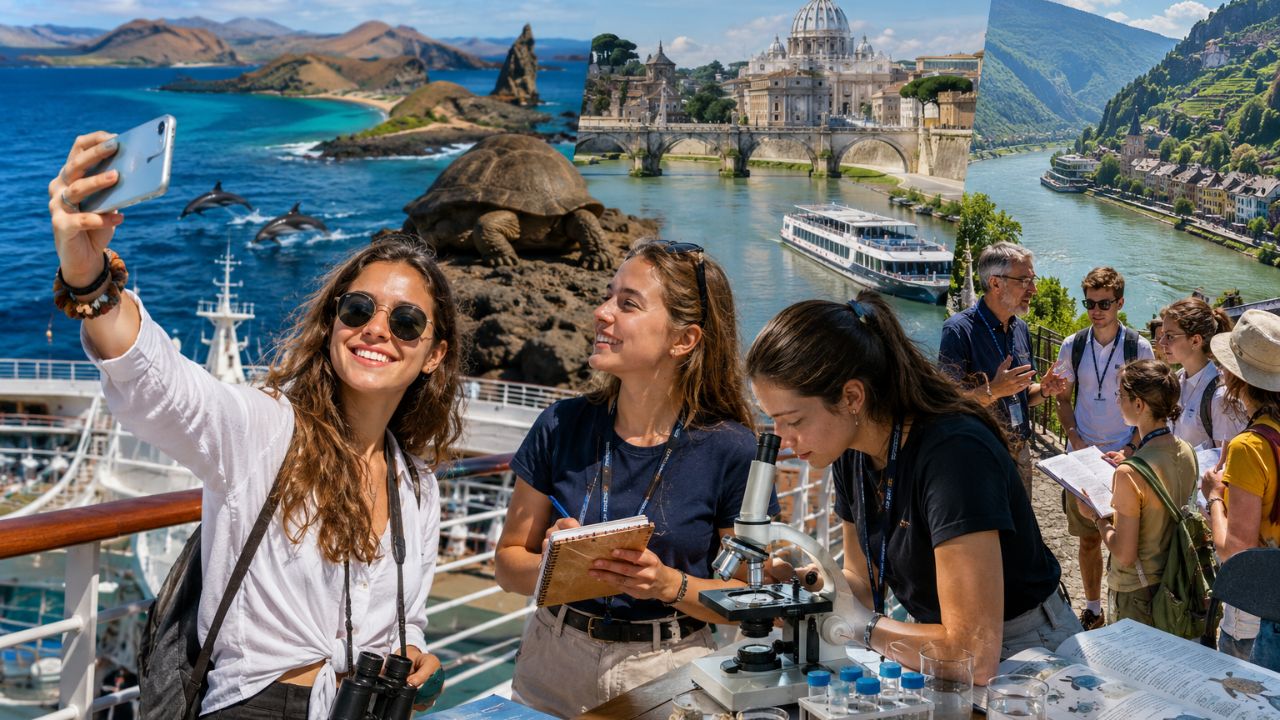
Image generated by AI
Aviation Updates: How Severe Travel Chaos and Flight Cancellations Are Fueling the Massive Global Edutourism Boom
Exhausted by the highly unpredictable nature of modern commercial aviation, modern families are abandoning frantic, multi-stop itineraries in favor of deep, immersive 'worldschooling' aboard luxury ocean liners and river networks.
Image generated by AI
The daily cycle of airline news is currently dominated by deeply frustrating reports of massive airport disruptions, rolling flight cancellations, and absolute travel chaos across major global hubs. In direct response to this severe operational friction, a powerful counter-movement has emerged within the hospitality sector. Thousands of parents and solo adventurers are completely discarding frantic, flight-dependent holiday itineraries in favor of "edutourism"—a massive human awakening that transforms the Galapagos Islands, the historic waterways of Europe, and the massive aquatic highways of Southeast Asia into living, breathing classrooms. According to recent aviation updates, travelers are increasingly utilizing slow-travel maritime options to bypass the gridlocked aviation network. By eliminating the stress of missed flight connections, families can focus entirely on intellectual engagement, observing wild dolphins alongside marine biologists and physically interacting with the magnificent world around them.
Expanded Overview: The Spectacular Rise of Edutourism
This explosive paradigm shift is fundamentally restructuring how the hospitality sector designs consumer itineraries. Industry analysts report a massive surge in experiential lifestyle procurement. Modern globetrotters are aggressively rejecting passive, screen-heavy leisure.
This behavioral pivot is heavily backed by statistical evidence. Market research indicators confidently reveal that over 80% of younger demographics state that acquiring a tangible real-world capability or absorbing deep ancestral heritage makes their global exploration infinitely more meaningful. In response, mainstream vacation providers are completely overhauling their traditional entertainment packages. Shuffleboard courts are being ripped out to make way for state-of-the-art laboratory spaces, localized language immersion seminars, and elite masterclasses.
Section-Wise Breakdown: The Galapagos and Marine Campuses
To avoid the agonizing travel chaos of multi-destination international flights, travelers are flocking to modern ocean liners, which are dynamically evolving into elite academic campuses.
By unpacking their belongings just once, families participating in "worldschooling" voyages wake up to a brand-new cultural ecosystem or ecological preserve every single morning. In regions like the Galapagos Islands (Ecuador), educational directors utilize the vessel’s changing coordinates as a living textbook. When students study marine biology and the delicate physics of fluid dynamics while actively crossing specialized oceanic trenches, their data retention capabilities increase exponentially. The isolation of these deep-water ocean voyages fosters unparalleled peer collaboration, effectively mimicking elite private academies right on the high seas.
Section-Wise Breakdown: River Channels as Hands-On Laboratories
Away from the deep blue oceans, terrestrial expeditions and river cruise networks are experiencing an equally phenomenal upgrade in user engagement. On legendary aquatic highways such as the Mekong Delta and the Rhine River, journeys are being aggressively structured around complex socio-economic development, agricultural science, and architectural history.
Travelers on these routes are no longer merely gazing at distant landscapes through tinted glass windows. Instead, they are stepping directly into the heart of regional communities. Leading international field research coordinators confirm that standard sightseeing is dead in the premium market. Modern travelers demand high-stakes environments where they can actively participate in geothermal energy tracking, architectural restoration projects (such as those surrounding historic sites in Rome), or grassroots micro-lending operations alongside indigenous community leaders.
Flight Details: Global Edutourism Expansion Matrix
The specific regional focus areas driving this massive worldschooling movement have been consolidated into the mandatory matrix below, detailing how specific geographies dictate the educational curriculum.
Global Edutourism Expansion Matrix (2026)
| Educational Region | Core Curricular Focus | Learning Environment |
|---|---|---|
| Galapagos Islands / Ecuador | Marine Biology, Fluid Dynamics, Conservation | Deep-water oceanic trenches & coastal preserves |
| European Waterways (Rhine River) | Architectural History, Cultural Immersion | River cruise networks & overland trails |
| Southeast Asia (Mekong Delta) | Agricultural Science, Micro-Lending | Aquatic highways & regional communities |
Passenger Impact: Ditching the Airport for Deep Learning
For the modern passenger, engaging in edutourism represents a massive upgrade in logistical sanity and personal growth. Attempting to execute a multi-city educational tour via commercial aviation currently exposes families to high risks of systemic delays. A single wave of flight cancellations can entirely destroy a tightly packed itinerary, stranding families in sterile airport terminals instead of cultural heritage sites.
By transitioning to slow-travel, maritime-based edutourism, travelers completely insulate themselves from this friction. Furthermore, by engaging in actual, physical problem-solving on the ground, participants walk away with a profound level of cross-cultural empathy and systemic understanding that absolutely no standard university lecture or frantic weekend city-break could ever replicate.
Industry Analysis: Government Validation of the Trend
Aviation and hospitality strategists emphasize that this sweeping cultural trend is receiving substantial validation from formal regulatory bodies worldwide. Portals managed by the United States Department of State Bureau of Educational and Cultural Affairs and global heritage agencies like UNESCO continually highlight that international experiential learning serves as a critical pillar for public diplomacy.
During recent global hospitality summits, national tourism administrators declared that governments must rapidly modernize their visa regulations and educational recognition frameworks to better support this highly fluid, mobile demographic. Government white papers explicitly indicate that cross-border educational exchanges actively foster global security and inject critical financial support directly into rural economies. Nations that fail to upgrade their infrastructure to accommodate these traveling classrooms will inevitably lose their competitive edge.
Conclusion: A More Intentional Era of Exploration
Ultimately, the chaotic state of the global aviation network has acted as a powerful catalyst, accelerating the transition toward slow, purposeful, and deeply intentional exploration. We are finally learning to measure the success of a vacation not by the number of flights taken or superficial trinkets purchased, but by the profound expansion of our inner horizons. As families return home from these transformative edutourism odysseys along the Mekong Delta or the Galapagos, they carry a renewed confidence that their children are growing up to be conscious, compassionate, and deeply connected global citizens.
Key Takeaways
- Edutourism Boom: Over 80% of younger demographics prioritize acquiring real-world capabilities and heritage absorption during travel.
- Aviation Alternative: Slow-travel maritime "worldschooling" allows families to bypass severe airport disruptions and flight cancellations.
- Living Classrooms: Ocean liners in the Galapagos Islands are replacing traditional entertainment with marine biology labs and scientific masterclasses.
- Hands-On Learning: River cruises on the Rhine and Mekong Delta focus heavily on agricultural science, architectural history, and micro-lending.
- Government Backing: Global bodies like UNESCO and the US Department of State officially validate experiential learning as vital for public diplomacy.
FAQ: Global Edutourism Trends 2026
What is edutourism or worldschooling? Edutourism (or worldschooling) is a rapidly growing travel trend where vacations are explicitly designed around experiential learning, transforming cruise ships and tour routes into mobile, hands-on educational campuses.
Why is edutourism becoming so popular right now? Market research indicates that over 80% of younger travelers want vacations that provide permanent personal growth. Furthermore, utilizing single-embarkation maritime travel helps families completely bypass the severe travel chaos and flight cancellations plaguing commercial aviation.
Which global regions are leading the edutourism trend? The Galapagos Islands (Ecuador) are highly popular for marine biology and conservation, while the historic waterways of Europe (like the Rhine) focus on architectural history. Southeast Asia's Mekong Delta is heavily utilized for agricultural science and socio-economic learning.
Related Travel Guides
MSC Meraviglia Southampton Cruise Deployment Northern Europe 2028
Fourth of July US Travel Boom Alaska Maine Montana Delays 2026
Ultimate Worldschooling and Edutourism Planning Guide 2026
Disclaimer: This article is strictly for informational purposes. Statistical data regarding consumer preferences (80% demographic metric) and institutional stances (UNESCO, US Department of State) reflect industry reports at the time of publication. Travel trends, edutourism curricula, and specific maritime itineraries are highly dynamic and subject to continuous modification by operators. Travelers should verify all educational programming and travel requirements directly with their chosen expedition provider prior to booking.
Disclaimer
This article is for informational and educational purposes only. It does not constitute legal, financial, or professional advice. While we strive to provide accurate and up-to-date information, travel policies, regulations, and conditions change rapidly. Always verify information with official sources before making travel decisions. Nomad Lawyer makes no representations about the accuracy, reliability, completeness, or suitability of the information provided. Readers should consult qualified professionals for advice specific to their circumstances. The views expressed in this article are those of the author and do not necessarily reflect the views of Nomad Lawyer.
Raushan Kumar
Founder & Lead Developer
Full-stack developer with 11+ years of experience and a passionate traveller. Raushan built Nomad Lawyer from the ground up with a vision to create the best travel and law experience on the web.
Learn more about our team →