
New Zealand Funds Conservation and Infrastructure with 100 NZD Visitor Levy
New Zealand's restructured 100 NZD International Visitor Levy generates NZD $90M annually, funding frontline conservation and regional infrastructure.

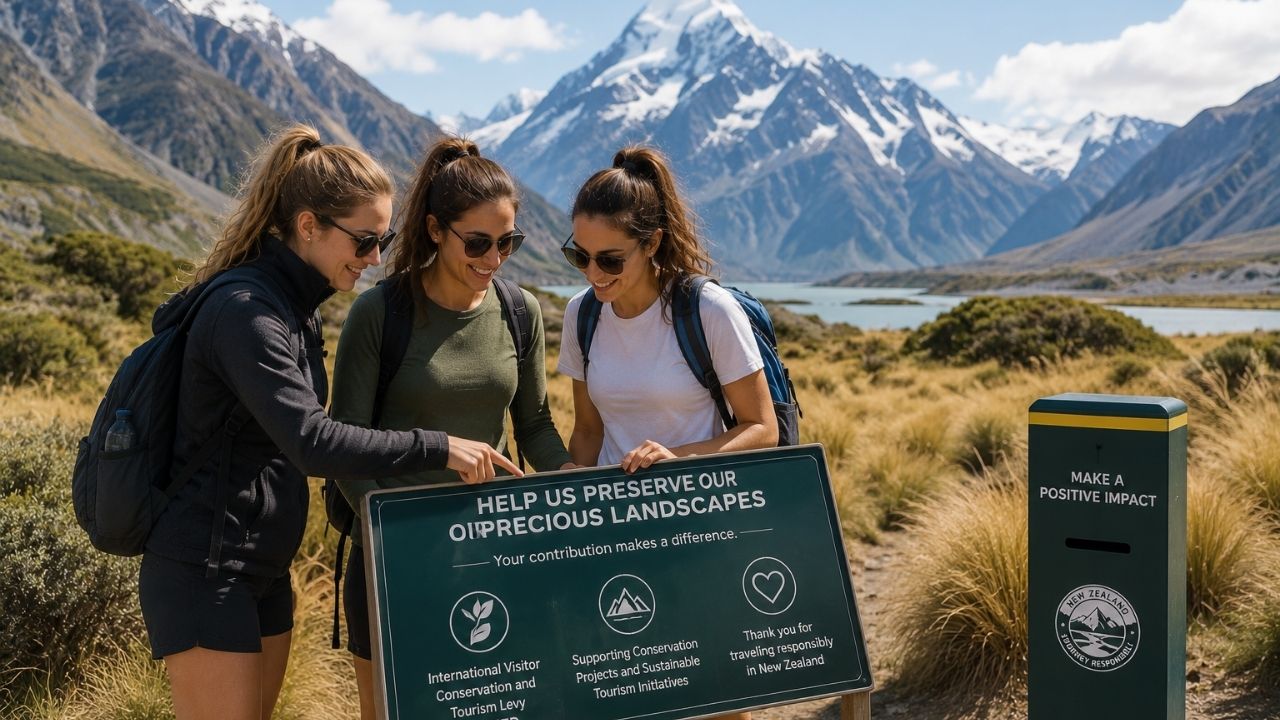
Image generated by AI
New Zealand's restructured 100 NZD International Visitor Conservation and Tourism Levy (IVL) is generating NZD $90 million annually to fund frontline biodiversity protection and regional eco-infrastructure.
[WELLINGTON, New Zealand] — Official reporting frameworks released by the Ministry of Business, Innovation and Employment (MBIE) and the Department of Conservation (DOC) outline the impact of New Zealand's eco-tax strategy. Following the baseline increase of the International Visitor Conservation and Tourism Levy (IVL) from 35 NZD to 100 NZD, border collections generate an annual fund pool of NZD $90 million. Administered through a 50:50 governance split between conservation initiatives and municipal infrastructure, the user-pays model ensures foreign tourists directly fund biosecurity, predator control, and trail maintenance across national parks.
Eco-Tax Strategy and Budget 2026 Revenue Allocations
Cabinet oversight frameworks established in 2026 govern the systematic distribution of IVL collections across government departments.
Under Budget 2026 announcements delivered by the New Zealand Treasury, eco-tax revenues were deployed to offset a NZD $9.428 million annual baseline savings target in Vote Conservation. Officials secured a time-limited NZD $10.578 million baseline uplift drawn directly from IVL collections.
This administrative mechanism redirects foreign tourist funding into frontline biosecurity screening, public trail maintenance, and predator control across ecologically sensitive reserves, including Tongariro National Park and the Hauraki Gulf.
IVL Revenue Allocation Framework:
├── Annual Levy Collection Pool: NZD $90 Million
├── Department of Conservation (DOC): NZD $55 Million/Year (Frontline Biodiversity & Biosecurity)
└── Ministry of Business, Innovation & Employment (MBIE): NZD $35 Million/Year (Regional Infrastructure)
Wildlife Ecosystem Protection in Fiordland and Stewart Island
The Department of Conservation utilizes its NZD $55 million annual allocation to protect native biodiversity and eradicate invasive predators.
Major project commitments include NZD $26.9 million allocated to Tiakina Ngā Manu (the National Predator Control Programme), alongside a multi-year budget of NZD $81.3 million targeting invasive rats, stoats, and possums. Eradication campaigns focus heavily on Stewart Island / Rakiura, Fiordland National Park, and central North Island forest corridors.
These biosecurity measures protect vulnerable native species—including the kiwi, kea, kākāpō, and Hector’s dolphin—from ecosystem decay caused by introduced mammalian predators.
Predator Eradication & Species Protection Allocations:
├── Tiakina Ngā Manu Programme Pool: NZD $26.9 Million
├── Multi-Year Invasive Predator Control: NZD $81.3 Million (Stewart Island, Fiordland, Tongariro)
└── Species Protection Targets: Kiwi, Kea, Kākāpō, Hector's Dolphin & Bryde's Whale
Marine Reserve Expansion Across the Hauraki Gulf Marine Park
Eco-tax revenue streams support major expansions of protected coastal and marine sanctuaries.
Protected marine reserve coverage within the Hauraki Gulf Marine Park is expanding from 6.7% to 18% total area. To support this biological corridor expansion, multi-year financial allocations totaling NZD $14.2 million have been committed to marine management and monitoring.
Additionally, NZD $7.1 million in capital expenditure is dedicated to reducing extinction risks for flagship marine species, funding acoustic monitoring networks and maritime navigation rules to protect Bryde’s whales and Hector’s dolphins.
Hauraki Gulf Marine Sanctuary Expansion:
├── Reserve Coverage Area: Increased from 6.7% to 18% total marine park coverage
├── Marine Management Funding: NZD $14.2 Million multi-year monitoring allocation
└── Flagship Species Protection: NZD $7.1 Million capital spend for Bryde's whales & dolphins
Regional Infrastructure Upgrades in Queenstown, Rotorua, and West Coast
The Ministry of Business, Innovation and Employment manages its NZD $35 million annual IVL portion to upgrade municipal infrastructure in high-density tourism regions.
Targeted capital investments focus on areas experiencing heavy seasonal visitor traffic, including the West Coast (Tai Poutini), Rotorua, and Queenstown. Specific infrastructure projects include:
- Whakapapa 3 Waters Project: NZD $15.5 million allocated to modernize drinking water, stormwater, and wastewater systems in alpine environments.
- Passenger Vehicle Electrification Project: NZD $10.1 million committed to low-emission public transit along major tourist routes.
Regional Eco-Infrastructure Project Funding:
├── Whakapapa 3 Waters Project: NZD $15.5 Million (Water & Wastewater Management)
└── Passenger Vehicle Electrification: NZD $10.1 Million (Low-Emission Regional Public Transit)
International Visitor Expenditure and Macroeconomic Metrics
Surging inbound tourist arrivals provide the financial base for New Zealand's user-pays conservation model.
In the year ending March 2026, total annual international visitor expenditure reached NZD $13.7 billion, representing a year-on-year increase of NZD $1.5 billion. Total international arrivals reached 3.7 million in the year to June 2026, reflecting an 8.9% year-over-year growth.
Australia maintained its status as the primary origin market, generating 43% market share with 1.59 million Trans-Tasman arrivals. Long-haul Chinese visitors demonstrated high yield performance, achieving a peak daily spend of NZD $502, up 36% year-over-year.
| Metric / Program Category | Economic Metric & Policy Allocation | Operational Purpose |
|---|---|---|
| IVL Eco-Tax Rate | 100 NZD per international arrival | Increased from 35 NZD baseline |
| Annual IVL Fund Pool | NZD $90 Million per year | Total border levy collections |
| DOC Annual Split | NZD $55 Million per year | Biodiversity, biosecurity & ranger operations |
| MBIE Annual Split | NZD $35 Million per year | Regional tourism infrastructure & transport |
| Annual Tourism Spend | NZD $13.7 Billion (Year to March 2026) | Up NZD $1.5 Billion year-over-year |
| Annual Tourist Arrivals | 3.7 Million (Year to June 2026) | +8.9% year-over-year growth |
| Australia Market Share | 1.59 Million Arrivals (43% share) | Dominant Trans-Tasman origin market |
| Chinese Visitor Daily Spend | NZD $502 per day | +36% year-over-year yield increase |
| Whakapapa 3 Waters Asset | NZD $15.5 Million | Alpine drinking water & wastewater project |
| Vehicle Electrification | NZD $10.1 Million | Regional EV public transit deployment |
Proposed 2027 Differential Park Access Fees for Foreign Tourists
Conservation policy releases published in July 2026 outline plans for a secondary user-pays pricing structure across iconic national parks starting in 2027.
Under the proposed model, foreign tourists entering high-volume national parks will pay direct site-entry fees, while domestic New Zealand residents retain 100% free access to public conservation lands.
Targeted sites facing heavy foot traffic include Aoraki / Mount Cook, Tongariro National Park, and Fiordland National Park. Direct access charges will create a dedicated revenue stream for local track upgrades, search-and-rescue readiness, and alpine waste management.
Frequently Asked Questions (FAQ)
Q1: What is the International Visitor Conservation and Tourism Levy (IVL)?
A: The IVL is a entry fee collected from standard international tourists arriving in New Zealand, used to fund frontline conservation, biosecurity, and regional tourism infrastructure.
Q2: How much is the New Zealand eco-tax in 2026?
A: The standard IVL rate is 100 NZD for international long-haul travelers, with select Pacific Island nations benefiting from modified visa schedules.
Q3: Which New Zealand locations benefit from eco-tax funding?
A: Funds are distributed across key natural areas including Stewart Island / Rakiura, Fiordland National Park, Hauraki Gulf Marine Park, Tongariro National Park, Aoraki / Mount Cook, Rotorua, and the West Coast (Tai Poutini).
Q4: Will international visitors pay extra fees to enter national parks?
A: Conservation policy proposals from July 2026 outline direct access charges for foreign tourists visiting high-volume national parks starting in 2027, while New Zealand residents retain free entry.
Why This Matters for Travelers, Local Councils, and Conservationists
Evaluating New Zealand's 100 NZD IVL eco-tax framework demonstrates key benefits across tourism governance:
- For Foreign Travelers: Paying the 100 NZD levy directly funds biosecurity and trail maintenance, ensuring national parks like Aoraki / Mount Cook remain pristine.
- For Regional Councils: Allocating NZD $35 million annually to MBIE funds critical local infrastructure, including wastewater upgrades in high-traffic hubs like Queenstown and Rotorua.
- For Conservation Rangers: Directing NZD $55 million annually to DOC secures multi-year funding for predator control across Stewart Island and Fiordland National Park.
Related Travel Guides
Disclaimer
This article is for informational and educational purposes only. It does not constitute legal, financial, or professional advice. While we strive to provide accurate and up-to-date information, travel policies, regulations, and conditions change rapidly. Always verify information with official sources before making travel decisions. Nomad Lawyer makes no representations about the accuracy, reliability, completeness, or suitability of the information provided. Readers should consult qualified professionals for advice specific to their circumstances. The views expressed in this article are those of the author and do not necessarily reflect the views of Nomad Lawyer.
Raushan Kumar
Founder & Lead Developer
Full-stack developer with 11+ years of experience and a passionate traveller. Raushan built Nomad Lawyer from the ground up with a vision to create the best travel and law experience on the web.
Learn more about our team →