
New Zealand Commercial Real Estate Shift: Office-to-Hotel Conversions Reshape Tourism Market in 2026
New Zealand is seeing a surge in office-to-hotel conversions as rising construction costs and CBD office vacancies drive developers toward adaptive reuse in Auckland, Wellington, and Christchurch.

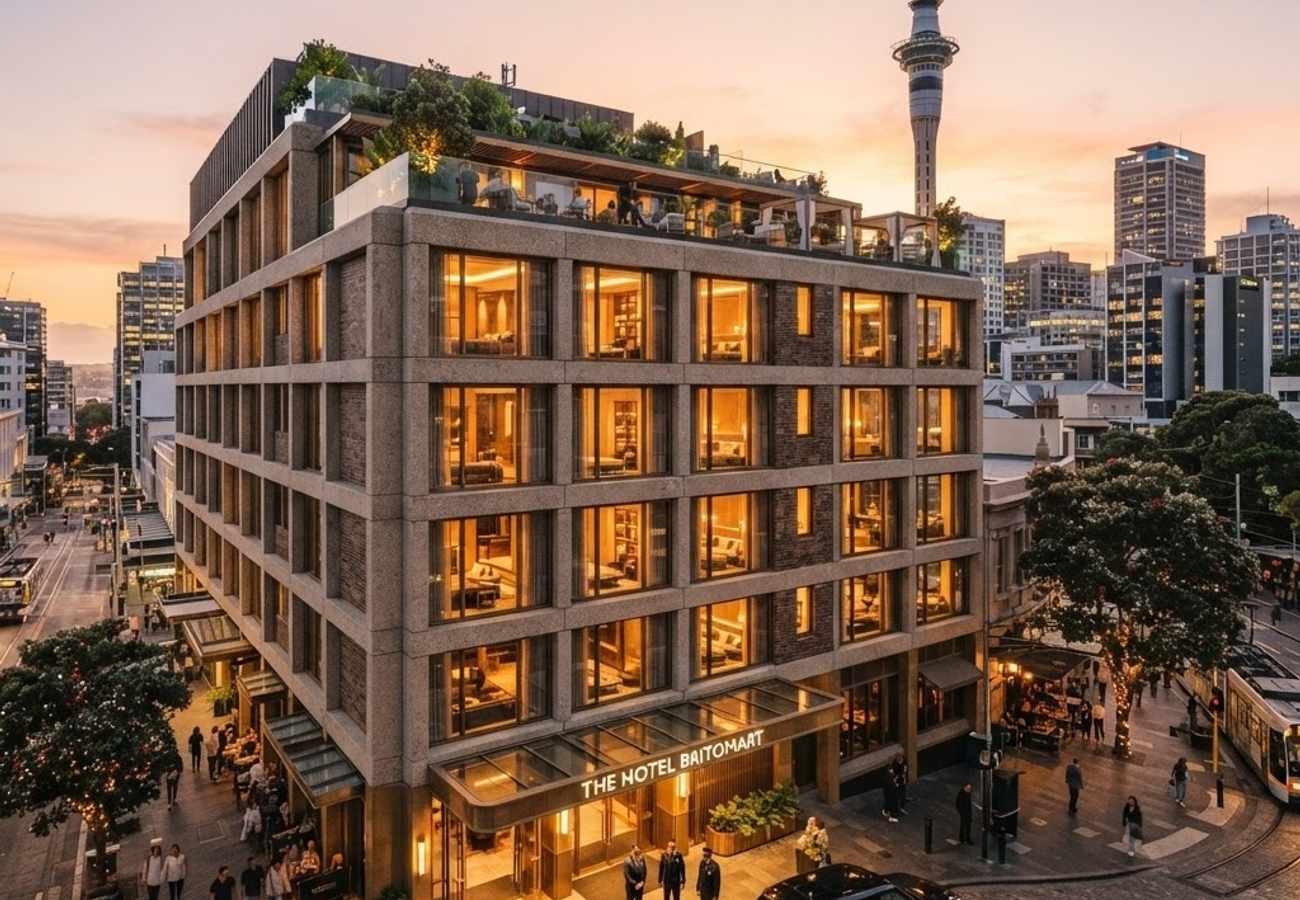
Image generated by AI
New Zealand is witnessing a structural revolution in its central business districts as developers abandon traditional ground-up construction in favor of converting vacant office towers into high-end hotels. This strategic pivot, concentrated in Auckland, Wellington, and Christchurch, is a direct response to unsustainable building costs and a permanent shift in corporate workplace dynamics.
The traditional "greenfield" hotel project—building from the dirt up—has become a financial liability for institutional investors. Between skyrocketing material prices and a chronic shortage of skilled labor, the capital required to launch a new luxury property now often exceeds the projected market value of the completed asset. Consequently, the industry is shifting toward "adaptive reuse," where secondary commercial assets are reflagged as lifestyle accommodations to secure a lower cost basis and faster market entry.
The Financial Collapse of Greenfield Hotel Development
The economics of new hotel construction in Aotearoa New Zealand have reached a critical breaking point. In major metropolitan hubs, the capital expenditure for a luxury or upper-upscale hotel now ranges from NZD $600,000 to over $900,000 per key. These figures exclude the cost of land acquisition, which, when combined with infrastructure contributions and holding costs, makes new builds economically unfeasible for many private equity firms and banks.
Beyond raw material inflation, the New Zealand Building Code imposes rigorous seismic resilience mandates. In dense urban centers, meeting these standards requires expensive sub-grade site preparation and deep piling. This regulatory burden has led institutional lenders to tighten their grip, demanding lower loan-to-value (LTV) ratios and higher debt-service coverage ratios (DSCR), effectively halting most un-hedged new construction starts.
CBD Office Devaluation Creates Opportunity
While the hotel sector struggles with construction costs, the commercial office sector is facing a crisis of occupancy. The permanent adoption of hybrid work models has triggered a "flight to quality," leaving B-grade and C-grade office towers from the late 20th century largely redundant. These properties are plagued by rising vacancy rates and aging mechanical systems that require massive capital injections to meet modern energy standards.
For hospitality developers, this devaluation is a strategic windfall. Landlords facing debt-refinancing pressures and lease roll-offs are selling secondary CBD assets at valuations significantly below their replacement cost. This gap allows investors to acquire prime real estate at a discount and repurpose the floor space into revenue-generating hotel rooms.
Comparative Economics of Adaptive Reuse
The primary catalyst for this trend is the dramatic compression of capital expenditure. Converting an existing office tower into an upper-upscale hotel typically costs between NZD $300,000 and $500,000 per key. This represents a capital saving of 40% to 50% compared to building from scratch.
The following data outlines the operational and financial advantages of adaptive reuse over traditional construction:
| Development Parameter | Greenfield Luxury Build | Office-to-Hotel Adaptive Reuse | Financial & Operational Impact |
|---|---|---|---|
| Capital Expenditure (per key) | NZD $600,000 – $900,000+ | NZD $300,000 – $500,000 | 40% – 50% capital savings |
| Land Acquisition Requirement | Separate major expenditure | Embedded in building purchase | Eliminates separate land outlay |
| Development Schedule | 36 – 48 months | 18 – 24 months | 12 – 24 months accelerated delivery |
| Embodied Carbon Reduction | Baseline (high new carbon footprint) | Up to 67% reduction | Higher Green Star rating potential |
| Structural Frame Expenditure | 25% – 35% of total budget | Fully retained superstructure | Major direct material savings |
| Planning & Consenting Risk | High (full resource consent) | Moderate (change of use consenting) | Lower holding charges and friction |
These savings are primarily achieved by retaining the building's "skeleton." Since the reinforced concrete columns, floor slabs, and foundations typically account for 25% to 35% of a new build's budget, preserving these elements eliminates the need for costly earthworks and raw material procurement.
Accelerating Speed to Market
Time is a critical variable in real estate arbitrage. A standard greenfield project in New Zealand takes between 36 and 48 months to move from site acquisition to operational commissioning. Adaptive reuse slashes this timeline to 18 to 24 months.
This acceleration provides three distinct financial advantages:
- Reduced Interest: A shorter construction window significantly lowers the cumulative capitalized interest and financing costs.
- Faster Cash Flow: Hotels can begin generating revenue and servicing debt nearly two years sooner than a new build.
- Market Agility: Developers can capture sudden surges in travel demand without being trapped in a multi-year construction cycle.
ESG Mandates and Carbon Accounting
Environmental, Social, and Governance (ESG) criteria are no longer optional for institutional capital; they are a requirement. New construction generates massive upfront embodied carbon through the production of steel and concrete. In contrast, retaining an existing structural frame can reduce upfront embodied carbon by up to 67%.
This environmental efficiency is essential for securing high Green Star ratings from the New Zealand Green Building Council (NZGBC). For sovereign wealth funds and superannuation funds, a 5-Star or 6-Star rating is a prerequisite for unlocking preferential green financing rates and avoiding future carbon-tax liabilities.
Strategic Pivot of Global Hotel Brands
Major operators like InterContinental Hotels Group (IHG), Accor, and Event Hospitality & Entertainment (EVT) are capitalizing on this trend through "asset-light" models. Rather than risking their own balance sheets on real estate acquisition, these brands enter into management agreements with domestic developers who have acquired the discounted office assets. This allows global brands to expand their footprint in New Zealand without the capital risk associated with construction.
Why This Matters: The Impact on Travel and Investment
For the traveler, this shift means a new wave of "lifestyle" hotels integrated into the heart of the city, often housed in buildings with unique architectural character that a modern glass box cannot replicate. From a logistical standpoint, the increase in room supply in CBDs—delivered faster than previously possible—could stabilize hotel pricing during peak tourism seasons.
From a legal and investment perspective, this creates a new asset class of "hybrid" properties. The transition from commercial zoning to hospitality use requires a nuanced understanding of "change of use" consenting, which is generally less risky than full resource consent for a new build. This trend signals a broader movement toward urban sustainability, where the goal is no longer to demolish and rebuild, but to evolve existing infrastructure to meet modern economic needs.
The era of the blank-slate hotel is ending, replaced by a smarter, faster, and greener era of urban repurposing.
Related Travel Guides
Disclaimer
This article is for informational and educational purposes only. It does not constitute legal, financial, or professional advice. While we strive to provide accurate and up-to-date information, travel policies, regulations, and conditions change rapidly. Always verify information with official sources before making travel decisions. Nomad Lawyer makes no representations about the accuracy, reliability, completeness, or suitability of the information provided. Readers should consult qualified professionals for advice specific to their circumstances. The views expressed in this article are those of the author and do not necessarily reflect the views of Nomad Lawyer.
Kunal K Choudhary
Co-Founder & Contributor
A passionate traveller and tech enthusiast. Kunal contributes to the vision and growth of Nomad Lawyer, bringing fresh perspectives and driving the community forward.
Learn more about our team →