
NASA Acquires Secretive Air Force Boeing 737 as New Zero-Gravity Testbed for Artemis Lunar Suit Validation
NASA Armstrong Flight Research Center awarded an $8.4 million contract to convert a classified Air Force 737-73W into a reduced-gravity aircraft for Artemis moon mission testing by October 2026.

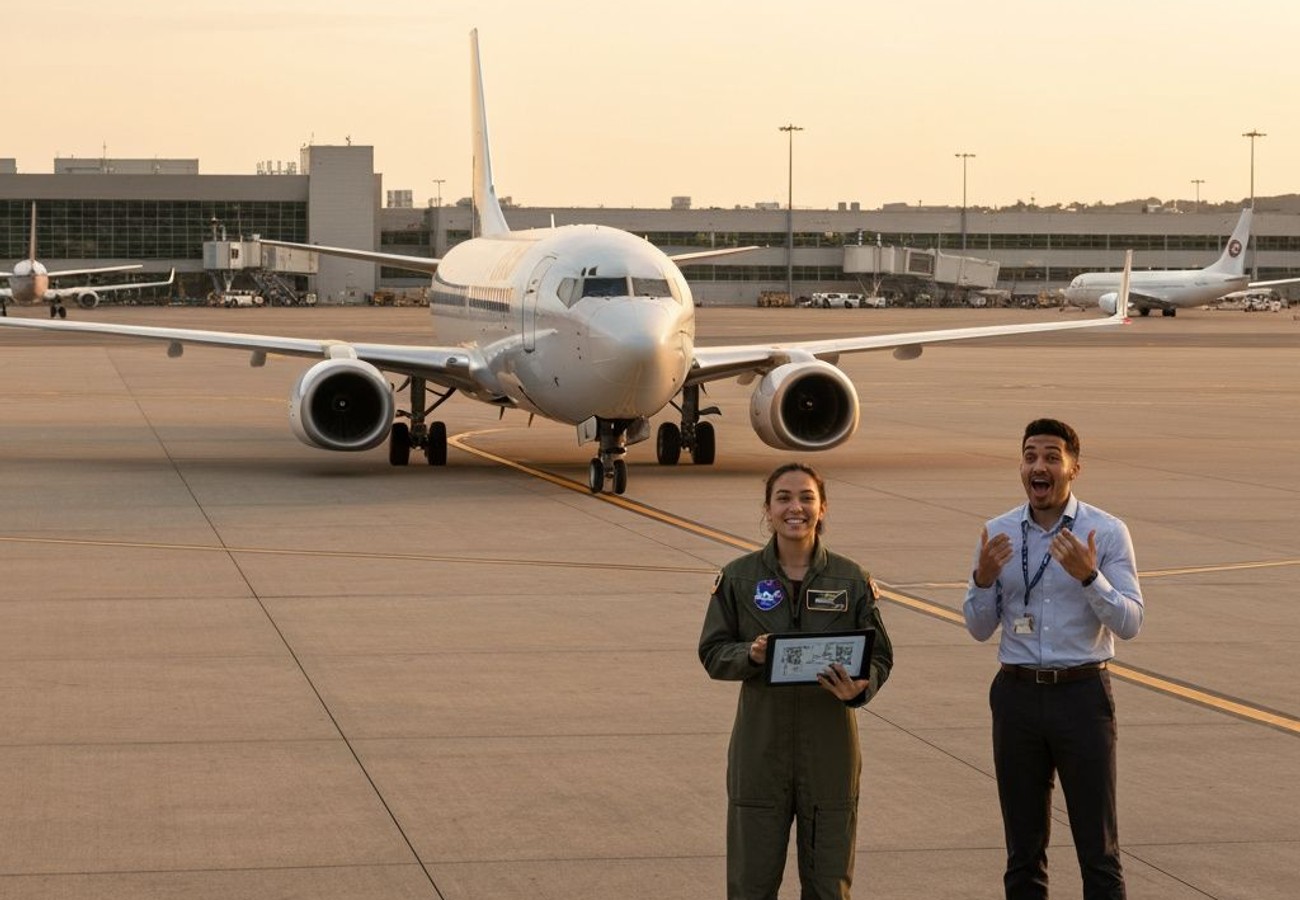
Image generated by AI
NASA Locks Down Classified 737 for Artemis Moon Mission Testing
NASA's Armstrong Flight Research Center just made a bold move in the shadowy world of aerospace contracting. The agency is acquiring a Boeing 737-73W directly from the U.S. Air Force—a jet so classified that even NASA initially wasn't permitted to know its current military modifications.
This isn't your typical aircraft purchase. Denmar Technical Services, Inc., a small aviation firm based in Reno, Nevada, won a sole-source contract worth $8.4 million to assess, modify, and prepare the aircraft for its new purpose: validating astronaut lunar suits in a zero-gravity environment.
The clock is ticking. NASA needs the work completed by October 1, 2026—a timeline that reflects the agency's urgent push to land humans on the Moon again.
The "Vomit Comet" Mission Explained
Once modified, the 737 will join NASA's fleet of reduced-gravity testbed aircraft. These planes are colloquially known as "Vomit Comets" because of what happens during their signature maneuver: steep parabolic dives that simulate the weightlessness of space.
Reddit: "They literally throw up parabolas at you—the aircraft climbs to 35,000 feet, then nosedives at a precise angle, creating about 25-30 seconds of true zero-g. Your stomach does not appreciate this." — r/space
The aircraft will perform these extreme maneuvers carrying astronauts wearing full Artemis lunar suits. Engineers need to validate that every system—from communication devices to mobility joints—functions correctly in a low-gravity environment before crews attempt an actual landing.
This testing phase is non-negotiable. Unlike the Apollo program, which ended in the early 1970s, today's mission planners have no margin for error with equipment failures at the lunar surface.
The Artemis Timeline and Lunar Ambitions
Let's establish context: Artemis II, which flew in April 2026, marked the first crewed lunar fly-by since Apollo 17. The spacecraft looped around the Moon and returned safely—a crucial stepping stone.
The real test comes next. NASA targets a crewed lunar landing in 2028. That mission, Artemis III, will land humans at the lunar south pole, an environment far more challenging than the Apollo landing zones.
The new 737 testbed directly supports this timeline. Astronauts must verify that their suits, life support systems, and crew equipment operate flawlessly under lunar gravity (approximately one-sixth of Earth's gravity) before boarding any lander.
The Classified Aircraft Problem—And Why Denmar Is Perfect
Here's where the story gets murky. The Boeing 737-73W currently serves the U.S. Air Force under a classified military program. Its exact mission remains unknown.
When NASA wanted to acquire the aircraft, federal contracting law created an immediate barrier: NASA couldn't be told the specifics of what the Air Force had already modified on this jet. The defense establishment doesn't share classified knowledge across agencies without strict operational need.
Enter Denmar Technical Services. The company was already the contractor managing the Air Force's classified modifications. This made Denmar the only firm legally positioned to:
- Complete the Air Force's existing closeout tasks
- Assess whether the 737 could handle NASA's zero-gravity mission
- Perform overdue maintenance and inspections
- Modify the cabin for reduced-gravity operations
- Restore airworthiness and paint NASA identifiers
This isn't favoritism—it's a legal necessity. Denmar holds the classified clearances and technical knowledge no other firm possesses.
The Mystery Aircraft: N712JM
Aviation enthusiasts and defense analysts have already identified the likely candidate: aircraft N712JM, a 737-73W registered to the U.S. Air Force's Rapid Capabilities Office at Joint Base Anacostia-Bolling in Washington, D.C.
Here's what we know about N712JM: The Air Force acquired it in 2020, though Denmar had held FAA registration since 2019 following Boeing's original 2013 delivery through a trusteeship arrangement.
In 2020, observers noticed something unusual. The aircraft bore a distinctive green protective coating and carried visible external instrumentation and sensor wiring—telltale signs of active flight testing.
It subsequently conducted numerous test flights in military ranges off Southern California, often executing unusual flight profiles not typical of standard transport operations.
The registration address links directly to the Rapid Capabilities Office, an Air Force division known for managing black programs including the B-21 Raider stealth bomber and the X-37B spaceplane. Whatever N712JM was testing, it was high-priority.
Denmar's Secret Portfolio
Denmar Technical Services describes itself as a "national leader in infrared and radiofrequency survivability, signature modeling, and agile software development." That corporate language masks something more specific: Denmar specializes in building and modifying exotic aircraft.
The company is widely understood to be the prime contractor behind the NT-43A, commonly known by its callsign RAT55—often described as "the world's most secretive 737." That aircraft is built on a much older 737-200 airframe and has undergone extensive radar test modifications.
The current NASA contract involves a newer 700-series model, so it's not the same aircraft. But it reflects Denmar's deep expertise in transforming standard commercial jets into classified military and space-support platforms.
What Remains Unknown
Despite the contract award announcement, NASA has declined to publicly confirm the aircraft's identity or its previous military mission. The sole-source justification document—the paperwork that explains why only Denmar could legally do this work—references the classified Air Force program but redacts the specifics.
This creates an intriguing pattern: NASA has increasingly turned to some of the most secretive 737s in existence to support its less sensitive research and testing missions. It's a practical solution to a bureaucratic problem, but it also highlights how intertwined aerospace development has become between military and civilian space programs.
The modified 737 will eventually operate out of NASA Johnson Space Center in Houston, Texas, bringing the classified aircraft into NASA's more transparent operational environment.
Whether we'll ever learn the 737's original Air Force mission remains unclear. For now, its future belongs to humanity's return to the Moon.
The most secretive aircraft in the world just got a new job—and this time, the mission is lunar.
Related Travel Guides
Disclaimer
This article is for informational and educational purposes only. It does not constitute legal, financial, or professional advice. While we strive to provide accurate and up-to-date information, travel policies, regulations, and conditions change rapidly. Always verify information with official sources before making travel decisions. Nomad Lawyer makes no representations about the accuracy, reliability, completeness, or suitability of the information provided. Readers should consult qualified professionals for advice specific to their circumstances. The views expressed in this article are those of the author and do not necessarily reflect the views of Nomad Lawyer.
Kunal K Choudhary
Co-Founder & Contributor
A passionate traveller and tech enthusiast. Kunal contributes to the vision and growth of Nomad Lawyer, bringing fresh perspectives and driving the community forward.
Learn more about our team →