
The Most Dangerous Jobs in America and Their Injury Risks
BLS 2024 data reveals the deadliest occupations in America — from logging to sanitation — and what work injury lawyers see when these workers file claims.

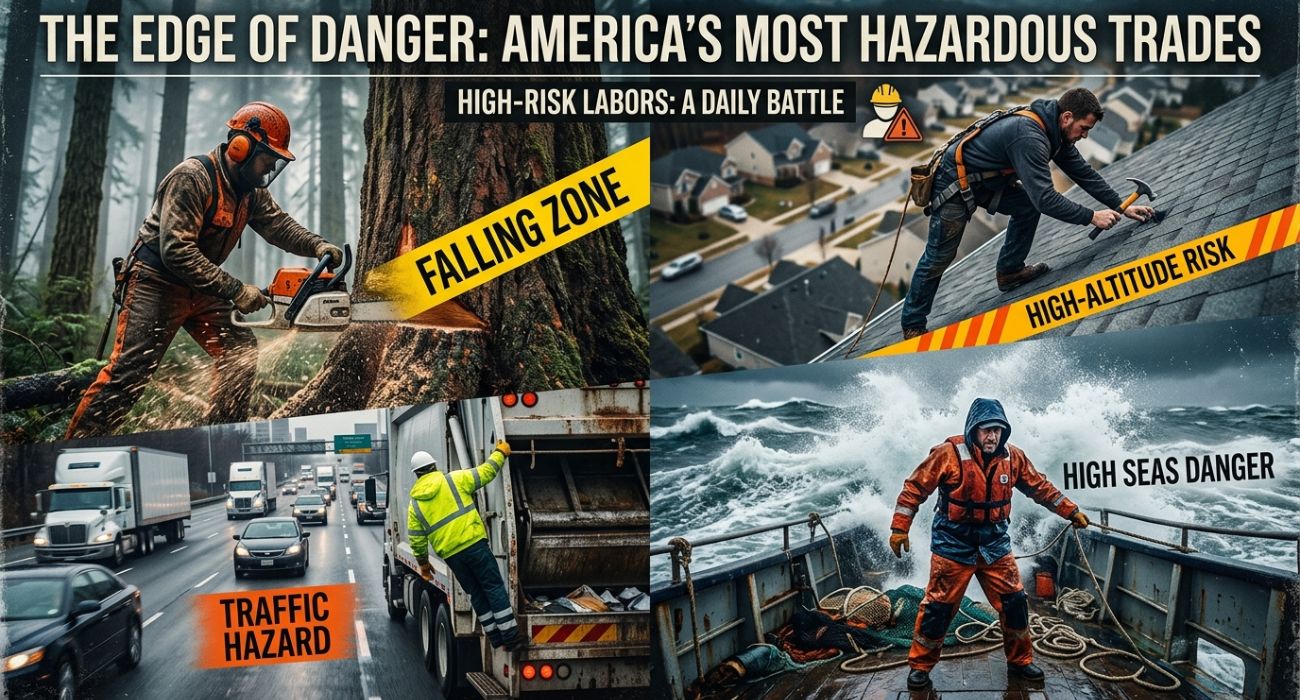
Image generated by AI
In early 2026, the United States Bureau of Labor Statistics (BLS) released its Census of Fatal Occupational Injuries for 2024, reporting a year-over-year improvement in workplace fatality rates. According to the report, the 3.3 fatalities per 100,000 full-time equivalent (FTE) workers also represent a second consecutive annual improvement in occupational safety since 2022, which was the deadliest year in the last decade.
A deeper look into the BLS statistics reveals that transportation and material moving are the occupational groups with the highest fatality rates. With a 12.5 fatality rate per 100,000 FTE laborers, these groups are the riskiest for American workers. Material moving encompasses the building trades, so it is safe to say that truck drivers and construction workers are among the most likely to face fatal risks while on the job.
The Most Dangerous Jobs in the U.S.
The BLS calculates workplace fatality rates based on the total number of hours worked in each occupation. Although transportation accidents generated the most fatalities in 2024, the logging industry represents the highest rate with 110.4 deaths per 100,000 FTE workers. Many work injury lawyers manage caseloads prominently featuring loggers filing claims against their employers and insurance companies after accidents.
Before listing other dangerous American jobs, here is a better understanding of the BLS report's six tracking categories:
Transportation Accidents — This has consistently been the most active category, accounting for nearly 40% of all occupational fatalities. It covers road traffic accidents involving vehicle operators, passengers, and pedestrians, as well as aircraft, trains, and watercraft used for commercial and industrial operations.
Slips and Falls — The majority of fatal situations in this category involve workers falling to a lower level, such as falling from roofs, ladders, or construction scaffolding.
Fatal Contact With Equipment and Objects — Occupational safety specialists refer to this as "contact incidents," including workers struck by falling objects, getting tangled in machinery, structural collapses, and crushing accidents.
Violent Acts — This category includes intentional self-harm and workplace violence, covering both workplace homicides and suicides.
Exposure to Harmful Substances and Toxic Workplaces — Electrocutions are part of this category, which includes active duty military members present in the U.S. but excludes combat deaths. Fatal accidental overdoses at work are also tracked here.
Fires and Explosions — This category consistently presents the lowest incidence and includes structural fires, industrial explosions, and accidents involving pressurized equipment.
Why Is Logging Such a Dangerous Employment Sector?
Logging has always been a dangerous occupation because it demands extreme physical activity in the risky environment of remote timberlands. Workers in this sector are constantly at risk of being struck by falling trees and rolling logs — known as the "widowmakers of the logging industry." Loggers also face multiple hazards as they operate chainsaws and other heavy machinery on steep and unstable terrain.
Commercial Fishing
Although the BLS includes fatal hunting accidents in this occupational group for reporting purposes, most deaths involve members of commercial fishing crews and fleets. This job is exceptionally hazardous because of its many unpredictable factors, which range from maritime weather to capsizing and operating high-tension equipment on slick decks.
Residential and Commercial Roofing
With 104 occupational deaths in 2024 and a fatality rate of 48.7 per 100,000 FTE workers, roofing has consistently appeared on the list of the most dangerous industries for workers. The elevation hazards roofers routinely face explain why they are overrepresented in the BLS slips and falls category. Falling from roofs, ladders, and scaffolding is the most common cause of occupational deaths, compounded by workplace stress, heat disorientation, and having to work on slick surfaces.
Structural Iron and Steel Workers
The fatality rate of 37.8 per 100,000 FTE workers in this sector is lower than for roofers; however, working in structural iron and steel construction sites remains extremely dangerous. The risk of fatal falls is proportionally higher with project elevation — most fatal accidents involve falling from elevated structural frameworks erected for high-rise buildings and bridges. Crushing and contact accidents are also common because the work often involves operating high-powered tools and heavy machinery.
Sanitation Workers
In recent decades, working in garbage collection and waste management has become more dangerous than working as a police officer. The relative risks faced by refuse and recyclable material collectors in the U.S. are 12 times higher than average. In 2024, the fatality rate of 37.4 per 100,000 FTE workers in this sector was considerably higher than in law enforcement. Workers face persistent transportation and machinery risks — most fatal accidents involve workers struck by vehicles on public roadways or falling off the back of garbage trucks.
Aircraft Pilots and Flight Engineers
Commercial airlines manage remarkably safe workplaces; however, this BLS category extends to regional cargo pilots, agricultural crop-dusting operations, helicopter transportation, and test pilots. Aircraft crashes during low-altitude maneuvers are the primary risk. Others include mechanical failures and sudden aviation weather changes. In 2024, the fatality rate for this sector was 36.7 per 100,000 FTE workers.
Do Dangerous Jobs Pay Well?
Facing higher risks at work does not automatically generate higher compensation. The reality of BLS data shatters the incorrect assumption that high physical risks justify higher paychecks. Of the occupational groups listed above, only pilots and flight engineers enjoy above-average salaries. Most of America's deadliest occupations offer median wages around or below national averages.
Some work injury lawyers introduce this factor to jurors when handling claims for clients. Workplace risk does not guarantee fair compensation — for this reason, many personal injury law firms stay busy handling claims filed by workers against employers and insurance companies.
When dangerous work goes uncompensated and unreported, the legal system becomes the last line of protection for America's most vulnerable workers.
Related Travel Guides
How Sudden Weather Changes Lead to Multi-Car Accidents
Disclaimer
This article is for informational and educational purposes only. It does not constitute legal, financial, or professional advice. While we strive to provide accurate and up-to-date information, travel policies, regulations, and conditions change rapidly. Always verify information with official sources before making travel decisions. Nomad Lawyer makes no representations about the accuracy, reliability, completeness, or suitability of the information provided. Readers should consult qualified professionals for advice specific to their circumstances. The views expressed in this article are those of the author and do not necessarily reflect the views of Nomad Lawyer.
Raushan Kumar
Founder & Lead Developer
Full-stack developer with 11+ years of experience and a passionate traveller. Raushan built Nomad Lawyer from the ground up with a vision to create the best travel and law experience on the web.
Learn more about our team →