
The Extraordinary Engineering Challenge That Still Defies Modern Aviation: Why the SR-71's Legendary Engine Remains Unmatched
Breaking airline news and aviation industry updates for 2026.

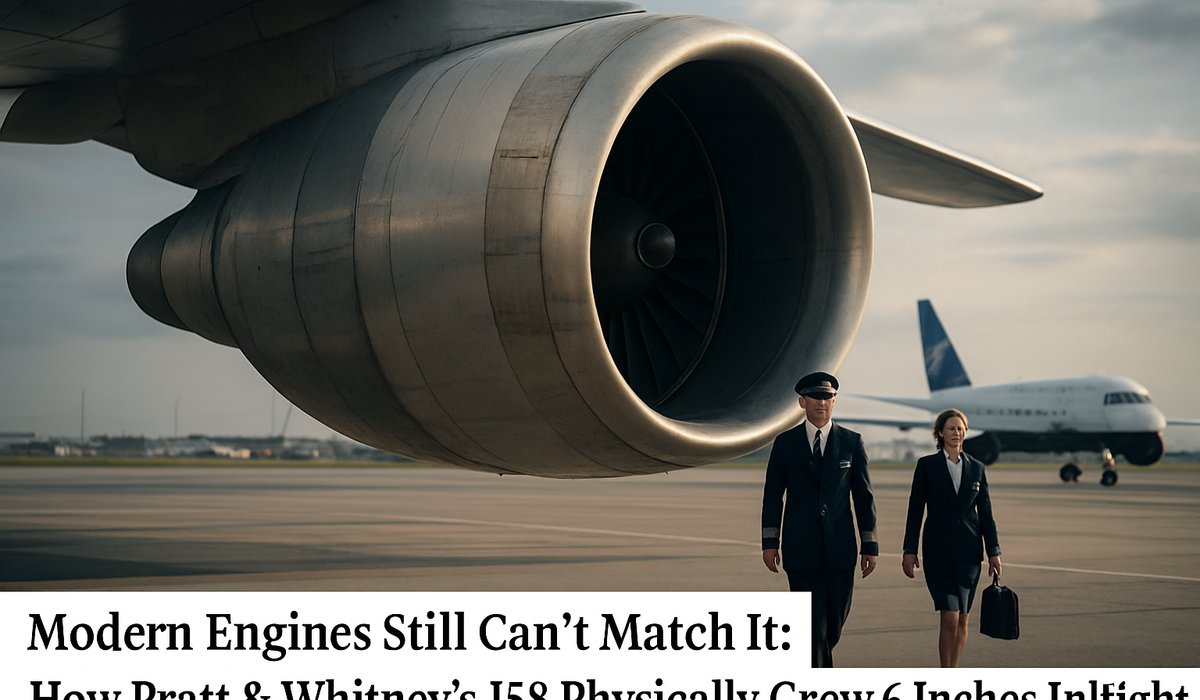
Image generated by AI
The Extraordinary Engineering Challenge That Still Defies Modern Aviation: Why the SR-71's Legendary Engine Remains Unmatched
How Cold War-era thermal innovation outpaced contemporary jet propulsion technology
A Thermal Puzzle That Reshaped Engine Design
The Lockheed SR-71 Blackbird represents one of aviation's most audacious engineering achievements—a reconnaissance aircraft that operated at speeds exceeding Mach 3, generating aerodynamic friction temperatures that would vaporize conventional materials. Yet perhaps its most remarkable feature wasn't its velocity or altitude capability, but rather the Pratt & Whitney J58 turbojets' ability to physically expand up to six inches during sustained high-speed flight without catastrophic failure.
This thermal expansion phenomenon highlights a critical engineering reality: Cold War-era propulsion systems were forced to innovate in ways that modern aircraft engines, despite decades of computational advancement, have yet to fully replicate.
When Materials Met Extreme Physics
During cruise at maximum velocity, the SR-71's engines experienced temperatures exceeding 430 degrees Celsius (over 800 degrees Fahrenheit) at the inlet alone. The resulting thermal stress didn't simply damage components—it fundamentally transformed them. The J58's titanium alloy casings would grow measurably longer as heat penetrated the engine's architecture, requiring engineers to design clearances and mechanical tolerances that accommodated continuous dimensional changes.
Engineers couldn't rely on today's finite-element analysis and computational fluid dynamics. Instead, they employed rigorous empirical testing, advanced metallurgical understanding, and mechanical ingenuity to create an engine that functioned reliably while literally shifting beneath its own operational load.
The Design Innovation That Endures
The solutions implemented—variable geometry components, precision clearances engineered for thermal growth, and materials selected specifically for their behavior under extreme conditions—represented a quantum leap in propulsion engineering. The J58 wasn't simply built to withstand heat; it was engineered to perform optimally while continuously transforming.
Modern jet engines, developed with sophisticated computer modeling and advanced materials like single-crystal superalloys, operate more efficiently and cleanly. Yet they achieve this through different engineering philosophies. Contemporary engines prioritize thermal efficiency and emissions control rather than the sheer mechanical accommodation of extreme dimensional change.
A Legacy That Outpaces Modern Engineering
The SR-71 program ended in 1998, yet no subsequent military or commercial engine has matched the J58's ability to handle such extreme physical transformation while maintaining operational integrity. Modern aviation has traded some of that mechanical adaptability for computational precision and materials science advances.
The Blackbird's engine remains a testament to an era when engineers solved problems through innovation born of necessity—when pushing boundaries meant overcoming challenges that computers couldn't yet predict, and materials had to perform in conditions that seemed physically impossible.
Frequently Asked Questions
What made the SR-71's J58 engine physically grow during flight? Sustained Mach 3+ velocities generated aerodynamic heating temperatures exceeding 430°C at engine inlets, causing titanium alloy components to thermally expand by up to six inches, a characteristic modern engines manage differently through advanced materials rather than mechanical accommodation.
How did Cold War engineers solve thermal expansion problems without modern computers? Teams relied on empirical testing, advanced metallurgical science, and precision mechanical design—engineering clearances and tolerances specifically to accommodate the engine's dimensional changes during high-temperature operation.
Why can't modern jet engines replicate the SR-71's thermal characteristics? Contemporary engines prioritize fuel efficiency, emissions reduction, and computational optimization using different materials and design philosophies that manage thermal stress through material science rather than mechanical adaptation.
Are there any active aircraft engines comparable to the J58 today? While military afterburning engines push performance boundaries, none have been documented as requiring or demonstrating the same six-inch thermal expansion accommodation of the original J58.
What engineering lessons from the SR-71 influence aviation design today? The program's thermal management innovations and materials research continue influencing high-performance engine design, though modern approaches emphasize computational modeling and advanced superalloys over mechanical thermal accommodation.
Related Travel Guides
External Resources
Disclaimer
This article is for informational and educational purposes only. It does not constitute legal, financial, or professional advice. While we strive to provide accurate and up-to-date information, travel policies, regulations, and conditions change rapidly. Always verify information with official sources before making travel decisions. Nomad Lawyer makes no representations about the accuracy, reliability, completeness, or suitability of the information provided. Readers should consult qualified professionals for advice specific to their circumstances. The views expressed in this article are those of the author and do not necessarily reflect the views of Nomad Lawyer.
Preeti Gunjan
Contributor & Community Manager
A passionate traveller and community builder. Preeti helps grow the Nomad Lawyer community, fostering engagement and bringing the reader experience to life.
Learn more about our team →